How MowReview makes money: As an Amazon Associate, MowReview earns from qualifying purchases, at no extra cost to you. We don’t test mowers ourselves; we explain what manufacturers and independent testers report. How we research
Quick answer
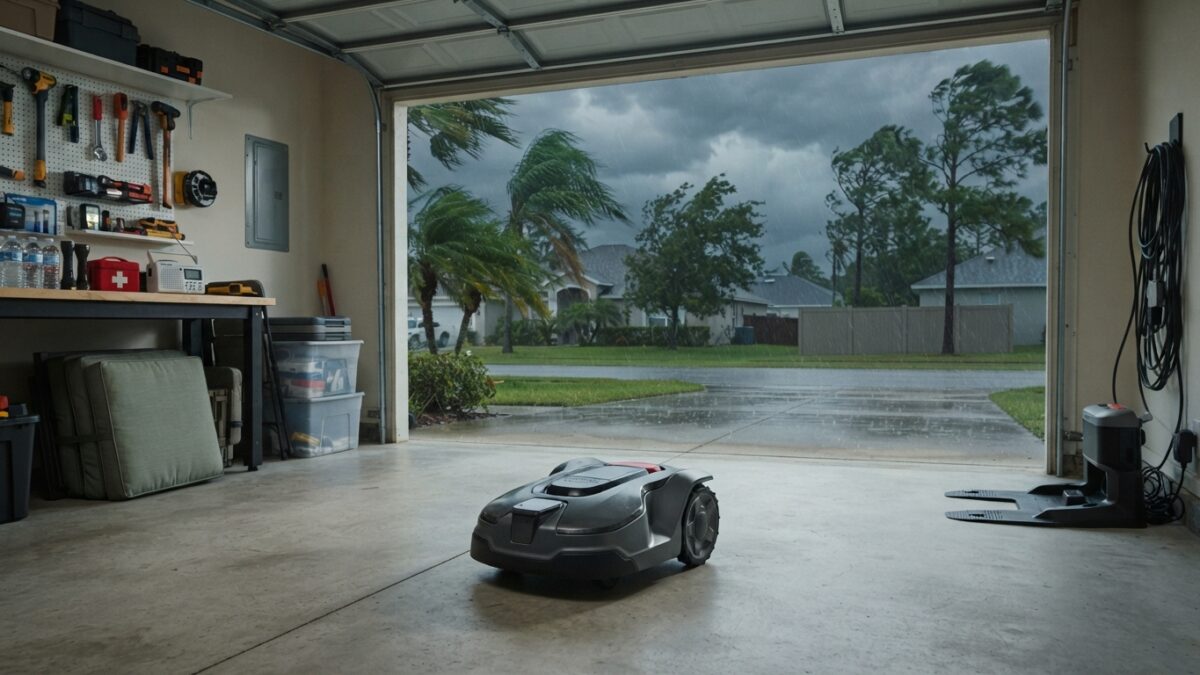
When a hurricane watch is issued (about 48 hours before tropical-storm-force winds arrive), bring the robot mower, its charging station and its RTK antenna and mast indoors. No consumer robot mower body we found is rated for submersion, warranties exclude water damage, and standard homeowners insurance often has a separate hurricane deductible for wind and excludes flood damage entirely. Once the storm passes, wait until the lawn is clear of debris and no longer waterlogged before restarting. Every extra day is a day the mower doesn’t ingest a nail from the neighbor’s roof or spin its wheels in mud.
Robot mowers are a common sight in Florida, along the Gulf Coast and up the Southeastern seaboard, exactly the states hurricanes hit. Every June through November, owners face the same set of questions: When do I bring it in? What can it survive? What about the RTK antenna up on the mast? And what does my insurance actually cover?
This guide answers them with sources you can hand to an insurance agent. MowReview quotes no prices and hasn’t tested these mowers. How we research explains why.
Watch vs. warning: the 48-hour rule
| Alert | Meaning | Typical lead time |
|---|---|---|
| Hurricane Watch | Hurricane conditions possible | About 48 hours before tropical-storm-force winds arrive |
| Hurricane Warning | Hurricane conditions expected | About 36 hours before tropical-storm-force winds arrive |
Source: NOAA National Ocean Service, “Watch vs. Warning.”
NOAA’s guidance for outdoor property is direct: “secure loose outdoor items” as a storm threatens. A robot mower, its charging station and any RTK mast are loose outdoor items. The clock that matters is the watch, not the warning; by the time the warning arrives, preparations should already be done.
Why you can’t leave it out
Consumer robot mowers are rated for rain, but not for storm surge, flooding or projectile debris. Their IP ratings tell you exactly what they can handle.
| Mower | Rating |
|---|---|
| Husqvarna Automower 435X AWD | IPX4 (splashes from any direction) |
| Husqvarna Automower 440 iQ | IPX5 (low-pressure jets) |
| Mammotion LUBA 2 AWD mower and dock | IPX6 (high-pressure jets) |
| Mammotion LUBA 2 AWD RTK station | IPX7 (submersion 1 m, 30 min) |
| Mammotion LUBA 3 AWD | IPX6 |
| Segway Navimow X430 | IP66 |
| Ecovacs GOAT A3000 LiDAR | IPX6 (station IPX4) |
| Worx Landroid Vision | IPX5 |
IPX7 is the submersion rating; no mower body in this list claims it, though the Mammotion LUBA 2 RTK station does.
What’s missing here is any rating for projectile impact. Category 1 winds start at 74 mph, enough to move heavy loose items, and Category 3 winds carry roofing debris. A tree branch, a roof shingle or a neighbor’s garden gnome hitting a mower body at 100 mph doesn’t need to be IPX7-tested to destroy it.
What to bring in, and when
- When the National Hurricane Center posts a watch: park the mower on its dock, unplug the dock from the outdoor outlet, and start moving equipment.
- The mower. Fully charge it first, so it sits at a high state of charge indoors.
- The charging station. Disconnect the mains lead and the boundary wire (if wired). Bring the station body indoors; the buried wire stays.
- The RTK antenna, mast and cable. Unbolt the mast from its base if bolted, or lift it from its ground spike. Coil the cable. Bring the whole assembly indoors. A tall mast in tropical-storm-force wind is a projectile launcher.
- Anything else on the lawn. Blade brushes, storage boxes, garage covers, spare batteries. Anything the mower needs to run.
- Where to keep it. Inside the house or an attached garage, above any expected flood level. Not in a shed that might be destroyed by the same storm.
Insurance: two policies, not one
Two coverages you probably need to think about separately
Wind damage: covered under a standard HO-3 homeowners policy, subject to your policy’s terms. In many Atlantic and Gulf coastal states, a separate hurricane or windstorm deductible applies, and in some counties wind is excluded from the standard policy entirely, requiring a separate windstorm policy. The Insurance Information Institute has the details.
Flood damage: not covered by a standard homeowners policy. NFIP flood insurance is the standard route. FloodSmart says NFIP explicitly excludes “property outside of an insured building, such as landscaping…decks and patios, fences.” A mower left on the lawn during flooding is not covered. A mower in a garage is covered as contents, subject to your policy’s limits.
Practical takeaway: if you leave a robot mower outside in a hurricane, neither policy is likely to help. If you bring it inside a garage or house that’s covered by standard homeowners and NFIP contents coverage, both may apply within limits. Talk to your agent before hurricane season, not during it.
After the storm: don’t rush
Restarting the mower too soon is the second most common mistake, after leaving it out. What to do first:
- Walk the lawn. Look for branches, palm fronds, roof shingles, nails, glass and torn flashing. In coastal areas, add salt marks and drift debris.
- Wait for the ground to drain. Segway says wet, slippery grass makes wheels slip and spin, and Mammotion says soft ground can cause wheel slip and marks. A soaked lawn is where ruts form.
- Reinstall the antenna and remap if needed. The mast may not go back into exactly the same spot. Segway says moving the antenna after mapping shifts the map. Why RTK robot mowers lose signal covers signal debugging.
- Check the blades and underside. Even with the mower indoors, storm debris on the lawn will eventually hit the blade the first time you restart.
- UF/IFAS on citrus: in Florida, after a hurricane, UF/IFAS advises clearing dropped citrus quickly, because rotting fruit draws fruit flies and yeasts. See robot mowers and fruit trees for the mower angle.
The picks
IPX6 body and layered navigation
Mammotion LUBA 3 AWD
- RatingIPX6
- Navigation360° LiDAR, RTK, AI vision
- Stated max slope80%
An IPX6 rating means the mower is designed to handle high-pressure water spray, not submersion. But its layered navigation, including LiDAR, helps when nearby buildings and downed trees change the sightlines RTK needs after a storm. Standard and H versions cover different Southern grasses.
Good for
- Post-storm remapping under changed sightlines
- Sloped Southern lots
Less good for
- A polished app: PCWorld found connectivity “a little spotty”
- Buyers who don’t check standard vs. H
- Carrying: PCWorld found it “not fun to lift”
Two things not to do
- Don’t try to “wait it out” outside. Even IPX6 rating doesn’t cover storm surge, and the wind carries objects that damage the body.
- Don’t restart on a flooded lawn. Wet ground plus debris equals ruts, dulled blades and potentially a mower stuck in mud that a neighbor eventually rescues. Wait two or three dry days if you can.
For year-round Florida and Gulf Coast robot mowing, see robot mowers for St. Augustine. For Southwest desert lawns, robot mowers in extreme heat covers the heat side.
Questions
What should I do with my robot mower during a hurricane?
Bring it and its charging station indoors. NOAA advises securing loose outdoor items ahead of a storm, and no consumer robot mower we found is rated for submersion. Bring the RTK antenna in too.
When should I bring in a robot mower before a storm?
When a hurricane watch is issued. NOAA issues a watch when hurricane conditions are possible, typically 48 hours before tropical-storm-force winds arrive. A warning, issued about 36 hours before, is when preparations should already be done.
Is any robot mower rated for flooding?
No mower body we found is rated IPX7 (submersion). Husqvarna’s 435X AWD is IPX4, the 440 iQ is IPX5, the Mammotion LUBA 2 AWD mower and dock are IPX6, and the LUBA 2 RTK station is IPX7. Standing floodwater will destroy any of them.
Does homeowners insurance cover a hurricane-flooded robot mower?
Only through separate flood coverage. NFIP flood insurance specifically excludes property outside an insured building, so a mower left outside during flooding is not covered. A mower in a garage would be covered as contents, subject to your policy. In Atlantic and Gulf coastal states, wind damage often has a separate hurricane deductible.
What about the RTK antenna in a hurricane?
Bring the antenna, mast and cable indoors with the mower. A tall mast is a wind sail, and manufacturers don’t publish wind ratings for RTK masts.
When can I restart the mower after a hurricane?
Once the lawn is clear of storm debris (branches, roof shingles, metal), the ground is no longer soaked, and any standing water has drained. Check the blades and underside first, and walk the lawn before restarting the schedule.
The short version
When NOAA posts a hurricane watch, bring the mower, dock and RTK antenna indoors. No consumer mower is rated for submersion, warranties exclude water damage, and NFIP won’t cover a mower left outside. Standard homeowners often has a separate hurricane deductible for wind. After the storm, walk the lawn for debris and let the ground drain before restarting. The Navimow X430 and Mammotion LUBA 3 AWD both handle Florida and Gulf Coast lawns and can locate themselves in storage.
Storm prep is one part of Southern robot mowing.
Heat and wet ground matter too.