How MowReview makes money: As an Amazon Associate, MowReview earns from qualifying purchases, at no extra cost to you. We don’t test mowers ourselves; we explain what manufacturers and independent testers report. How we research
Quick answer
Wire-free mowers are easier to set up and change, and they’re now the mainstream choice. Boundary-wire mowers usually cost less and are unaffected by tree cover, which makes them a sensible option for a simple, heavily shaded lawn. The trade-off is installation: PCWorld recommends hiring a professional to bury the wire.
Until recently, every robot mower needed a wire pegged or buried around the lawn to tell it where the grass ended. Most new models don’t. Independent reviewers describe the older generation as held back by boundary wires, poor slope handling and a habit of getting stuck, and the current one as using laser scanning, cameras and all-wheel drive to manage terrain older mowers couldn’t.
That doesn’t make the wire obsolete. It makes it a specific choice for specific yards.
How each one works
A boundary wire is a low-voltage cable running around the edge of your lawn, pegged down or buried an inch or two under the surface. The mower senses the wire and turns away from it. The wire is a physical fence the mower can feel.
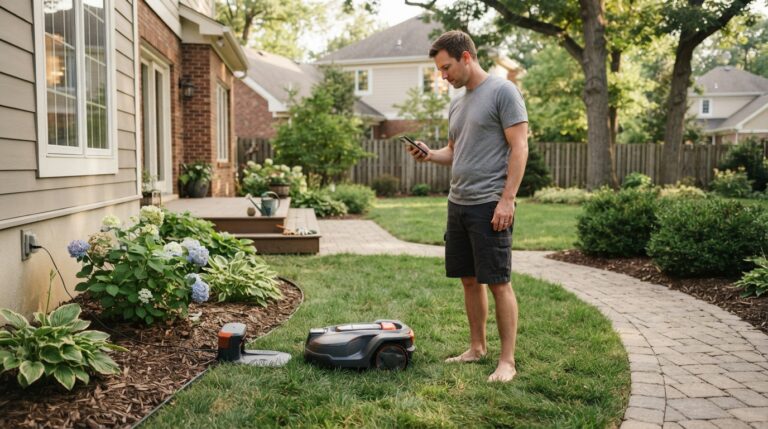
A wire-free mower keeps track of where it is instead. Most use RTK: satellite positioning corrected by a small antenna on your property, accurate to a couple of centimeters. Others use laser scanning (LiDAR) or cameras, or a combination. You draw the boundary by walking the lawn edge once with your phone, then edit no-go zones on screen.
| Boundary wire | Wire-free | |
|---|---|---|
| Setup | Lay the wire around the lawn; hours of work, or a professional install | Walk the edge once with the app |
| Changing the layout | Move the wire | Edit the map on your phone |
| Tree cover | Unaffected | A problem for satellite-based models |
| Cost | Usually lower; PCWorld notes wired models need fewer sensors and less processing | Usually higher |
| Things that go wrong | Wire breaks, from a spade, animals or ground movement | Signal loss, mapping problems, app trouble |
| Large properties | Wires top out at roughly 1,000 to 2,500 feet depending on the model, per PCWorld | Limited by rated area instead |
| Multiple zones | Needs wire to each area, or a guide wire | Usually handled in the app |
When a boundary wire is the better choice
- Your lawn sits under a heavy tree canopy. A wire doesn’t care about sky view at all. Ecovacs, which sells satellite-guided mowers itself, explains that dense tree cover reduces the open sky a mower can use for positioning.
- Your lawn shape is simple and settled. If the layout won’t change, installing the wire once is a fair trade for a lower price.
- You want to spend less. Wired models are generally cheaper for the same coverage.
- You’d rather not use an app much. Wired mowers often have more onboard controls, though many still offer an app.
When wire-free is the better choice
- Your lawn is open to the sky. This is where RTK works best.
- Your layout changes. New bed, new play area, a patch of grass recovering? Edit the map in seconds.
- You have several separate areas. Multi-zone mapping is standard on most wire-free models.
- You don’t want to dig. Installing a wire across an established lawn is real work.
- Your yard is steep. The highest slope ratings currently belong to all-wheel-drive wire-free mowers, rated around 80% to 84%.
There’s a third option
Some mowers do both. Husqvarna’s Automower 450X NERA runs on a traditional boundary wire, or wire-free using the company’s EPOS satellite kit, which is sold separately. If you want to start with a wire and change later, a model like this keeps the door open.
What actually goes wrong with each
Boundary wire problems
The wire breaks. A spade, an aerator, an animal or simple ground movement can cut it, and the mower stops until it’s repaired. Repair kits exist, and finding the break is the fiddly part. Burying the wire rather than pegging it on the surface reduces the risk considerably, which is why PCWorld suggests paying a professional to do it.
Wire-free problems
Signal and software. Under trees or close to buildings, satellite positioning weakens and the mower may mow crooked lines or stop. Mapping can also be awkward: PCWorld hit repeated Bluetooth dropouts while mapping one mower, and found another’s setup and app not always smooth. Some models also rely on a network connection, and Segway notes performance may be limited where signal is weak.
Which one is more reliable?
Neither, in general. They fail differently. A wire is simple and unaffected by weather or trees, but it’s a physical thing that can be cut. A wire-free mower has nothing to break in the ground, but depends on signal and software. The right question isn’t which is more reliable overall, but which failure is more likely in your yard. Heavy trees? The wire is the safer bet. A spade-happy gardener and an open lawn? Wire-free.
Questions
Can I install a boundary wire myself?
Yes, and many people do, pegging it along the lawn edge. It’s slow work on a large lawn. PCWorld recommends hiring a professional to bury the wire, which protects it from damage and hides it completely.
What happens if the boundary wire breaks?
The mower stops working until it’s repaired, since it can no longer sense the boundary. Repair connectors are inexpensive. The harder part is locating the break, which is easier with a buried wire whose route you’ve recorded.
Are wire-free mowers worth the extra money?
For most open lawns, yes, because setup takes an afternoon rather than a weekend and you can change the map whenever you like. For a simple lawn under heavy tree cover, a wired mower can be both cheaper and more dependable.
Sources
- PCWorld: Best robot lawn mowers (wired vs. wire-free, wire lengths, professional install)
- Ecovacs: LiDAR vs. RTK robot lawn mowers (tree cover, RTK accuracy)
- Men’s Journal: Four reasons 2026 robot mowers are different
- PCWorld: Ecovacs GOAT A3000 review (mapping dropouts)
- PCWorld: Mammotion LUBA 3 AWD review (setup and app)
- Amazon listing: Segway Navimow X430 (slope rating, network signal)
- MowShop: Husqvarna Automower 450X NERA (wire or EPOS kit)
Going wire-free? Pick your navigation next
Satellite, laser and camera systems each behave differently in real yards.