How MowReview makes money: As an Amazon Associate, MowReview earns from qualifying purchases, at no extra cost to you. We don’t test mowers ourselves; we explain what manufacturers and independent testers report. How we research
Quick answer
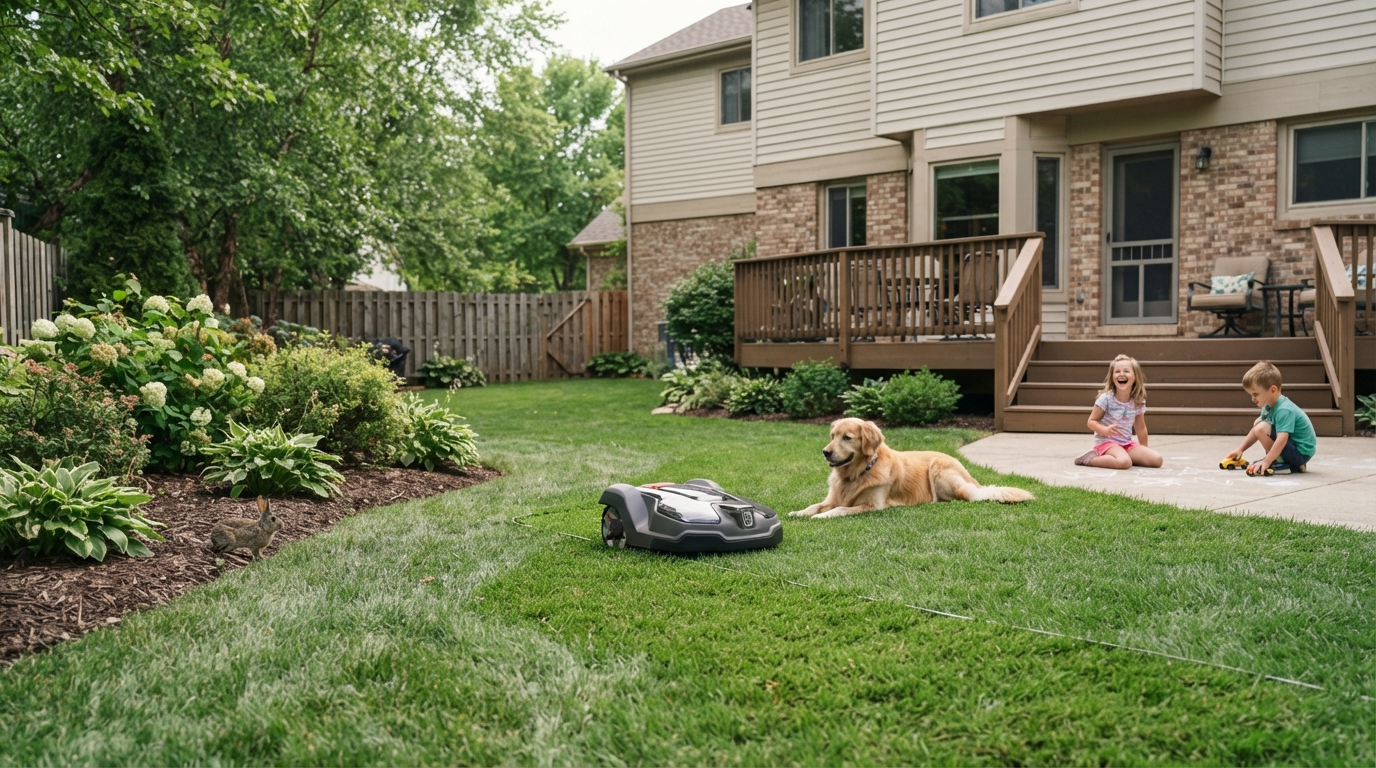
Robot mowers are built to a safety standard and use sensors designed to stop the blades when something goes wrong, but their obstacle detection isn’t perfect. The safest approach is simple: run the mower when children and pets aren’t in the yard, schedule it for daytime only, and walk the lawn for toys before the season starts.
If grandchildren visit, or a dog has the run of the yard, safety is probably the first question you have about a robot mower, and the right one to ask before any other. This guide covers what the U.S. safety standard does, what the sensors can and can’t do, the recalls on record, and the everyday habits that matter most.
There are no product recommendations or shopping links on this page. The answer to a safety question shouldn’t come with a sales pitch.
The safety standard behind robot mowers
In the United States, robotic mowers are covered by a voluntary safety standard, ANSI/OPEI 60335-2-107, which the U.S. Consumer Product Safety Commission lists on its page of mower standards. It’s the U.S. version of an international standard for battery-powered robotic lawn mowers.
According to its published summary, the standard addresses the significant hazards of these machines, including misuse that can reasonably be expected, such as someone approaching or picking up the mower while it runs. The full text is sold by standards organizations rather than published free, so it’s worth knowing its purpose rather than assuming what every clause says.
“Voluntary” means a manufacturer isn’t legally required to meet it. It’s reasonable to ask a manufacturer or dealer whether a model complies before you buy, especially for low-cost models from unfamiliar brands.
What the safety features do
Robot mowers use small, lightweight blades rather than a single heavy blade, and they carry sensors meant to stop those blades when something unexpected happens. Common features include:
- Lift and tilt sensors, designed to stop the blades if the mower is picked up or tipped.
- Bump sensors, which detect when the mower runs into something.
- A stop button and PIN code, so the mower can be halted quickly and can’t be started by a curious child.
- Obstacle recognition on many newer models, using cameras or laser sensors to spot objects and steer around them.
Exact features vary by model, so check the manual for the one you’re considering.
What “AI obstacle detection” can’t promise
Many mowers now advertise the ability to recognize pets, toys and even hedgehogs. It helps, but it isn’t a guarantee.
Researchers at the University of Oxford developed a safety test for robotic mowers using a dummy hedgehog. In one case, a mower detected the dummy and steered around it without contact, but when the test was repeated, the result couldn’t be reproduced. The researchers suggested the mower may have avoided a larger obstacle by chance rather than truly recognizing the animal.
The lesson for any household: treat obstacle detection as a backup, not the plan. The plan is to keep people and animals out of the mower’s way.
Recalls on record
Two U.S. recalls involving robot mowers are worth knowing about. Both involved fire risk from batteries or charging equipment, not blade injuries.
| Date | Product | Problem | Fix |
|---|---|---|---|
| February 2022 | Husqvarna Automower 435X AWD and 535 AWD (about 1,400 units) | The lithium-ion battery could overheat, posing a fire risk. Five reports of overheating, including two fires. No injuries. | Free software update; free replacement battery for units with more than 1,200 charging cycles |
| March 2023 | Docking stations sold with STIHL iMOW mowers (about 2,700 units) | The docking station’s circuit board could short circuit when exposed to moisture. Eight reports of overheating, including two fires. No injuries. | Free at-home repair by STIHL or a STIHL dealer |
You can check whether any product you own has been recalled at CPSC.gov/Recalls, and report a safety problem at SaferProducts.gov. Registering your mower with the manufacturer means you’ll be contacted directly if a recall affects it.
Safe habits that matter most
Around children and grandchildren
- Schedule mowing for times the yard is empty, such as school hours, not after-school play time or a weekend visit.
- Pause the schedule when grandchildren visit. Most apps let you do this in a couple of taps.
- Set the PIN or child lock, and keep the app on your own phone.
- Teach children that the mower isn’t a toy: no riding, sitting on or chasing it.
- Walk the lawn first. Balls, toys and garden hoses left out are the most common obstacles.
Around dogs and cats
- Watch your pet the first few times the mower runs. Some dogs ignore it, while others bark at it or chase it.
- Mow when pets are indoors if yours is curious or anxious around moving machines.
- Pick up after dogs before mowing, for obvious reasons.
Around wildlife
- Mow in daylight only. The Oxford researchers recommend daytime mowing, because many small animals are active after dark.
- Check the lawn in spring and early summer. The researchers recommend looking for vulnerable wildlife before mowing, including young animals, fledgling birds and amphibians. In American yards that can mean rabbit nests hidden in the grass, fledglings on the ground and toads.
- Leave a wild corner as a no-go zone if you want to give wildlife somewhere safe.
Never lift or tip a running mower
Stop the mower with its stop button before you pick it up, clear a jam or check the blades, and follow the manual’s instructions for disabling it before any maintenance. Wear gloves when handling blades.
Is a robot mower safer than a push or riding mower?
We can’t give you a reliable number comparing injury rates between robot mowers and conventional ones, and we won’t guess. What’s clear is that the risks are different. A robot mower removes the person from behind a spinning blade, but it works on its own, often while you’re not watching. That’s why the habits above, especially timing your mowing, matter more than any feature.
Questions
Will a robot mower stop if a child touches it?
Robot mowers are designed with sensors that stop the blades when the mower is lifted, tipped or bumps into something, and the U.S. safety standard addresses foreseeable misuse like this. But no sensor is perfect. The safe rule is to run the mower only when children aren’t in the yard.
Should I run my robot mower at night?
It’s better not to. Wildlife researchers at the University of Oxford recommend daytime-only mowing, because many small animals are active after dark. Daytime mowing also means you’re more likely to notice if something goes wrong.
Are robot mowers safe for dogs?
Many dogs ignore them after a while, but some chase or bark at them. Supervise the first few runs, and if your dog stays interested, schedule mowing for times when it’s indoors. Don’t rely on obstacle detection to keep a curious dog safe.
Sources
- U.S. Consumer Product Safety Commission: Mowers, voluntary standards
- ANSI: ANSI/OPEI 60335-2-107-2020 summary
- University of Oxford: Researchers develop hedgehog safety test for robotic lawnmowers
- CPSC: Husqvarna recalls all-wheel-drive robotic lawnmowers (2022)
- CPSC: STIHL recalls docking stations sold with iMOW robotic mowers (2023)
- STIHL: iMOW docking station recall
- Wikipedia: Robotic lawn mower (safety sensors)