How MowReview makes money: As an Amazon Associate, MowReview earns from qualifying purchases, at no extra cost to you. We don’t test mowers ourselves; we explain what manufacturers and independent testers report. How we research
Quick answer
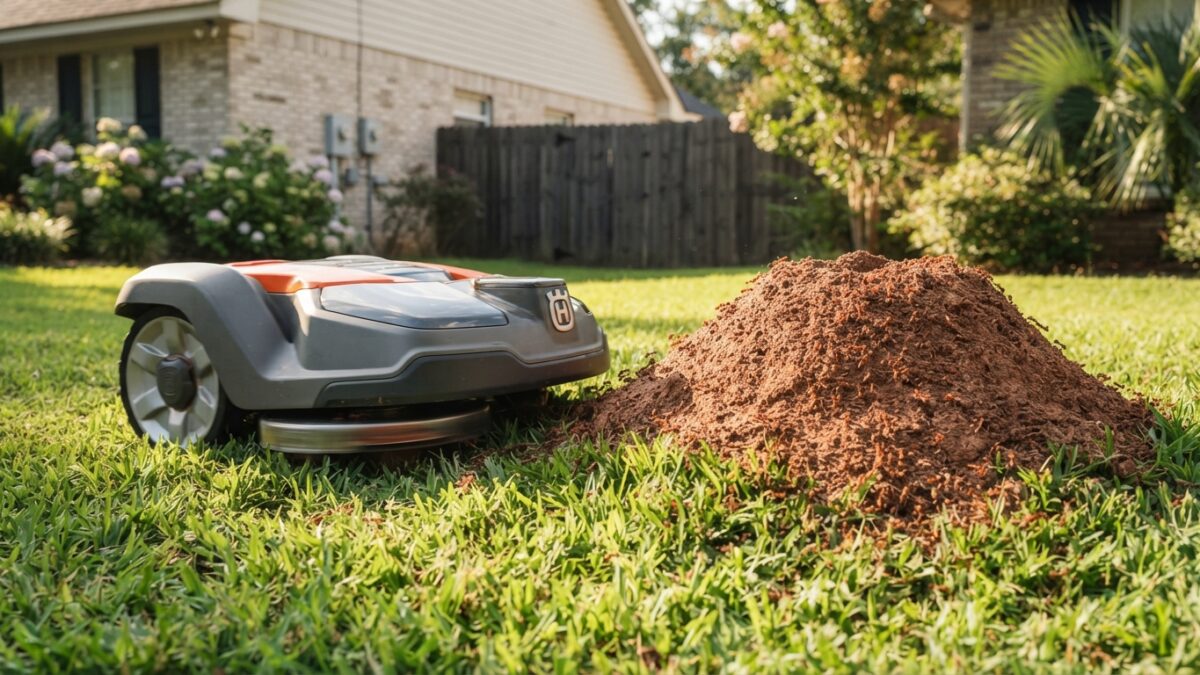
Fire ants and robot mowers don’t share a yard peacefully. A red imported fire ant mound can be 18 inches tall and hold 100,000 workers, and Texas A&M AgriLife says disturbing one puts anyone nearby at risk of stinging. Don’t run the mower over active mounds. Treat them first, using a two-step extension-service program of broadcast bait and mound drench. In the meantime, mark active mounds as no-go zones in the app. On golf courses, Texas A&M has found that frequent mowing suppresses colony establishment, but that’s low-height daily mowing, not once-weekly lawn mowing, and it doesn’t help with existing large mounds.
If you live anywhere from Central Texas east to Georgia, Florida and up into the Carolinas, red imported fire ants are part of owning a lawn. They build tall dirt mounds, they sting aggressively when disturbed, and they show up in yards that don’t have them within a season or two. A robot mower running over an active mound is a small disaster.
This guide covers what fire ants do to a mower, what the mower does to the mound, and how to plan a robot-mowed lawn where fire ants are a fact of life. MowReview quotes no prices and hasn’t tested these mowers. How we research explains why.
Fire ants and where they live
Red imported fire ants (Solenopsis invicta) are established across the Southeast, the Gulf Coast, Texas, and increasingly parts of California and the Southwest. NC State Extension describes a mound 2 feet in diameter and 18 inches tall containing about 100,000 workers plus reproductives. They sting when disturbed and don’t take much to disturb.
Fire ants aren’t a problem confined to farms. They show up in suburban lawns, along sidewalks, at the edges of driveways and out into the grass. Any lawn in fire-ant country will get them if it isn’t treated.
What happens when a robot mower hits a mound
The Texas A&M warning
Texas A&M AgriLife’s turfgrass IPM guide is direct: disturbing a mound causes the fire ants to “swarm out of the ground,” and “anyone in the vicinity is in danger of being bitten.” That includes the person who has to walk out to retrieve the stuck mower.
Several things go wrong at once when a robot mower runs over an active fire ant mound:
- The mower may not cross it. A tall mound (over about 4 inches) is what Segway’s Navimow manual calls a hard obstacle: the mower can’t drive over it, so it bumps and reverses.
- The mower may high-center on it. A softer mound or an old mound partly flattened can lift the wheels off the ground, leaving the mower spinning.
- The blade throws mound material. A rotating cutting disc encountering a mound of loose dirt and ants throws both out sideways.
- Ants swarm the mower. Fire ants respond to disturbance by attacking anything nearby. That’s the mower, and shortly after, the person retrieving it.
- Ants inside the mower. The mower’s underside is a warm, dry, dark place. It’s a nice home. There’s no manufacturer guidance on this specifically, but the physical setup lends itself.
Treating fire ants around a robot mower
Extension services recommend a “two-step” program. Every fire-ant-country state extension service publishes a version of it.
- Broadcast a fire ant bait across the whole lawn. This is a slow-acting bait that ants carry back to the mound and share. Effective in one to a few weeks, depending on the product.
- Treat individual mounds. Either a granular product applied around each mound, or a liquid mound drench. Both work faster than the bait alone.
- Wait the label’s stated time before mowing the treated area. Read the pesticide label. Some products call for the treatment to soak in without disturbance.
NC State Extension is explicit that when using a drench, you should not physically disturb the mound before or after application, or the treatment is compromised. Running a robot mower over a treated but still-active mound the day after treatment is exactly that.
Setting the mower up in fire-ant country
- Walk the lawn every week before the first mow of the week. Fire ant mounds appear overnight, especially after rain. Look for them the way you’d look for tree branches or dog toys.
- Mark active mounds as no-go zones in the app. Segway lets you draw off-limit islands for temporary objects and delete them later. Mammotion allows up to 50 no-go zones per mowing area.
- Delete the zone after the mound is dead and flattened.
- Keep the schedule off wet mornings. Fire ants are active in warm, humid weather, and the mound is soft after rain. Segway also says the mower’s wheels slip on wet ground.
- Wear closed shoes when rescuing the mower. Every time. Assume the mower is stuck near a mound until you’ve walked over and checked.
Frequent mowing on a golf course, not on your lawn
Texas A&M’s turfgrass research finds that frequent mowing on golf turf, at very low heights (greens mowed 7 times a week, fairways 3 times), suppresses fire ant colonies because the “constant disturbance of ant colonies…usually causes them to move to less disturbed areas.” That’s a real effect, but it’s for daily mowing at 0.1 to 0.5 inches of cut. A home lawn mowed at 2 inches by a robot every day or two isn’t the same intervention. Don’t skip treatment because you own a robot mower.
The picks (all Southern-friendly)
50 no-go zones for a shifting mound map
Mammotion LUBA 3 AWD (H version)
- Stated cutting height (H)2.2 to 4.0 in
- No-go zonesUp to 50 per mowing area
- Stated max slope80%
Fire ants move mounds. New mounds appear, old ones flatten. Fifty no-go zones per mowing area is enough to mark and delete active mounds week by week. The H version reaches 4 inches for standard St. Augustine, the main lawn grass across the fire-ant belt.
Good for
- St. Augustine or bermuda lawns in fire-ant country
- Yards where mounds appear regularly
Less good for
- Buyers who miss standard vs. H
- A polished app: PCWorld found connectivity “a little spotty”
Questions
What happens if a robot mower hits a fire ant mound?
The mound is disturbed and the ants swarm, which Texas A&M AgriLife says puts “anyone in the vicinity” in danger of being stung. The mower may high-center on a tall mound, and fire ants can climb onto and inside the mower body. Nobody wants to be the person rescuing it.
Should I mow over a fire ant mound?
No. Extension services recommend treating mounds before disturbing them, either with broadcast bait or a mound drench, and Texas A&M warns that mowing disturbs mounds and provokes stinging. Wait until the mound is treated and the ants are dead before running the mower over it.
Where do fire ants live?
Red imported fire ants (Solenopsis invicta) are widespread across the Southeast, the Gulf Coast, Texas and up into parts of the mid-South and Southwest. If you’re in Alabama, Georgia, Florida, Louisiana, Mississippi, South Carolina, Texas or the coastal Southeast, they’re a concern.
How tall can a fire ant mound get?
NC State Extension describes mounds up to 18 inches tall and 2 feet wide, with about 100,000 workers plus reproductives. That’s an obstacle a robot mower can’t cross, and it’s tall enough to catch on the mower body rather than the wheels.
How should I treat fire ant mounds around a robot mower?
Extension services recommend a two-step program: broadcast a fire ant bait across the whole lawn, then treat individual mounds with a mound drench or granular insecticide. Follow the label. Wait the label’s stated time before mowing the treated area.
Does frequent mowing reduce fire ants?
On golf courses, yes. Texas A&M says frequent mowing on greens and fairways suppresses colonies because constant disturbance drives them to move to less-disturbed areas. That’s for daily mowing at very low heights, not once-weekly home lawn mowing.
The short version
Never run a robot mower over an active fire ant mound. Treat mounds first, using the extension two-step program of bait plus mound drench, and mark active mounds as no-go zones in the app until they’re dead and flattened. The Mammotion LUBA 3 AWD H handles up to 50 no-go zones per area, useful for the shifting map fire ants create. Wear closed shoes when rescuing the mower, always.
Fire ants are one Southern-specific issue.
Match a mower to your grass and climate.