How MowReview makes money: As an Amazon Associate, MowReview earns from qualifying purchases, at no extra cost to you. We don’t test mowers ourselves; we explain what manufacturers and independent testers report. How we research
Quick answer
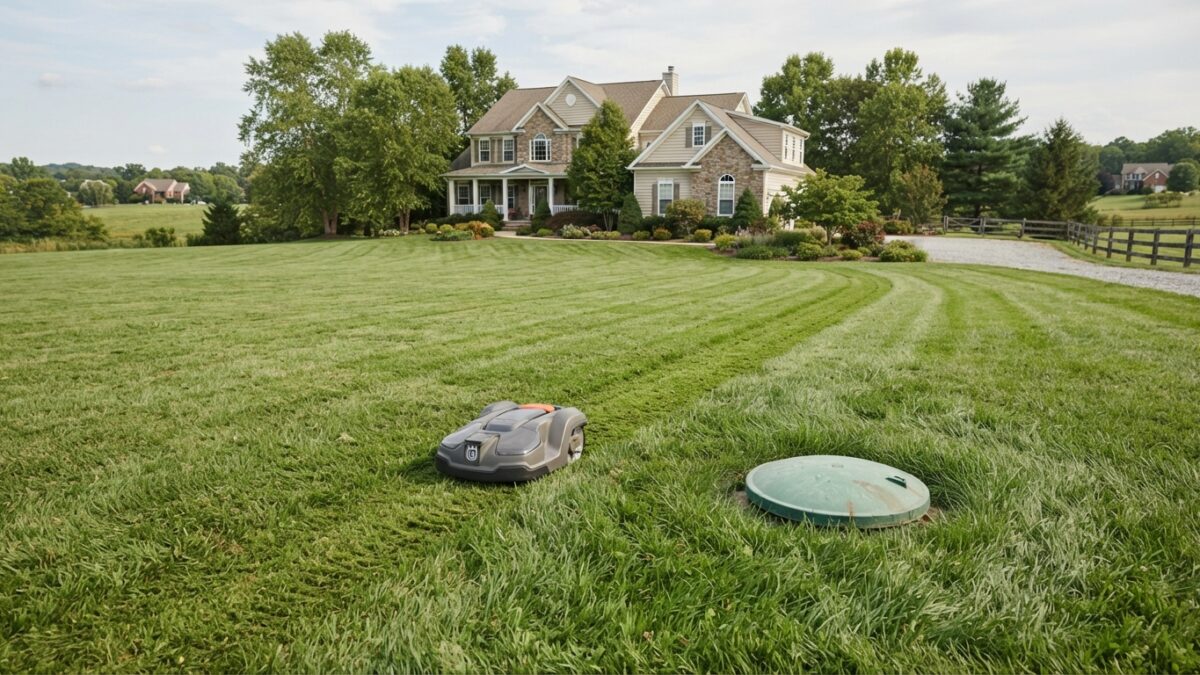
The EPA says “do not park or drive on your drainfield,” and Oklahoma State Extension warns that heavy equipment compacts drain-field soil and can damage pipes. Neither has ruled on light robotic mowers specifically, and a 40-pound robot mower is a fraction of the weight of a riding mower or the vehicles those rules target. If you have a septic drain field, the practical answer is: mow it, but with care. Vary the mowing pattern so no single track gets pounded daily. Mark raised septic tank access lids as no-go zones. Keep the mower off soaked ground. And plan the charging station and RTK antenna off the field entirely.
Rural and suburban lots on septic have a lawn feature nobody thinks about until they own one: the drain field. It’s the buried pipe grid that treats wastewater from the septic tank, and it needs air, drainage and healthy soil to work. Overloading it, compacting it or clogging it are the three ways it fails, and repairs are expensive.
A robot mower on a septic-lot lawn crosses the drain field over and over, which is the exact behavior the rules were written against. But it’s also 5 to 15 times lighter than a riding mower. This guide covers what the sources actually say. MowReview quotes no prices and hasn’t tested these mowers. How we research explains why.
What the EPA and extension services say
| Source | Guidance |
|---|---|
| EPA | “Do not park or drive on your drainfield.” Heavy vehicles compact soil and can damage pipes. Recommends native grasses and ground covers over the drainfield. |
| Oklahoma State Extension | “The best vegetation for drain fields are shallow-rooted turf grasses.” Heavy equipment or tillage causes compaction. |
Sources: EPA “How to Care for Your Septic System”; Oklahoma State Extension “Planting on Septic System Drain Fields.”
Neither source distinguishes between a car, a riding mower, a push mower or a robot mower. The EPA’s rule is worded absolutely: don’t drive on it. In practice, most homeowners mow their drain field with a push mower or a riding mower every week, and the systems are still working decades later. So the rule is best read as “don’t compact it,” with a robot mower falling on the lighter end of what people actually do.
How heavy is a robot mower?
| Mower | Weight |
|---|---|
| Mammotion YUKA mini | 23 lb |
| Segway Navimow i110N | 24 lb |
| Ecovacs GOAT A3000 LiDAR | 36 lb |
| Husqvarna Automower 435X AWD | 39 lb |
| Mammotion LUBA 3 AWD | 41 lb |
| Segway Navimow X3 series | About 43.7 to 43.9 lb |
| Segway Navimow X430 | 63.7 lb (PCWorld measurement) |
Compare with a typical walk-behind push mower (60 to 90 pounds), a self-propelled push mower (70 to 100 pounds), or a small riding mower (300 to 500 pounds).
A robot mower is nearly always the lightest thing on a septic-lot lawn short of a person. The concern isn’t a single pass but repeat passes over the same track.
Setting up over a drain field
- Locate the drain field first. The tank lids, the distribution box and the field lines run from the house outward. County records or the original permit usually show the layout.
- Vary the mowing pattern. Segway, Mammotion and Husqvarna apps let you choose a random or systematic pattern. Random suits a drain field because the mower doesn’t retrace the same lines each time.
- Move the mower’s turning spots off the drain field. A robot mower spins on the spot at every boundary, and that turning spot wears the lawn. Set the boundary so the field lines are inside the mowing area, not on its edge.
- Keep it off wet ground. Compaction happens worst on saturated soil. Segway says wet, slippery grass makes wheels slip and spin, and Mammotion says soft ground causes wheel slip and marks. Use the rain sensor or rain delay. See robot mowers in rain and wet grass.
- Place the dock off the drain field. The charging station sits in one spot for years. Put it on the far side of the lawn from the field.
- Place the RTK antenna off the drain field. A ground-spike antenna anchors and stays. Pick a spot that isn’t over field lines.
Septic tank access lids
Raised riser lids are obstacles
A flush concrete or plastic lid at grade is drivable by a robot mower, and its main hazard is dulling blades if the mower runs over it repeatedly. A raised riser lid (Polylok 20-inch or 24-inch and similar) sits above ground level and is an obstacle. Segway’s Navimow manual says the mower can hit hard obstacles over about 4 inches tall and reverse. That’s ugly for the lid, and worse for the mower. Mark raised lids as no-go zones in the app.
Even a flush lid deserves a small margin. It’s a hard, unyielding surface, and running over it hundreds of times a season isn’t kind to the mower’s bumper or blade disc.
The picks
All-wheel drive, still under 25 pounds
Mammotion YUKA mini
- Weight23 lb
- Stated cutting height (US H)2.0 to 3.5 in
- Stated coverage0.15 or 0.2 acre
The lightest mower we’ve compared. Compact, easy to carry, and easy to move if you need to service the septic tank. TechRadar found it delivered “neat, even cutting” and was light enough to carry.
Good for
- Small septic-lot lawns
- Owners who prefer minimum weight over the drain field
Less good for
- App experience: TechRadar found the app “basic and a bit unintuitive”
- Yards with weak Wi-Fi: TechRadar found the connection “could be patchy”
Wired, if the drain field can be routed around
Husqvarna Automower 435X AWD
- Weight39 lb
- BoundaryBuried wire, 1 to 8 in deep
- SupportUS dealer network
Wired installation lets you route the boundary wire off the drain field entirely, which is worth the extra effort on a septic lot. Husqvarna’s dealer network installs the wire, plans the route around obstacles like tank lids, and handles service.
Good for
- Owners who want dealer installation on a complicated lot
- Shaded lawns where RTK-only mowers struggle
Less good for
- Anyone avoiding a buried wire
- Renters or short-term owners
- Tall-cut grasses: it stops at 2.8 inches
What not to do on a drain field
- Don’t plant trees or shrubs. Roots damage pipes; extension services warn against this.
- Don’t drive vehicles or park equipment. The EPA is direct about this.
- Don’t build patios, sheds or driveways over the field. Impermeable surfaces starve the soil of oxygen.
- Don’t run heavy irrigation over the field. Saturated soil is where compaction is worst.
A robot mower’s charging station is small, but it sits in one spot for years. Place it off the drain field.
Questions
Can I run a robot mower over my septic drain field?
Extension services and the EPA advise against driving on a drain field because heavy equipment compacts the soil and can damage pipes. Robot mowers are lighter than push mowers (typically 20 to 65 pounds), but they cross the same ground repeatedly. Neither the EPA nor extension services have published guidance on light robotic mowers specifically.
What weight is safe to drive on a drain field?
The EPA says “do not park or drive on your drainfield.” That’s an absolute rule, without an exemption for lightweight equipment. Oklahoma State Extension says “heavy equipment/tillage” causes compaction. Robot mowers are far lighter than the vehicles those rules target, but the guidance is worded absolutely.
What about septic tank access lids?
Flush concrete or plastic lids can usually be crossed by a robot mower, since they’re level with the lawn. Raised riser lids that sit above grade are obstacles, and Segway’s manual says the mower can hit hard obstacles over about 4 inches tall. Mark raised lids as no-go zones in the mower app.
What grass grows over a septic field?
The EPA and extension services recommend shallow-rooted grasses and ground covers, not deep-rooted trees or shrubs. That’s a standard turfgrass, which suits a robot mower’s normal cut. Keep trees off the field, because roots can invade pipes.
How should I set up the mower to protect the drain field?
Vary the mowing pattern rather than repeating the same track, avoid the mower’s turning spots directly over field lines, keep the mower off wet ground (which is when compaction is worst), and mark septic tank lids as no-go zones.
Will a robot mower’s wheels damage the drain field?
We didn’t find a source that answers this directly. The EPA’s guidance targets vehicles and heavy equipment; a 40-pound robot passing over daily is a much lower load. Whether that adds up to compaction over years isn’t documented. If you’re worried, use a heavier mowing pattern and rotate directions.
The short version
The EPA says don’t drive on your drain field, and that guidance targets vehicles and heavy equipment. Robot mowers are much lighter than what those rules were written for, but they cross the same ground every day. Pick the lightest mower that fits your lawn, vary the mowing pattern, mark raised septic lids as no-go zones, keep the mower off soaked ground, and place the dock and antenna off the drain field.
Rural lots often have more constraints than urban ones.
Check what fits your full lot.