How MowReview makes money: As an Amazon Associate, MowReview earns from qualifying purchases, at no extra cost to you. We don’t test mowers ourselves; we explain what manufacturers and independent testers report. How we research
Quick answer
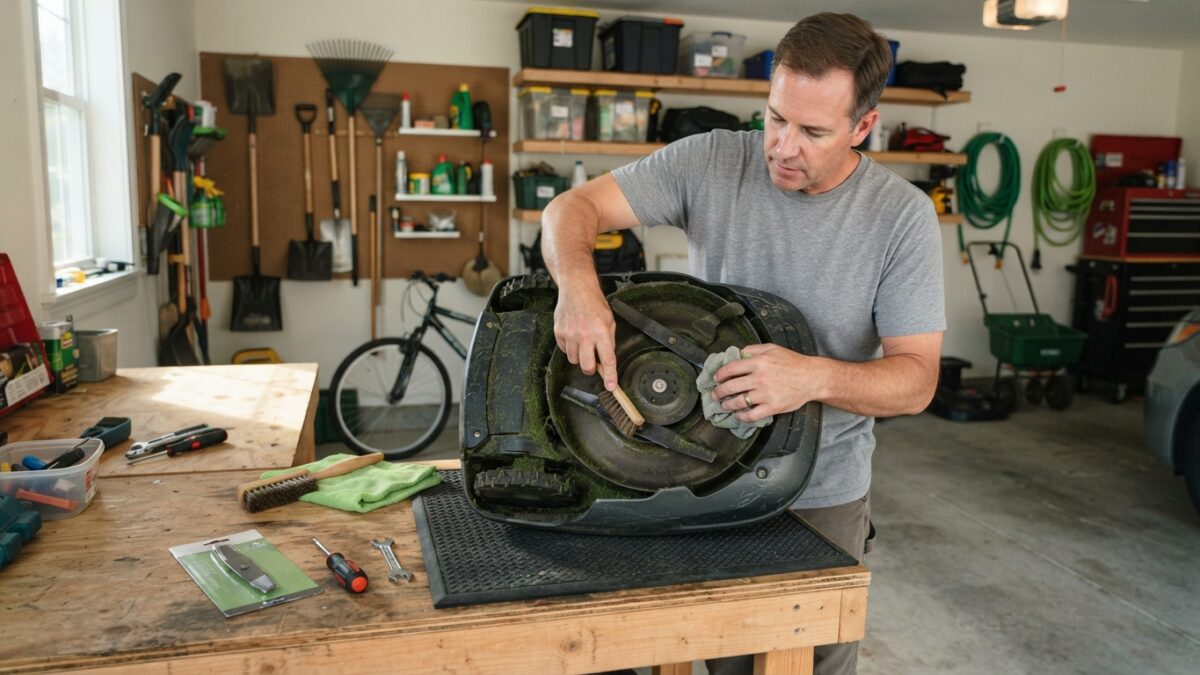
There are only four jobs: keep the underside and wheels clear of clippings, wipe the charging contacts, change the blades when they dull, and look after the battery. Husqvarna recommends fitting new blades and screws before winter storage each year. Always stop and disable the mower per its manual before touching the blades, and wear gloves.
Robot mowers ask far less of you than a gas mower. There’s no oil, no filters, no spark plug and no pull cord. What they do need is a few minutes of attention every couple of weeks, and the jobs below are almost the whole list.
Your manual takes priority over anything here, since water ratings, blade types and disabling procedures differ by model.
Before any of this
Stop the mower with its stop button and follow the manual’s procedure for disabling it before you tip it up, clean underneath or go near the blades. Wear gloves. The blades stay sharp when the mower is switched off.
Every couple of weeks: clean it
Clippings, soil and damp grass build up underneath. Segway warns that damp clippings are acidic and promote corrosion of blade screws and charging contacts over time, and that dried dirt can jam wheels and the cutting deck.
- Clear the underside of packed clippings, especially around the blade disc.
- Check the wheels turn freely and pick grass and string out of the axles.
- Wipe the charging contacts on both the mower and the dock with a dry cloth.
- Brush the sensors and camera lenses clean, since a dirty lens affects obstacle detection.
On water: check the manual first. Mowers have different water resistance ratings, and hosing one down can be the wrong move. Many manufacturers prefer a brush and a damp cloth to a jet of water.
Every few months: change the blades
Robot mowers use small, light blades that dull rather than break. Dull blades tear grass instead of cutting it, which leaves brown, ragged tips and makes the motor work harder.
How often depends on your grass. Dense warm-season grass wears blades faster than fine northern grass, and sandy soil faster still. Rather than following a calendar:
- Look at the lawn. Brown, frayed tips a day after mowing usually mean dull blades.
- Look at the blades. Rounded edges, nicks or bends mean replacement.
- Listen to the mower. Working noticeably harder in normal grass is a sign.
Buy blades made for your exact model, and replace the whole set at once so the disc stays balanced. Husqvarna recommends replacing the screws along with the blades. Most robot mower blades are replaced rather than sharpened.
Through the season: battery care
The battery is the part most likely to need replacing eventually, and it’s the one thing you can’t clean your way out of. Sensible habits:
- Leave it docked between mows, as designed.
- Don’t leave it flat for long periods. A deeply discharged lithium battery may not recover.
- Keep the contacts clean, since poor contact means poor charging.
- Follow the manual over any general advice on charge levels, because manufacturers genuinely disagree. Our winter storage guide sets out the differences.
Keep the software current
Check for firmware updates in the app now and then. Manufacturers push improvements to navigation, charging and obstacle handling, and Segway suggests checking for an update before you put the mower away for winter.
A simple season-by-season routine
| When | Job |
|---|---|
| Start of season | Clean, fit fresh blades if you didn’t before storage, check for firmware updates, walk the lawn for winter debris, and watch the first mow |
| Every couple of weeks | Clear the underside and wheels, wipe contacts and sensors |
| Every few months | Check blades and replace when dull |
| After heavy rain or a storm | Check for fallen branches and debris before the next mow |
| End of season | Deep clean, fit new blades and screws, inspect wheels and body, charge per the manual, and store indoors |
The annual once-over
Once a year, with the mower out and off, Husqvarna suggests checking for wear on parts such as the lower front wheel bearings, the blade disc and the body panels, and rotating the wheels while listening for squeaking, grinding or unusual resistance. Winter is the natural time for this, because there’s no rush to get back on the lawn and parts can be ordered without losing mowing days.
What to leave to a professional
Blades, cleaning and basic checks are straightforward home jobs. Anything involving opening the mower, replacing a battery pack or diagnosing a motor fault is better handled by the manufacturer or a dealer, particularly while the mower is under warranty, where opening it yourself may void cover.
Questions
Can I hose down a robot mower?
Check the manual first. Water resistance varies by model, and some manufacturers advise against a hose, preferring a brush and a damp cloth. Whatever the model, stop and disable the mower before cleaning it.
Do robot mower blades need sharpening?
Generally no. They’re small, light and designed to be replaced as a set rather than sharpened. Husqvarna recommends fitting new blades, along with new screws, before winter storage each year.
How do I know when the blades need changing?
Look at the lawn rather than the calendar. Brown, frayed grass tips a day after mowing are the clearest sign, along with visibly rounded or nicked blade edges. Thick grass and sandy soil wear blades faster.
How long does a robot mower battery last?
We don’t have independent data we’d trust on battery lifespan, and published figures vary widely. What’s clear is that the battery is the main wearing part, that manufacturers sell replacements, and that keeping it docked and never leaving it flat are the habits that help. Check replacement availability and warranty terms for your model.
Sources
- Husqvarna: Automower maintenance and storage (blades and screws, wear inspection)
- Husqvarna US support: Winter storage guide
- Segway Navimow: Maintenance and winterizing checklist (clippings, corrosion, firmware)
- Navimow UK: Winter care (charging contacts, battery levels)
- Mammotion: Preparing a robot mower for storage (cleaning, charge level)
End of season coming up?
Winter is when the blade change and the annual check are easiest to do properly.