How MowReview makes money: As an Amazon Associate, MowReview earns from qualifying purchases, at no extra cost to you. We don’t test mowers ourselves; we explain what manufacturers and independent testers report. How we research
Quick answer
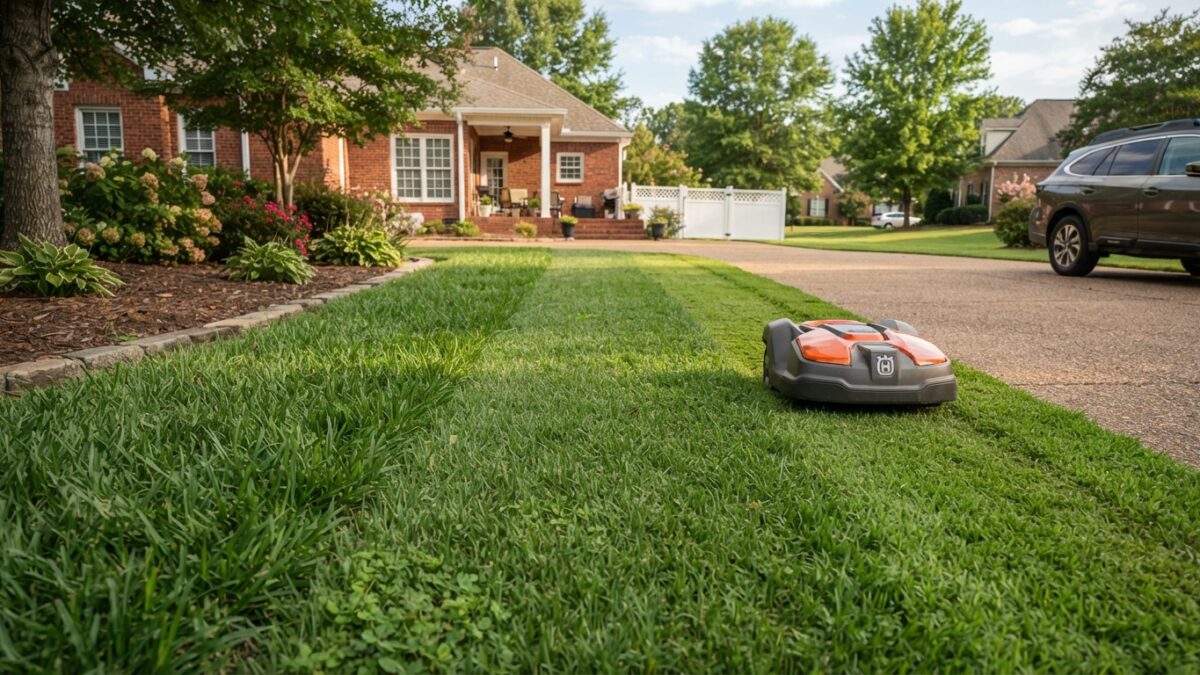
Warm-season grasses are thicker and tougher than northern lawns, and they make robot mowers work harder. Prioritize traction, ideally all-wheel drive, and check the mower’s cutting height range against what your grass needs, because St. Augustine in particular is cut higher than most mowers’ default settings. Independent testing has specifically found two-wheel-drive mowers slipping in thick St. Augustine.
Most robot mower reviews are written about northern lawns. If you live in the South or the Southwest, your grass behaves differently, and it changes what to look for.
Cool-season vs. warm-season, briefly
Cool-season grasses such as Kentucky bluegrass, tall fescue and perennial ryegrass grow through spring and fall, and dominate the northern half of the country. They’re generally finer and easier for a robot mower to cut.
Warm-season grasses such as St. Augustine, Bermuda and zoysia grow hardest in summer heat and dominate the South. They tend to be denser and tougher, and they spread by runners along the ground, which is exactly the kind of growth a small robot mower blade finds hardest.
What the testing actually shows
Bob Vila tested seven wire-free mowers on a Florida property with thick St. Augustine grass, steep side-yard slopes, narrow lawn sections and a large open backyard. That’s the closest thing to a real warm-season test we’ve found, and two findings matter here:
- The Worx Landroid Vision WR320, a two-wheel-drive mower, slipped for traction in thick grass along the edges of that yard.
- The mowers that came out best on that property were all-wheel-drive models.
The lesson isn’t that robot mowers can’t cut warm-season grass. It’s that thick grass punishes weak traction, and traction is the spec people skip.
What to look for, grass by grass
| Grass | What makes it hard | Prioritize |
|---|---|---|
| St. Augustine | Thick, coarse, spreads by heavy runners, and usually cut higher than other lawns | All-wheel drive and a high enough maximum cutting height |
| Bermuda | Dense and vigorous in summer, often cut low, grows fast in heat | Frequent mowing schedule and a low enough minimum cutting height |
| Zoysia | Dense and stiff-bladed, tough on blades | Traction and regular blade changes |
| Centipede and Bahia | Bahia sends up tough seed stalks that outpace a light cut | More frequent mowing in summer |
Check the cutting height range
This is the most commonly missed spec for Southern lawns. Robot mowers have a stated cutting height range: the Segway Navimow i105N, for example, is listed at 2 to 3.6 inches. If your grass is normally maintained above a mower’s maximum, that mower will scalp it.
St. Augustine is typically kept tall, so check the mower’s upper limit against what your lawn needs. Bermuda is often kept short, so check the lower limit instead. Your county’s Cooperative Extension office publishes recommended mowing heights for grasses in your area, and that’s the number to compare against the spec.
The one-third rule still applies
The usual advice is never to remove more than about a third of the grass blade at once. Robot mowers suit this naturally, since they cut a little and often. It also means that if your lawn gets ahead of the mower during a growth surge, the fix is to raise the cutting height and bring it down gradually, not to drop straight to your target height.
Southern growing seasons change the math
A long season means more mowing, which affects the comparison with a lawn service, and it also means more blade wear. Where northern owners might change blades a couple of times a season, a Southern lawn cutting thick grass for nine or ten months will get through more. Budget accordingly, and see our cost comparison for how season length changes the numbers.
It also means winter storage looks different. In much of the South the mower may run nearly year-round, with only a short break, rather than being packed away for months.
Practical settings for warm-season lawns
- Mow more often in peak growth. Warm-season grasses grow fastest in the hottest months, which is the opposite of northern lawns.
- Start high and come down. Set the cutting height above your target for the first few weeks, then lower it gradually.
- Change blades more often. Dense grass dulls them faster, and dull blades tear rather than cut.
- Avoid mowing in the hottest part of the day when the lawn is under heat stress, which also keeps the mower out of the yard when people are using it.
- Watch the edges. That’s where thick runners build up, and where Bob Vila saw traction problems.
Questions
Can robot mowers cut St. Augustine grass?
Yes, and Bob Vila’s 2026 testing was carried out on a Florida property with thick St. Augustine. The caution is traction: that same testing found a two-wheel-drive mower slipping in thick grass along the edges, so all-wheel drive is worth prioritizing. Also check that the mower’s maximum cutting height suits a lawn kept tall.
What cutting height should I set for Bermuda grass?
Bermuda is usually maintained shorter than other lawn grasses, so check that your mower’s minimum cutting height goes low enough. Your county’s Cooperative Extension office publishes recommended heights for your area, which is a more reliable guide than a national figure.
Do I need to change blades more often on a Southern lawn?
Probably. Dense warm-season grass and a longer growing season both wear blades faster than a short northern season on fine grass. Check them regularly and replace them when they’re dull, since dull blades tear the grass instead of cutting it cleanly.
Thick grass means traction comes first
All-wheel-drive models handle dense growth and slopes better. Here’s the comparison.