How MowReview makes money: As an Amazon Associate, MowReview earns from qualifying purchases, at no extra cost to you. We don’t test mowers ourselves; we explain what manufacturers and independent testers report. How we research
Quick answer
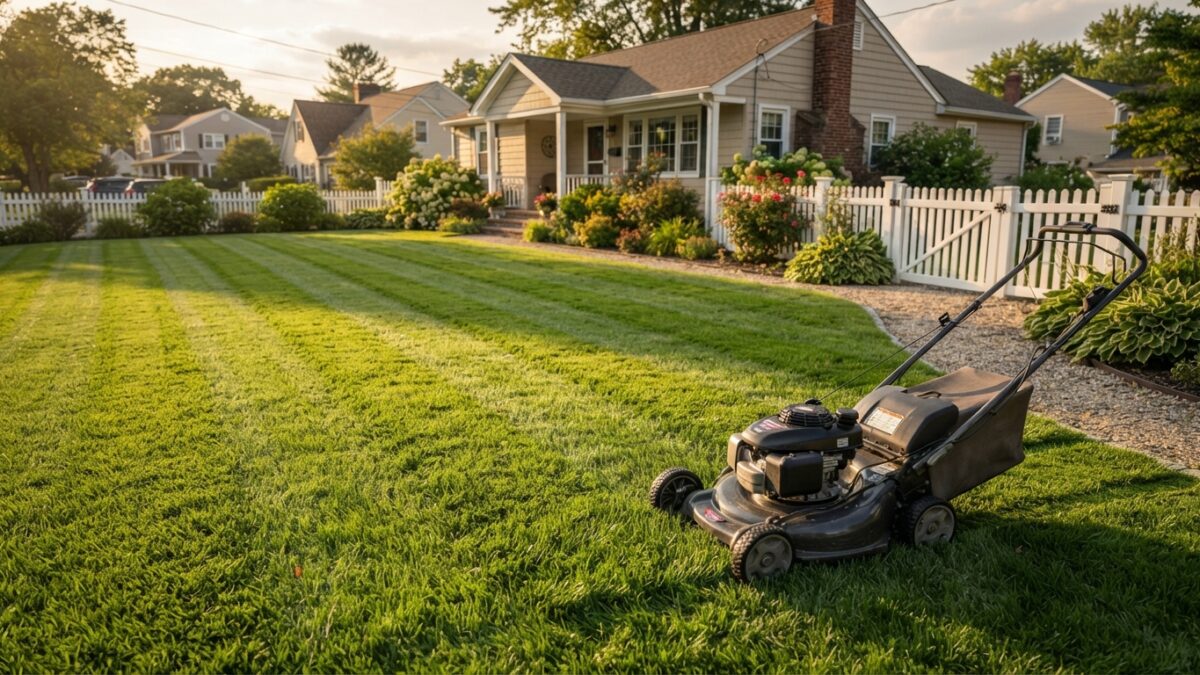
Lawn stripes are just grass bent in alternating directions, reflecting light differently. To get them with a push mower, raise the deck, mow straight rows in alternating directions, and bend the grass as you go. Ranked by result: a striping kit that hangs behind your mower is best and easiest, a lawn roller pulled across the rows afterward is next, and mowing alone gives faint stripes. Cool-season grasses such as Kentucky bluegrass, fescue and ryegrass stripe best. Bermuda, zoysia and St. Augustine show subtler stripes.
Ballpark and golf-course stripes look like they need special grass or expensive equipment. They don’t. Every stripe is simply grass leaning one way next to grass leaning the other way. Blades bent toward you show their darker sides, and blades bent away reflect more light.
This guide ranks three ways to stripe a lawn with an ordinary push or self-propelled mower, explains which grasses stripe best, and covers the technique, from mowing height to how to turn. MowReview quotes no prices and hasn’t tested the products mentioned. How we research explains why.
How stripes work
Scotts explains it simply: “Blades bent towards you look dark, while those bent the opposite way look lighter.” Mow one row heading away from the house and the next row heading back, and you get alternating light and dark bands. The more the grass is bent, the stronger the effect. That’s what striping kits and rollers add.
Three ways to stripe, ranked
| Rank | Method | Stripe strength | Extra work |
|---|---|---|---|
| 1 | Striping kit on the mower | Strong | None once fitted |
| 2 | Lawn roller after mowing | Strong | A second pass over the lawn |
| 3 | Mowing pattern alone | Faint | None |
1. A striping kit: best overall
A striping kit is a roller or weighted flap that mounts behind the mower deck and bends the grass as you mow. CheckMate, which sells kits sized for many mower brands, says its roller “gently bends the grass as you mow,” and that the mower’s rear tire tracks contribute to the stripe, so the roller must be sized to connect them. That’s why kits are sold by mower brand, model and deck size.
2. A lawn roller: strong stripes, more work
Scotts says a roller bends the blades further for more dramatic stripes, and that you can rent one if you don’t own it. Mow normally, then pull a lightly filled roller over the rows in the same alternating directions. It’s a second pass, but it works with any mower.
3. Mowing pattern alone: faint but free
Even with no extra equipment, alternating straight rows bend the grass slightly, and mowers with a full-width rear roller tend to stripe better than four-wheel models. On a fescue lawn at a tall height, you’ll see faint bands, especially from an upstairs window.
Which grasses stripe best
| Grass | Striping |
|---|---|
| Kentucky bluegrass, tall and fine fescue, perennial ryegrass | Best: upright growth holds the bend |
| Zoysia, centipede, bermuda, St. Augustine | Subtler: these grasses spread and crawl |
Source: CheckMate’s guide to how its striping kits work. Scotts also says striping works best on cool-season grass.
Southern lawns can still stripe, especially bermuda overseeded with ryegrass in winter, when the rye’s upright blades take the bend. See mowing ryegrass over bermuda.
The technique, step by step
- Raise the deck. Scotts recommends the highest setting, because taller grass bends more easily, and says even half an inch higher helps. Stay within your grass’s healthy range: see St. Augustine and bermuda mowing heights.
- Start along a straight edge. Scotts suggests beginning beside a sidewalk or driveway so your first row is straight. Every other row follows it.
- Mow a perimeter lap first. Two laps around the edge give you room to turn without scuffing the stripes.
- Lift the deck slightly as you turn. Scotts says to lift the mower deck while turning at the end of each row, then mow back beside your last pass.
- Overlap each row slightly so there are no thin, uncut lines between stripes.
- For a checkerboard, mow again at 90 degrees. Scotts says a second pass at a right angle to the first gives the checkerboard look.
- Change the pattern every few weeks. Repeating the exact same rows each time causes wear lines and grain, which UF/IFAS warns about.
Sketch it first
Scotts suggests sketching your pattern on a plan of your lawn the first time, especially for checkerboards and diamonds. It’s the easiest way to work out where to start so the rows come out straight from the street view.
The picks
Ranked 1: strongest stripes, least work
CheckMate lawn striping kit
- TypeRoller that mounts behind the deck
- FitSized by mower brand, model and deck
- Best grassesBluegrass, fescue, ryegrass
A kit made for your mower family, so it stripes every time you mow with no extra pass. CheckMate selects the mounting hardware and roller size for the specific mower.
Good for
- Cool-season lawns
- Owners who want stripes every mow
Less good for
- Warm-season grasses: CheckMate says stripes are usually less distinct on bermuda, zoysia, centipede and St. Augustine
- Guessing the size: CheckMate says the roller must be sized to connect the rear tire tracks
Ranked 2: works with any mower
Brinly PRC-24BH push/tow lawn roller
- DrumPoly, fill with water or sand
- Filled weightUp to 270 lb (as reviewed)
- UsePush by hand or tow
Bob Vila’s pick for best lawn roller. Its steel frame works as a push roller for small yards or a tow-behind for a lawn tractor, and you control the weight by how much you fill it.
Good for
- Any mower, with no kit to fit
- Also rolling new seed or sod
Less good for
- Pushing uphill when full: fill it lightly for striping
- Checking the model: Bob Vila’s review lists both PRC-242BH and PRC-24BH, so confirm the listing
Stripes without pushing
Mammotion LUBA 3 AWD
- PatternsSet in the app
- Cutting height1.0 to 2.7 in (H: 2.2 to 4.0 in)
- Stated slope80%
TechRadar described a neat finish with stripes, and Gear Diary described a golf-course-style checkerboard. Robot stripes are lighter than a roller’s, but they appear without any work from you.
Good for
- Owners who want a patterned lawn without mowing it
- Sloped lawns
Less good for
- Deep, ballpark-style stripes: a roller bends grass further
- Soft, shady turf: TechRadar found the front tires can damage grass there when turning
- Buying the wrong version: choose standard or H by grass height
Questions
How do lawn stripes work?
They’re bent grass reflecting light. Scotts explains that blades bent toward you look dark and blades bent away look lighter, so alternating mowing direction creates light and dark stripes.
Can you stripe a lawn without a striping kit?
Yes, faintly. Mowing straight rows in alternating directions bends the grass a little on its own. A striping kit or a roller bends it further, which Scotts says gives more dramatic stripes.
Which grass stripes best?
Cool-season grasses. CheckMate says Kentucky bluegrass, fescue and ryegrass give the best results because they grow upright, while zoysia, centipede, bermuda and St. Augustine usually show more subtle stripes.
What height should I mow to get stripes?
Higher than usual. Scotts recommends mowing at the highest setting, because taller grass bends more easily, and says even raising the height by half an inch can help.
How do I make a checkerboard pattern?
Mow the lawn in stripes, then mow it again at a 90-degree angle to the first pass, as Scotts describes.
Can a robot mower make stripes?
Some can. Reviewers described a striped finish from the Mammotion LUBA 3 AWD, and Gear Diary described a golf-course-style checkerboard. Robot stripes are usually lighter than a roller’s, and Tom’s Guide found a Navimow flattened its stripe pattern driving back to the dock.
The short version
Raise the deck, mow straight alternating rows, lift the deck slightly at each turn, and bend the grass as you go. A striping kit gives the best result for the least effort, a roller is the any-mower alternative, and cool-season grasses show the boldest stripes. Change the pattern now and then so the lawn doesn’t wear in lines.
Want the lawn mowed for you?
Robot mowers that cut patterns automatically.