How MowReview makes money: As an Amazon Associate, MowReview earns from qualifying purchases, at no extra cost to you. We don’t test mowers ourselves; we explain what manufacturers and independent testers report. How we research
Quick answer
Rock salt (sodium chloride) is the worst common deicer for lawns. Iowa State Extension calls it the most harmful to plants. The safest chemical option is calcium magnesium acetate (CMA), which causes little or no plant damage and works to about -15°F, but costs 20 to 30 times as much. Calcium chloride, potassium chloride and magnesium chloride sit in between. Whatever you use, shovel first, use a coffee mug’s worth rather than a bucket, and never pile salty snow on the lawn. Then flush the edges with water in spring.
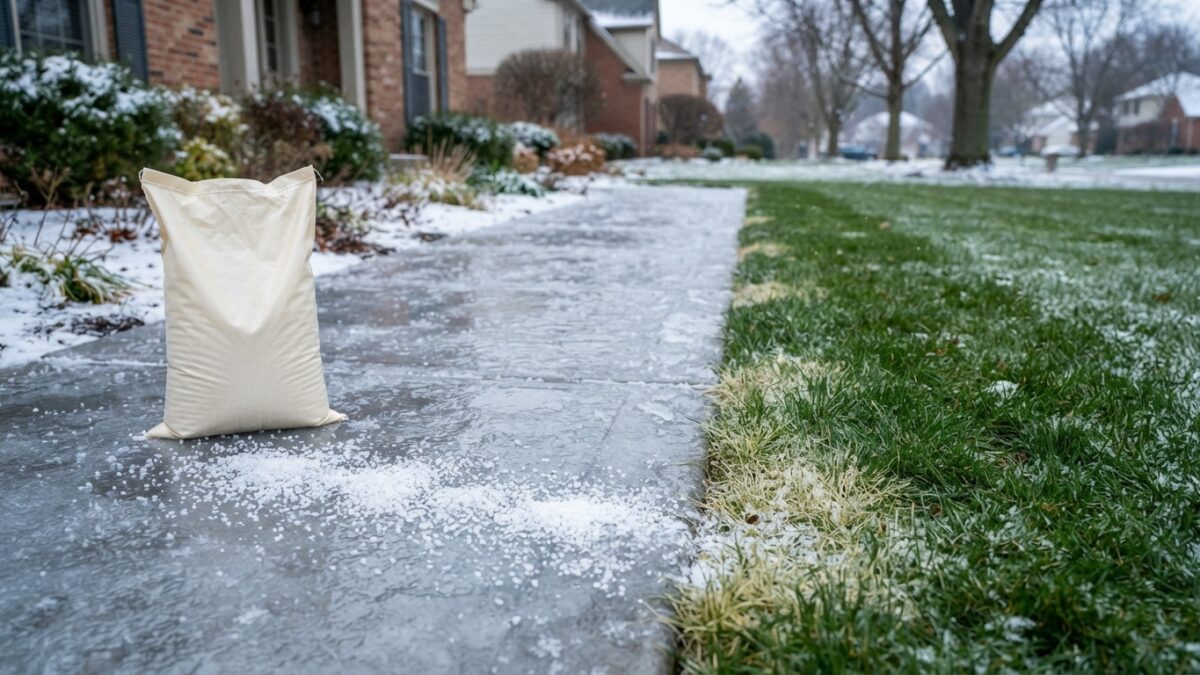
Every spring, northern lawns show the same brown strip along the driveway, the sidewalk and the street. It isn’t winter kill or disease. It’s salt. Deicers that keep paths safe soak into the soil next to them, where they pull water away from grass roots and damage the soil itself.
This guide ranks six deicers by how safe they are for grass, using guidance from Iowa State, UW-Madison and UConn, then covers how much to use and how to repair damage. MowReview quotes no prices and hasn’t tested the products mentioned. How we research explains why.
How salt damages a lawn
Iowa State Extension explains that salt can cause “physiological drought,” in which plants can’t take up water even when the soil is wet. The sodium in rock salt also harms soil structure. UW-Madison Extension says damage typically occurs within about 30 feet of salted surfaces, and that in residential areas most damage comes from salt building up in the soil.
Six deicers, ranked for lawns
| Rank | Deicer | Works to about | Effect on plants | Other notes |
|---|---|---|---|---|
| 1 | Sand or traction grit | Doesn’t melt | Not harmful | Traction only; gets tracked indoors |
| 2 | Calcium magnesium acetate (CMA) | -15°F | Little or no damage | Salt-free; 20 to 30 times the cost of rock salt; can be hard to find |
| 3 | Potassium chloride | Not stated | Less harmful than rock salt | Corrosive |
| 4 | Magnesium chloride | -13°F | Less harmful than rock salt, but still damaging if over-applied | |
| 5 | Calcium chloride | -20°F | Slightly less harmful than rock salt | Fast; corrosive to concrete and metal |
| 6 | Sodium chloride (rock salt) | Best above 15°F | Most harmful | Cheapest; sodium damages soil structure |
Source: Iowa State University Extension, “Using Deicing Salts in the Home Landscape.”
What about “pet-safe” ice melts?
Many pet-labeled products are salt- and chloride-free. Morton, for example, says its Safe-T-Pet is “salt- and chloride-free” and melts ice to 10°F, but doesn’t name the active ingredient on its product page. Chloride-free products avoid the chloride that builds up in soil, though “pet safe” on a label isn’t a lawn-safety rating. Read the ingredients.
How to use less of any deicer
- Shovel first. Iowa State says to wait until the snow or ice stops falling, then remove as much as possible before applying anything.
- Use a coffee mug, not a bucket. UW-Madison Extension says a 12-ounce mug of salt can treat a 20-foot driveway or about 10 sidewalk squares.
- Spread grains apart. UW-Madison says grains should be separated, not clumped. A handheld spreader makes this easy.
- Mix in sand for traction. Both Iowa State and UW-Madison suggest mixing salt with sand to cut the total salt used.
- Don’t shovel salty snow onto the lawn or around shrubs. Iowa State says not to pile it around trees and shrubs.
- Redirect meltwater away from beds and lawn edges where you can.
Repairing salt damage in spring
- Flush the salt out. Iowa State says to water salt-affected areas thoroughly as soon as the ground thaws in early spring.
- Then reseed. UConn’s home garden program warns that if you don’t flush salts from the soil first, grass seed “may not germinate well.” It also notes that cool-season seed needs soil above 50°F.
- Choose tougher grass for the edges. UConn suggests fescues where salt is a recurring problem.
- Don’t count on gypsum. UW-Madison says gypsum needs good drainage to work, and the soil beside paved areas often drains poorly.
Robot mower owners
Salt and grit along driveway edges can work into wheels and the cutting deck. Give the mower a clean before its first spring run. When to take your robot mower out of storage covers the spring start-up.
The picks
Ranked 2 overall, the safest that melts
Calcium magnesium acetate (CMA) ice melt
- Works toAbout -15°F
- Plant damageLittle or none
- TypeSalt-free
Iowa State’s top chemical choice for plant safety. Use it on the paths that border your lawn and beds, and keep cheaper deicers for areas far from plants.
Good for
- Walks and driveways edged by lawn
- Paths beside foundation plantings
Less good for
- Budgets: Iowa State says it costs 20 to 30 times as much as rock salt
- Last-minute buying: Iowa State notes it’s sometimes hard to find, so stock up early
For extreme cold, in small amounts
Calcium chloride ice melt pellets
- Works toAbout -20°F
- Plant damageSlightly less than rock salt
- SpeedFast
The coldest-working deicer in Iowa State’s comparison, so you need less of it on bitter days. It leaves no visible residue when dry.
Good for
- Northern winters below about 15°F, where rock salt stops working well
- Steps and trouble spots that need fast melting
Less good for
- New concrete and metal railings: Iowa State says it’s corrosive to both
- Lawn edges: it’s still only slightly less harmful to plants than rock salt
To use less of any deicer
Scotts Elite Spreader
- TypeBroadcast spreader
- ProductsLists ice melt, seed and fertilizer
- Edge controlEdgeGuard
Scotts lists ice melt among the products it spreads, and an even spread keeps grains separated, which UW-Madison says is how to use salt efficiently. EdgeGuard blocks one side of the pattern, which helps keep deicer off the lawn edge. The same spreader handles spring seed and fertilizer.
Good for
- Long driveways
- Year-round use on seed and fertilizer
Less good for
- Small paths and steps, where a handheld spreader or a mug is enough
- Long-term repairs: Scotts’ FAQ says it has no mechanical warranty, offering a one-year refund guarantee instead
Questions
What ice melt is safe for grass?
Calcium magnesium acetate (CMA) is the safest chemical deicer for lawns. Iowa State Extension says it causes little or no plant damage and works to about -15°F, though it costs 20 to 30 times as much as rock salt. Sand adds traction without harming plants but doesn’t melt ice.
Does rock salt kill grass?
It can. Iowa State Extension says sodium chloride, or rock salt, is the most harmful deicer to plants, and its sodium also harms soil structure. UW-Madison Extension says damage typically occurs within about 30 feet of salted surfaces.
Is calcium chloride better for lawns than rock salt?
Slightly. Iowa State Extension rates calcium chloride as slightly less harmful to plants than sodium chloride, and it works to about -20°F, but it’s corrosive to concrete and metal.
How much ice melt should I use?
Less than you think. UW-Madison Extension says a 12-ounce coffee mug of salt can treat a 20-foot driveway or about 10 sidewalk squares, spread so the grains are separated. Shovel first, then apply only where needed.
How do I fix salt damage on my lawn in spring?
Flush the salt out first. Iowa State Extension says to water salt-affected areas thoroughly as soon as the ground thaws. UConn’s home garden program says to flush salts before reseeding, or seed may not germinate well, and suggests fescues where salt is a recurring problem.
Does gypsum fix salt damage in lawns?
Not reliably. UW-Madison Extension says gypsum needs good soil drainage to work, and the soil beside driveways and sidewalks often drains poorly, which limits its effect.
The short version
Shovel first, use a mug of deicer rather than a bucket, and spread it thin. Near lawns and beds, choose CMA or sand. Save calcium chloride for bitter cold and rock salt for spots far from plants. Never pile salty snow on the grass, and flush the edges with water as soon as the ground thaws.
Getting the yard through winter
More cold-weather jobs for the lawn and garden.