How MowReview makes money: As an Amazon Associate, MowReview earns from qualifying purchases, at no extra cost to you. We don’t test mowers ourselves; we explain what manufacturers and independent testers report. How we research
Quick answer
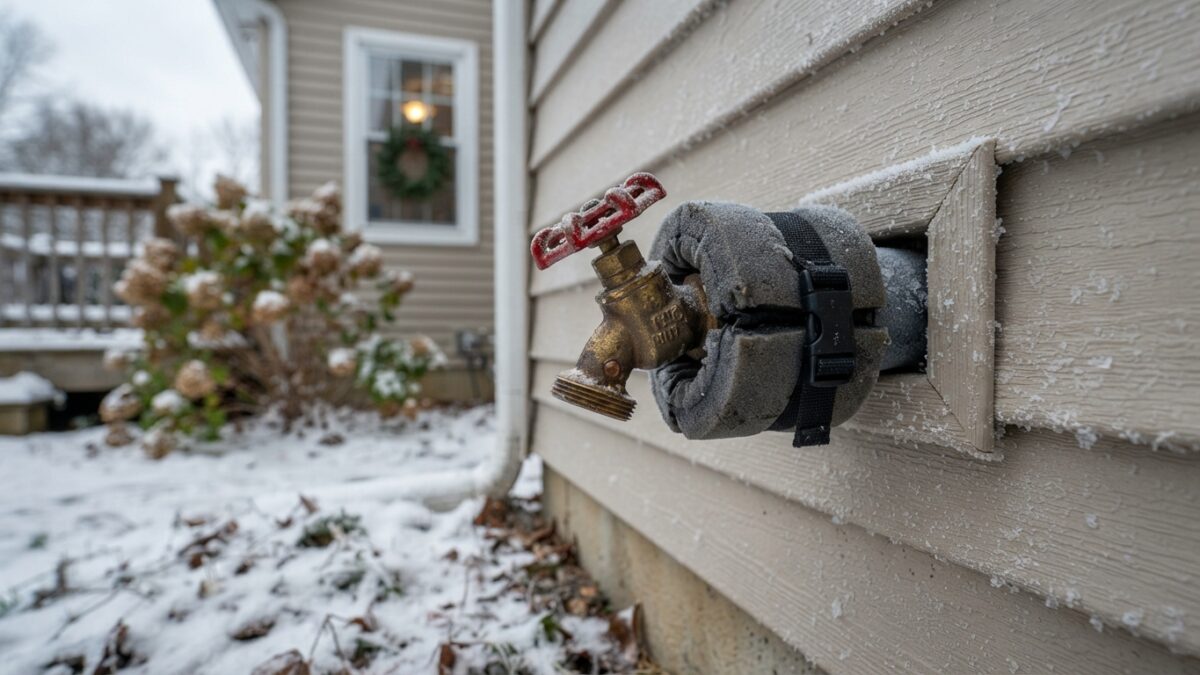
Before the first hard freeze, disconnect and drain the garden hose, close the indoor shutoff valve that feeds the outdoor faucet, then open the outdoor faucet and leave it open so the last water can drain and expand. Those are the American Red Cross’s steps. Then fit an insulated faucet cover. A frost-free spigot does the shutoff for you, but only if you take the hose off: a hose left connected can trap water that freezes inside the valve.
An outdoor faucet is the most exposed piece of plumbing on most houses: a short length of pipe through an outside wall, often in the coldest corner of the basement or crawlspace. When water trapped there freezes, it expands and can split the pipe inside the wall. Often nobody notices until the spring thaw, when you turn on the hose and water pours into the basement.
This guide covers the seven steps to protect an outdoor faucet, how frost-free spigots work, what faucet covers can and can’t do, and how to thaw one safely. MowReview quotes no prices and hasn’t tested the products mentioned. How we research explains why.
7 steps before the first hard freeze
- Disconnect the hose. The Red Cross says to remove, drain and store outdoor hoses. The City of Everett, Washington’s frozen-pipe guide gives the same first step.
- Remove splitters, timers and quick-connects too. A frost-free sillcock manual we checked says sprinkler timers, splitters and manifolds can block drainage and should never be left on.
- Close the indoor shutoff valve that supplies the outdoor faucet. The Red Cross says to “close inside valves supplying outdoor hose bibs.”
- Open the outdoor faucet and leave it open. The Red Cross says to keep the outside valve open “so that any water remaining in the pipe can expand.” If your indoor valve has a small drain cap, open it over a bucket to empty the section between the valves.
- Cover the faucet. An insulated faucet cover slows heat loss from the pipe. Everett’s guide says to insulate outside pipes and faucets.
- Insulate exposed pipes inside. The Red Cross says to insulate both hot and cold pipes in unheated areas such as basements, crawlspaces, attics and garages, using pipe sleeves or UL-listed heat tape or heat cable.
- Find and test your main water shutoff, as Everett advises, so you can stop the water quickly if a pipe breaks.
How frost-free spigots work
A frost-free (or freezeless) sillcock has a long body that runs through the wall, with the actual valve at the inside end. One manufacturer’s manual explains that it “works by shutting off the water in the heated interior of the building,” then drains the outdoor section, so there’s no water left where it’s cold.
Two things make it work:
- It must slope down toward the outside. The manual requires “a 5-degree downward pitch from inlet to outlet.”
- The hose must come off. The manual says to “always remove hose in freezing temperatures to ensure complete drainage.” A connected hose holds water in the valve, where it can freeze and crack it. The manual warns that damage from not following its instructions may not be covered by any warranty.
If you have a frost-free spigot and it still froze, a hose left on over winter is the usual reason.
What faucet covers can and can’t do
A foam faucet cover traps a little heat from the house around the faucet. It’s good protection for mild climates and cold snaps, and a sensible extra layer everywhere. It isn’t a substitute for shutting off and draining in a hard winter. In the Q&A on Tractor Supply’s listing for the Frost King foam cover, one answer says it “will not reliably protect” a faucet at -20°F, and another recommends shutting off and draining the line at -8°F. Frost King’s own representative describes the cover as “water resistant but not waterproof.”
| Your faucet | Minimum protection |
|---|---|
| Standard faucet, cold winter | Hose off, inside valve closed, outside faucet open and drained, plus a cover |
| Standard faucet, mild winter with occasional freezes | Hose off and a cover; shut off and drain before a hard freeze |
| Frost-free sillcock | Hose and attachments off; cover optional |
| Faucet with no indoor shutoff | Cover and pipe insulation now; ask a plumber about adding a shutoff or a frost-free sillcock |
If it freezes anyway
The Red Cross says to keep the faucet open so melting water can flow, and to apply gentle heat with an electric heating pad, a hair dryer, a space heater kept away from flammable materials, or towels soaked in hot water. Never use an open flame: “A blowtorch can make water in a frozen pipe boil and cause the pipe to explode.” Everett’s guide warns that thawing with electrical appliances can risk shock, so keep cords and dryers away from water. If you can’t find or reach the frozen section, call a licensed plumber.
Sprinklers and pools too
The Red Cross also advises draining swimming pool and sprinkler supply lines according to the manufacturer’s or installer’s instructions, and warns against adding antifreeze unless directed. How to blow out a sprinkler system covers irrigation lines.
The picks
An easy extra layer
Frost King foam faucet cover
- MaterialPolystyrene foam shell
- FitStandard single outdoor faucets
- InstallNo tools; reusable
A cheap, reusable cover that slips over a standard outdoor faucet and holds in heat from the house. Tractor Supply lists a 4.7 rating from 84 reviews.
Good for
- An extra layer after shutting off and draining
- Mild climates with occasional freezes
Less good for
- Severe cold on its own: a Q&A answer says it won’t reliably protect at -20°F
- Wet exposure: Frost King says it’s water resistant, not waterproof
- Vinyl siding with gaps: support suggests stuffing insulation around it
The permanent fix
Frost-free sillcock
- How it worksValve shuts off inside the heated wall
- Install5-degree downward pitch
- LengthMatch to your wall thickness
Replaces a standard spigot with one that shuts off inside the house, so there’s no need to find an indoor valve each fall. Many also include a vacuum breaker to stop hose water siphoning back into the supply.
Good for
- Cold-climate homes with standard spigots
- Faucets with no indoor shutoff
Less good for
- Leaving the hose on: the manual says always remove it in freezing weather
- DIY without plumbing experience: it must be installed with a 5-degree downward pitch
- Guessing the length: the valve must sit inside the heated part of the wall
For pipes in unheated spaces
Foam pipe insulation sleeves
- TypePre-slit foam tubes
- FitMatch to pipe diameter
- WhereBasements, crawlspaces, garages
The Red Cross recommends pipe sleeves on both hot and cold lines in unheated areas. Start with the pipe that runs to your outdoor faucet, which is often in the coldest corner.
Good for
- Supply lines to outdoor faucets
- Any pipe in a crawlspace or garage
Less good for
- Severe cold alone: insulation slows freezing but doesn’t add heat; the Red Cross also lists UL-listed heat tape or cable
- Gaps at joints and elbows: tape seams so cold air can’t reach the pipe
Questions
How do I keep my outdoor faucet from freezing?
Remove and drain the hose, close the indoor valve that supplies the outdoor faucet, then open the outdoor faucet and leave it open so trapped water can drain and expand. The American Red Cross recommends these steps. An insulated faucet cover adds protection.
Should I leave my outside faucet open in winter?
Yes, after shutting the indoor supply valve. The American Red Cross says to keep the outside valve open so any water remaining in the pipe can expand without breaking it.
Do frost-free spigots freeze?
They can if a hose is left on. A frost-free sillcock shuts off water inside the heated house and drains the outdoor section, but one manufacturer’s manual says to always remove the hose in freezing temperatures, because a connected hose can trap water that freezes and damages the valve.
Do outdoor faucet covers work?
They help, but they aren’t a substitute for shutting off and draining. In Frost King’s Q&A for its foam faucet cover, one answer says it won’t reliably protect a faucet at -20°F, and another recommends shutting off and draining the line at -8°F.
How do I thaw a frozen outdoor faucet?
Gently. The American Red Cross recommends a hair dryer, an electric heating pad or towels soaked in hot water, with the faucet open, and warns never to use a blowtorch, kerosene or propane heater, or other open flame. Call a licensed plumber if you can’t thaw it.
Where is the shutoff valve for my outdoor faucet?
Usually inside the house, on the pipe leading to the outdoor faucet, often in a basement, crawlspace or utility room near the wall where the faucet is. Also find and test your main water shutoff, as the City of Everett advises, so you can stop the water fast if a pipe breaks.
The short version
Hose off, attachments off, indoor valve shut, outdoor faucet opened and left open, then a cover on top. If you have a frost-free spigot, the only job is taking the hose off. And if a faucet freezes, warm it gently with a hair dryer or warm towels, never a flame.
Winterizing the yard
Sprinklers, batteries and the rest of the cold-weather list.