How MowReview makes money: As an Amazon Associate, MowReview earns from qualifying purchases, at no extra cost to you. We don’t test mowers ourselves; we explain what manufacturers and independent testers report. How we research
Quick answer
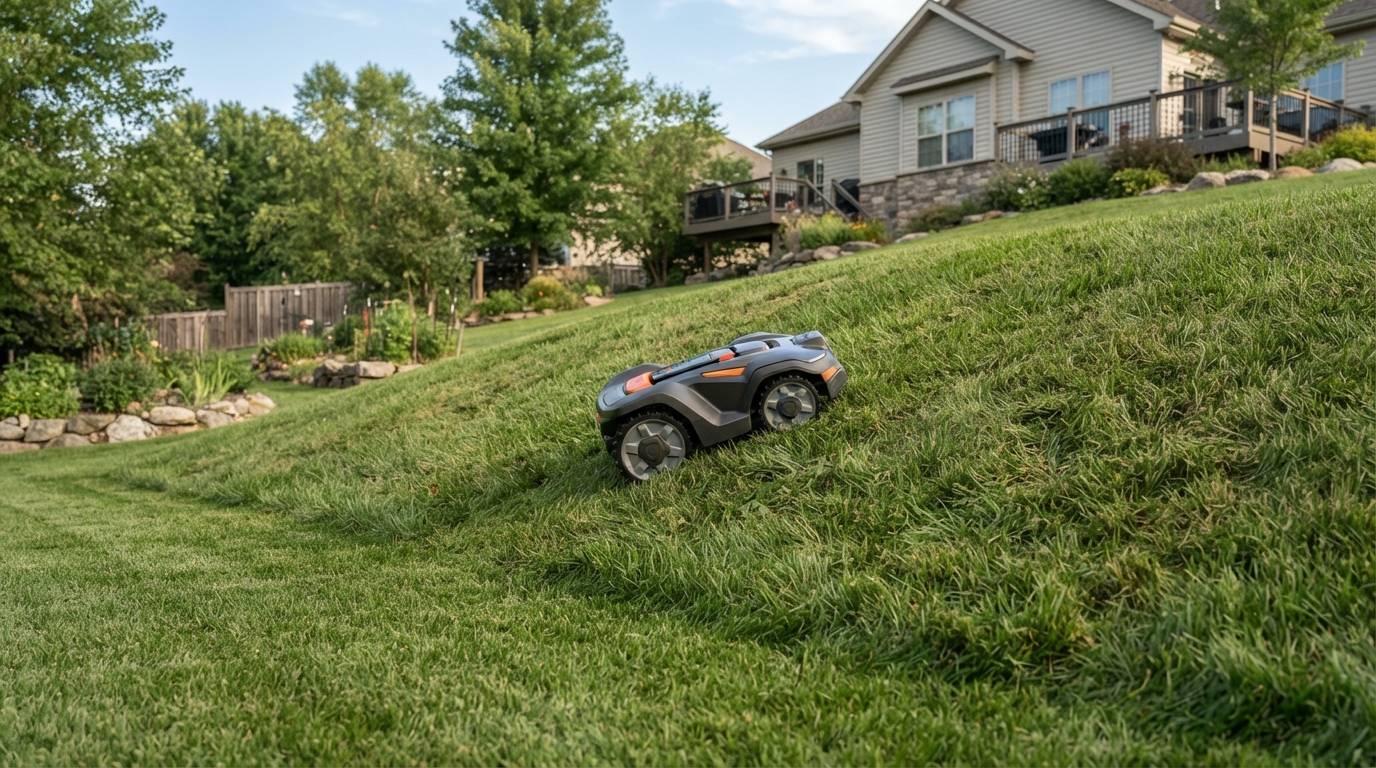
Robot mower slope ratings are usually given as a percent grade, not degrees. A 100% grade is 45 degrees, so a mower rated for “80%” can handle about 39 degrees. Measure your steepest section, convert it, and choose a mower rated comfortably above it, because ratings describe good conditions, not wet grass or sharp dips.
Slope is where robot mower specs mislead people most, usually by accident. “Handles 80% slopes” sounds like a near-vertical wall. It isn’t. And “30%” sounds modest, but it’s a hill you’d notice pushing a mower up. This guide explains what the numbers mean, how to measure your own yard in a few minutes, and how much margin to leave.
Percent grade vs. degrees
A percent grade compares how far the ground rises with how far it runs across. If the ground rises 1 foot over 10 feet, that’s a 10% grade. If it rises 10 feet over 10 feet, that’s 100%, which is a 45-degree slope.
Degrees measure the angle itself. A flat lawn is 0 degrees and a wall is 90.
The two don’t rise at the same rate, which is why the numbers look so different. Most robot mower makers quote percent. Some quote both: Husqvarna, for example, describes one of its ratings as 70%, or 35 degrees.
| Percent grade | Degrees | Rise over 10 feet |
|---|---|---|
| 10% | 5.7° | 1 foot |
| 15% | 8.5° | 1 foot 6 inches |
| 20% | 11.3° | 2 feet |
| 25% | 14.0° | 2 feet 6 inches |
| 30% | 16.7° | 3 feet |
| 35% | 19.3° | 3 feet 6 inches |
| 40% | 21.8° | 4 feet |
| 45% | 24.2° | 4 feet 6 inches |
| 50% | 26.6° | 5 feet |
| 60% | 31.0° | 6 feet |
| 70% | 35.0° | 7 feet |
| 80% | 38.7° | 8 feet |
| 84% | 40.0° | 8 feet 5 inches |
| 100% | 45.0° | 10 feet |
To convert yourself: degrees equals the arctangent of (percent ÷ 100). Any scientific calculator or phone calculator in scientific mode will do it.
How to measure your steepest slope
You don’t need special equipment. Pick one of these methods, and measure the steepest part of the lawn the mower will actually cut, not the average.
Method 1: a board, a level and a tape measure
This is the most reliable method for most yards.
- Lay a straight board (4 feet long is ideal) on the slope, pointing straight downhill.
- Keep the uphill end on the ground and lift the downhill end until a carpenter’s level on the board reads level.
- Measure the gap between the downhill end of the board and the ground, in inches.
- Divide that gap by the board length in inches, then multiply by 100.
Example: a 4-foot board is 48 inches. If the gap is 12 inches, that’s 12 ÷ 48 × 100 = 25%, or about 14 degrees.
Method 2: your phone
iPhones include a level in the built-in Measure app, and many free level apps are available for Android phones. Lay the phone on a straight board resting on the slope and read the angle in degrees. Then use the table above to convert. Laying the phone on a board, rather than directly on the grass, stops bumps from throwing off the reading.
Method 3: a string line for long slopes
For a long bank, push one stake in at the top and one at the bottom. Tie a string to the top stake at ground level, stretch it to the bottom stake, and level it with an inexpensive line level. Measure the horizontal length of the string (the run) and the height of the string above the ground at the bottom stake (the rise). Rise divided by run, times 100, gives the percent grade.
Measure in more than one place
Slopes are rarely even. Measure the steepest few feet you can find, and also any spot where the ground changes sharply from steep to flat, such as the bottom of a bank or the edge of a patio. Those transitions are where mowers struggle most.
Why a rating isn’t a promise
A slope rating is the maximum the manufacturer says the mower can handle in good conditions. Three things commonly reduce what it manages in a real yard:
- Wet grass and soft ground, which reduce grip for any mower.
- Sharp transitions. The UK review site The Robot Mowers found the Mammotion LUBA 3 AWD handled a very steep test bank well, but struggled most where it met flatter ground.
- The optimism of the number itself. Mammotion’s own buying guide acknowledges that manufacturer slope ratings don’t always reflect real-world performance.
Some manuals also give a separate, lower limit for slopes near the edge of the lawn or along a boundary. Check the manual for the model you’re considering before you buy.
How much margin to leave
Our rule of thumb: if your steepest section is within about 10 percentage points of a mower’s rating, treat it as a borderline fit. That means a 35% slope on a mower rated for 45%, or a 70% bank on a mower rated for 80%. Move up to a higher rating if you can, especially if the slope is often damp or ends in a sharp dip.
If only one small area is too steep, you have another option. Most wire-free mowers let you mark it as a no-go zone in the app, so a mower suited to the rest of the yard can skip it.
Typical ratings, by type of mower
| Mower | Drive | Stated slope |
|---|---|---|
| Segway Navimow X430 / X450 | All-wheel | 84% (40°) |
| Mammotion LUBA 3 AWD | All-wheel | 80% (about 39°) |
| Ecovacs GOAT A3000 LiDAR | Rear-wheel | 50% (27°) |
| Worx Landroid Vision WR320 | Two-wheel | 30% (17°) |
The pattern is clear: the highest ratings belong to all-wheel-drive mowers. For the full comparison, see our guide to the best robot mowers for hills and steep slopes.
Questions
Is a 30% slope steep?
A 30% grade is about 17 degrees, a rise of 3 feet over 10 feet. You’d notice it pushing a mower up. It’s at the limit of some two-wheel-drive robot mowers and well within the range of all-wheel-drive models.
How can I measure a slope without special tools?
Lay a straight 4-foot board on the slope, lift the downhill end until a level on the board reads level, and measure the gap to the ground in inches. Divide the gap by 48 and multiply by 100 to get the percent grade. A phone level app laid on the board also works.
Is 45 degrees the same as 45 percent?
No. A 45-degree slope is a 100% grade. A 45% grade is only about 24 degrees. Mixing the two up is the most common mistake people make when comparing robot mowers.
Sources
- Husqvarna: Automower product page and FAQ (70% / 35° example)
- The Robot Mowers: Mammotion LUBA 3 AWD review (slope test)
- Mammotion: Best robot lawn mower 2026 (slope ratings vs. real performance)
- Amazon listing: Segway Navimow X430 (slope rating)
- TechRadar: Mammotion LUBA 3 AWD 3000 review (slope rating)
- Gear Diary: Ecovacs GOAT A3000 LiDAR Pro review (slope rating)
- Bob Vila: The best robotic lawn mowers of 2026 (Worx slope rating)
Know your slope? See which mowers can handle it
With your steepest number in hand, the shortlist gets short quickly.