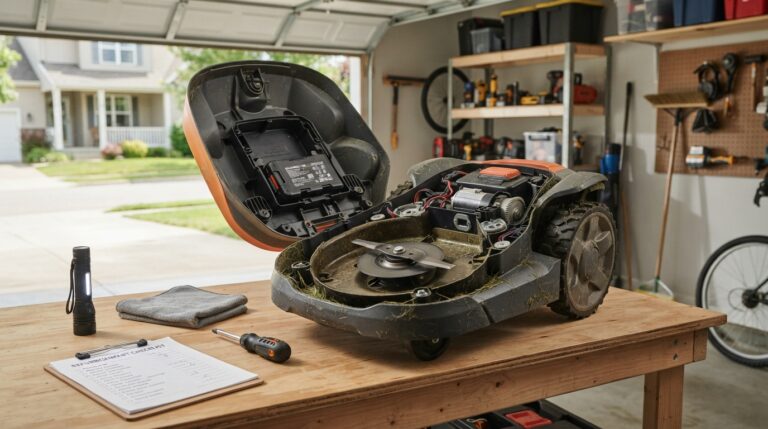
How MowReview makes money: As an Amazon Associate, MowReview earns from qualifying purchases, at no extra cost to you. We don’t test mowers ourselves; we explain what manufacturers and independent testers report. How we research
Quick answer
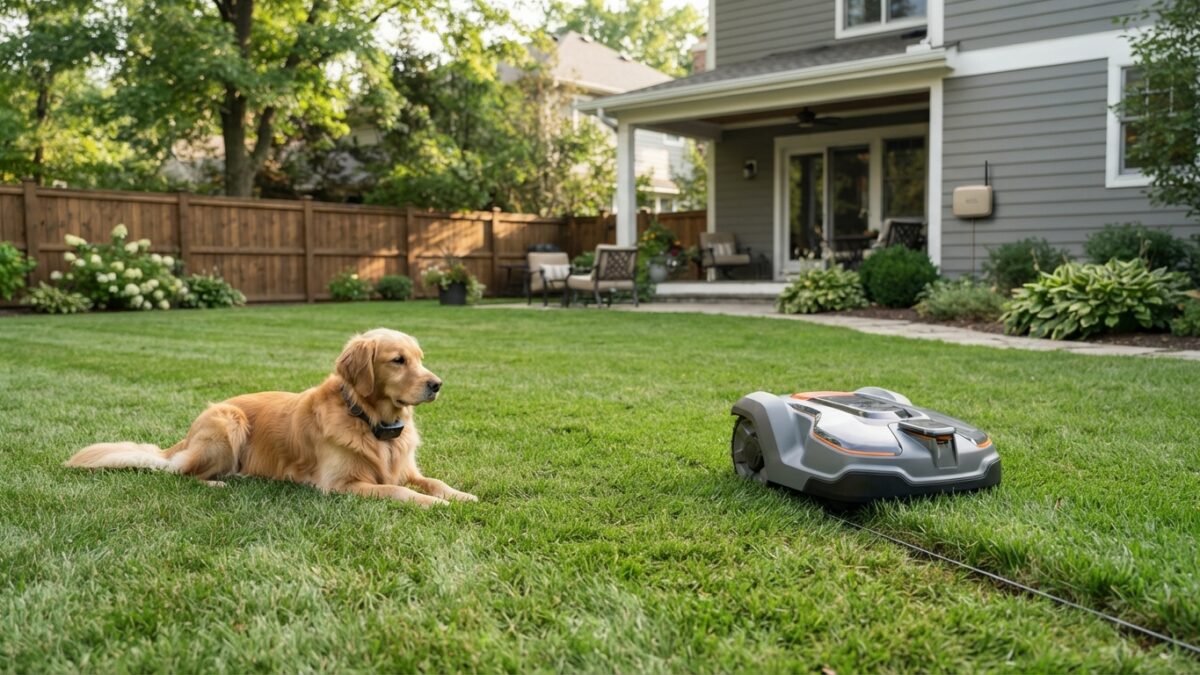
Wired robot mowers and invisible dog fences can share a yard, but they can interfere with each other, and a mower blade can cut a pet-fence wire buried too shallow. The two systems both use buried wire loops and low-frequency radio signals, and Husqvarna’s own installation guidance warns that parallel wires can cancel signals. If you’re planning to keep an invisible fence, a wire-free robot mower (Segway Navimow, Mammotion LUBA, Ecovacs GOAT) removes the interference risk entirely, but the dog is now free in the same yard as the mower, so scheduling and obstacle avoidance become the trade-off.
Invisible dog fences and robot mowers are both common in suburban yards, and both use buried wire. Put them in the same lawn without thinking about it, and you can end up with a dog collar that beeps at the wrong times, a mower that stops mid-run, or, worst of all, a cut fence wire and a dog on the wrong side of it. This guide covers what actually happens, and how to plan around it.
MowReview quotes no prices and hasn’t tested these mowers. How we research explains why.
Why the two systems can clash
Both invisible dog fences and wired robot mowers work the same way at a high level: a transmitter sends a signal down a buried wire loop, and a receiver (the dog’s collar or the mower) senses the signal to decide where the boundary is.
Two wire loops carrying similar signals in the same yard can interfere. Husqvarna’s own installation guidance says to keep parallel wires apart to avoid signal cancellation. That page is written about Automower’s own guide wire versus its boundary wire, but the physics apply to any two buried loops. Some pet-fence brands, such as DogWatch, market compatibility with robot mowers because their signal uses FM rather than AM, and they say FM is “less susceptible to interference from other signals.” Take that as a manufacturer’s claim, not an independent test.
What we couldn’t find is any robot-mower manufacturer publishing a specific separation distance from an invisible pet fence. So the honest guidance is: keep them as far apart as the yard allows, test the dog’s collar before every mowing run for the first few weeks, and note where the mower’s boundary and the pet fence overlap.
The blade-versus-wire problem
Check the pet fence’s burial depth
PetSafe’s installation guidance is to bury the invisible fence wire 1 to 3 inches deep, or to run it through PVC or a garden hose where burial isn’t practical. The lowest robot mower cutting height is about 0.8 inches (many models start higher). If a pet fence wire migrates toward the surface, for example through frost heave over a Northern winter, a mower blade running near ground level can nick it. Before installing a robot mower, walk the pet fence line and probe the depth in a few spots.
If you find a wire close to the surface, three fixes work:
- Rebury it deeper where the manufacturer allows.
- Run it through PVC or garden hose in the shallow sections, which PetSafe explicitly permits.
- Raise the mower’s minimum cutting height so the blades never reach ground level. Every mower has a minimum, and you can set the app higher.
Wire-free removes the wire problem, adds a dog problem
A wire-free robot mower doesn’t have a boundary loop. Segway Navimow, Mammotion LUBA, Ecovacs GOAT and Worx Landroid Vision all use satellite, LiDAR or camera navigation. That takes electromagnetic interference off the table.
What it doesn’t fix is what happens when the mower and the dog share the same yard. The dog is still contained by the invisible fence, and the mower is inside that same containment area. Options:
- Schedule around the dog. Run the mower while the dog is inside, at dinner, or overnight. Most brands let you set a schedule by day and time.
- Give the dog its own zone. Map a no-go zone around the dog’s usual play area, so the mower stays away from that patch.
- Pick a mower with obstacle avoidance. Camera-equipped mowers such as Mammotion’s LUBA 3, Ecovacs’s GOAT and Husqvarna’s AI-vision Automower models are designed to detect animals and slow or stop. None publishes formal pet-safety testing, so treat this as a backup rather than the plan.
Our robot mowers and dogs guide covers pet safety in more depth.
The picks
LiDAR plus 300+ obstacle types
Mammotion LUBA 3 AWD
- BoundaryVirtual, RTK plus LiDAR
- Object detectionStated 300+ obstacle types
- No-go zonesUp to 50 per mowing area
Wire-free with layered navigation, and Mammotion allows up to 50 no-go zones per area, which is useful for cordoning off a dog’s play patch. Its LiDAR helps in shaded yards where an RTK-only mower can lose signal.
Good for
- Multiple pets and multiple no-go zones
- Yards partly under tree cover
Less good for
- A smooth app: PCWorld found connectivity “a little spotty”
- Carrying: PCWorld called it “not fun to lift”
Wired, if the wires can be kept apart
Husqvarna Automower 435X AWD
- BoundaryBuried wire
- Obstacle sensingUltrasonic, plus collision sensor
- SupportUS dealer network
A wired Automower can share a yard with an invisible dog fence if the two wires are kept apart. A Husqvarna dealer installs the mower’s boundary wire and can plan a route that stays clear of the pet fence loop. This model senses obstacles ultrasonically rather than with a camera, so it won’t recognize a dog as a dog: keep the dog indoors while it mows. Frost Guard and Rain Guard handle the weather.
Good for
- Owners who already have a wired setup and want dealer support
- Shaded yards where wire-free RTK would struggle
Less good for
- Yards where the pet fence and mower boundary overlap closely
- Anyone avoiding buried wire
How to plan the two systems together
- Walk the pet fence line first. Mark it clearly, and probe the wire depth. If any part is shallower than 2 inches, rebury or sleeve it before installing the mower.
- Test the collar around the whole loop. Do this before you install the mower, so you have a baseline.
- If going wired, plan the mower’s wire to run at least a few feet from the pet fence wire. The two loops shouldn’t share a corridor.
- If going wire-free, plan the mower’s boundary in the app. Draw it inside the pet fence, not on top of it.
- Retest the collar after installation. Walk the pet fence line with the collar receiver in your hand. If the collar beeps in the wrong places, the systems are interfering.
- Set a mowing schedule that doesn’t clash with the dog’s outdoor time.
- Watch the first few runs. A dog seeing a robot mower for the first time can chase it, corner it or attack it. Some settle after a week; some never do.
For yards where the dog and mower share space more closely, see robot mowers and dogs. For fenced yards, robot mowers for a fenced yard covers physical fences.
Questions
Will a robot mower interfere with an invisible dog fence?
A wired robot mower can, because both systems use buried wire and radio signals. Robot mower guide-wire installation guidance warns that parallel wires can cancel each other’s signals. No mower brand publishes a specific separation distance from a pet-containment loop, so keep the two systems as far apart as your lawn allows and test the dog collar before letting the dog out.
Can a robot mower cut an invisible dog fence wire?
If the pet fence wire is buried too shallow, yes. PetSafe’s installation guidance is to bury the wire 1 to 3 inches deep, and a mower blade running at 0.8 inches on the lowest cutting setting can nick a wire that has migrated toward the surface. Check the pet-fence wire’s depth before installing a robot mower.
What if I use a wire-free robot mower?
Wire-free mowers (Segway Navimow, Mammotion LUBA, Ecovacs GOAT) don’t have a boundary wire, so they can’t interfere with the invisible fence. The dog is now inside the same yard as a moving machine, though, so you’ll need to schedule the mower around the dog or keep the dog inside during runs.
How deep should I bury an invisible dog fence to avoid mower blades?
PetSafe says 1 to 3 inches, or run the wire through PVC or a garden hose where burial isn’t practical. In areas where frost heave might push wires up, bury deeper if the manufacturer allows, and re-check depth after winter.
My dog runs after the robot mower. What can I do?
Schedule the mower for times the dog is indoors, or map the mowing area to include a no-go zone around the dog’s usual play area. Robot mowers with camera obstacle avoidance stop or slow for dogs, but no manufacturer publishes formal pet-safety testing.
Can I run the robot mower’s charging station on the same GFCI outlet as the invisible fence transmitter?
Usually yes, if the outlet has enough capacity. Both are low-power devices. Check the outlet is GFCI-protected (the National Electrical Code requires GFCI protection on outdoor receptacles).
The short version
Two buried wire systems in one yard can interfere, and a shallow pet-fence wire can be nicked by a mower blade. Wire-free robot mowers remove both problems and put the mower and dog in the same yard, which is a scheduling problem instead. Check the pet fence’s depth, keep any two boundary wires apart, and test the dog’s collar before and after installing the mower.
Pets are one factor. Grass and slope are others.
Match a mower to the full picture of your yard.