How MowReview makes money: As an Amazon Associate, MowReview earns from qualifying purchases, at no extra cost to you. We don’t test mowers ourselves; we explain what manufacturers and independent testers report. How we research
Quick answer
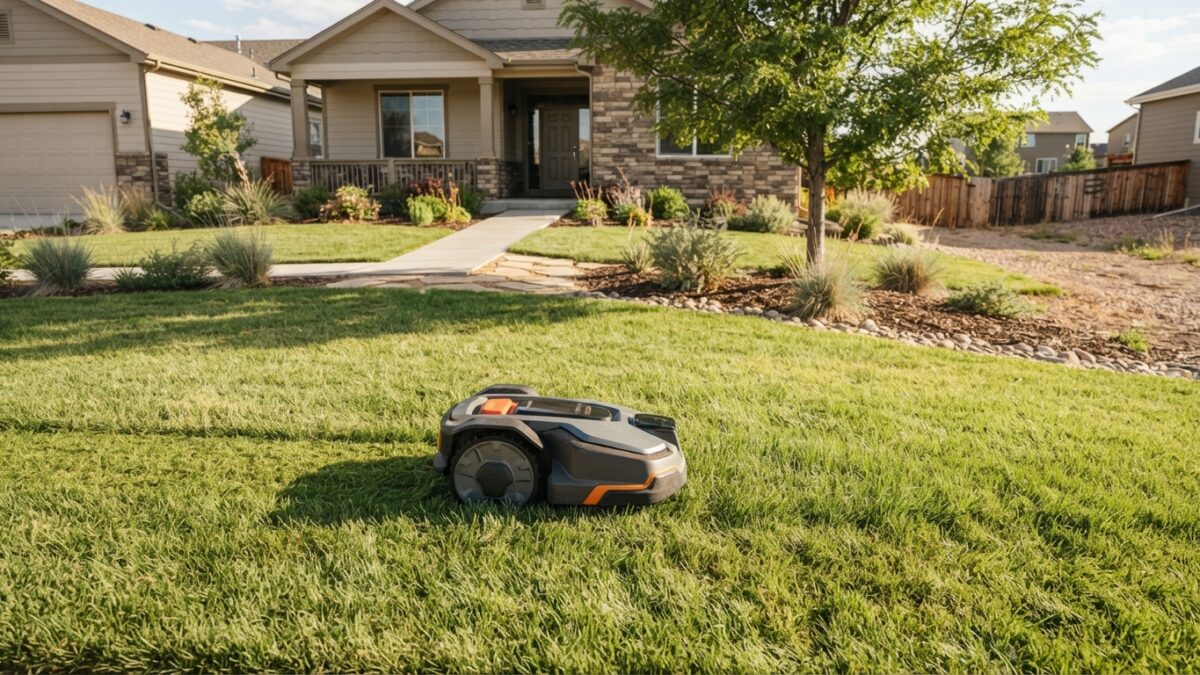
Buffalo grass (the native North American Bouteloua dactyloides, not the Australian name for St. Augustine) is one of the easiest grasses to match on height: extension services put it at about 2 to 3 inches, which every popular robot mower’s range covers. The harder question is whether a robot mower is the right tool at all. Many buffalo grass owners chose it because they wanted a low-water native lawn they could mow once a season, or never. A robot mower crossing it every day is the opposite of that reason. If you do want it mown, the Navimow X430, the Navimow H-series and Husqvarna’s 435X AWD all fit the height range and suit its full-sun, low-water niche.
Buffalo grass is a native warm-season grass of the Great Plains, and it’s the lawn grass Colorado State, Kansas State and Nebraska Extension all point to for people who want less water, less mowing and less fertilizer. It’s not one of the mainstream Southeast or Northeast lawn grasses; if you’re not east of the Rockies and west of the Mississippi, you probably don’t have it.
This guide covers what buffalo grass needs, which robot mowers fit its height, and the honest question of whether a robot mower is the right choice for a grass most owners buy to avoid mowing. MowReview quotes no prices and hasn’t tested these mowers. How we research explains why.
How high buffalo grass should be cut
| Source | Recommendation |
|---|---|
| Colorado State University Extension | About 2 in weekly for irrigated lawns; natural unmowed height is only 3 to 6 in |
| University of Nebraska Turf | 2 to 3 in for best quality; unmowed reaches 8 to 12 in |
| Kansas State Turfgrass | 2 to 3 in mowed; “may not have to be mowed at all”; mowing removes male pollen stalks |
Sources: CSU Extension buffalograss lawn guide and Garden Notes 565; UNL Turf establishment guide; K-State Turfgrass and K-State Ford County guide.
Which robot mowers fit
Every popular US model’s range covers 2 to 3 inches:
- Full range for buffalo grass: Segway Navimow X430 (0.75 to 4), X3 (2 to 4), i-series (2 to 3.6), H-series (1.2 to 2.4); Mammotion LUBA 3 AWD standard (1.0 to 2.7) and H (2.2 to 4.0), LUBA mini AWD standard (0.8 to 2.6) and H (2.2 to 4.0), YUKA mini H (2.0 to 3.5); Ecovacs GOAT A3000 LiDAR (1.2 to 3.6); Worx Landroid Vision (1.57 to 3.54); Husqvarna Automower 435X AWD (1.2 to 2.8); Dreame A3 AWD Pro (1.2 to 3.9).
Height doesn’t narrow the field, so the choice comes down to lawn size, slope and how you want to run it.
The real question first
Is a robot mower even what you want?
Colorado State, Nebraska and Kansas State all note that many buffalo grass owners choose it for the water and mowing savings. Kansas State’s Ford County guide says it “may not have to be mowed at all,” and only needs mowing to remove pollen stalks. A robot mower that trims every day is designed to make sure the grass never gets long, which is the opposite of the buffalo grass philosophy. If your reason for planting buffalo grass was to mow less, a robot mower is the wrong tool. A conventional walk-behind or push mower, used once or twice a season, matches how the grass was intended to be used.
Where a robot mower does suit a buffalo grass lawn:
- You want a manicured, low-cut buffalo grass front yard that looks like a conventional lawn.
- You’re combining buffalo grass with a small area of blue grama or other native grass and want them all trimmed.
- You’re old, disabled or short on time, and even the occasional mow is a chore.
- You just want to remove the pollen stalks reliably without pushing anything.
If none of those describe you, save the money.
The picks (if a robot mower does fit)
Fine height steps, drought-friendly schedule
Husqvarna Automower 435X AWD
- Stated cutting height1.2 to 2.8 in
- WeatherFrost Guard and Rain Guard
- DriveAll-wheel drive
Height adjustment in eighth-inch steps and dealer support suit a lawn where you want to hold a precise 2 to 2.5 inches. Husqvarna’s Frost Guard also parks the mower at or below 41°F, useful in the high-plains cool mornings, and Rain Guard pauses on forecast rain, useful when the mower shouldn’t be running on the dry, dormant turf drought inevitably brings.
Good for
- Manicured buffalo grass lawns on the Plains
- Owners who want dealer installation and service
Less good for
- High-elevation front-range lots: performance is best below about 6,500 feet
- Blade costs on a lightly used lawn: Husqvarna says blades typically last 3 to 6 weeks
- The “no-mow” philosophy
Setting up on buffalo grass
- Cut back the schedule. Buffalo grass grows slowly, so a mower running every day is wasted energy. Two or three sessions a week matches how the lawn actually grows.
- Watch for wear paths. Colorado State says buffalo grass doesn’t tolerate concentrated constant traffic. If a track shows in front of the dock or along a boundary, reshape the map. Will a robot mower damage my lawn? covers wear paths.
- Pause in drought dormancy. Buffalo grass browns off in extended drought and greens up when rain returns. Mowing dormant turf adds wear without helping.
- Pause in winter. As a warm-season grass, it stops growing in cold weather. Robot mower winter storage covers what to do.
Other things buffalo grass asks of a mower
Full sun
Colorado State says it’s “not a good lawn choice” with more than half a day of heavy shade, and Kansas State says it makes almost no growth in heavy shade. That suits satellite-based robot mowers, whose RTK antennas need clear sky anyway.
Moderate traffic tolerance
Colorado State says it handles occasional heavy use but not concentrated constant traffic. On a lawn where the kids play, or on the dog’s route, you may still want a conventional mower and less frequent traffic.
Not for elevation
Colorado State caps buffalo grass performance around 6,500 feet. Above that in the Rockies, other native grasses (like blue grama or fine fescues) fit better. See robot mowers for fine fescue lawns.
If your Plains or Western lawn is a different grass, or you’re mixing buffalo grass with cool-season turf, see robot mowers for Kentucky bluegrass and robot mowers for tall fescue.
Questions
What height should a robot mower cut buffalo grass?
For a conventionally mown lawn, Colorado State recommends about 2 inches, and Nebraska Extension gives 2 to 3 inches. Kansas State also gives 2 to 3 inches, and notes some owners don’t mow buffalo grass at all, letting it stay at its natural 4 to 8 inches.
Should I even use a robot mower on buffalo grass?
Only if you want a conventionally mown lawn. Many buffalo grass owners choose it precisely because it grows slowly and can be left unmown or mowed once or twice a season. A robot mower running daily runs counter to that reason for planting it.
Which robot mowers suit buffalo grass?
Every popular robot mower’s range covers 2 to 3 inches, including the Navimow X430, X3, i-series and H-series, the Mammotion LUBA 3 AWD (both versions) and LUBA mini AWD, the YUKA mini H, the Ecovacs GOAT A3000 LiDAR, the Worx Landroid Vision, the Husqvarna 435X AWD and the Dreame A3 AWD Pro.
Does buffalo grass need full sun?
Yes. Colorado State says buffalo grass “is not a good lawn choice” with more than half a day of heavy shade, and Kansas State says it makes almost no growth in heavy shade. It’s a full-sun grass, which suits satellite-based robot mowers with clear sky.
Can buffalo grass handle a robot mower’s daily wheel traffic?
Only moderately. Colorado State says buffalo grass handles occasional heavy use but not concentrated constant traffic. It’s not the grass for a sports field or a busy dog run, and a robot mower crossing the same turns every day may show wear paths on soft turf.
Where does buffalo grass grow best?
Native to the North American Great Plains: eastern Colorado, Kansas, Nebraska, western Oklahoma, the Texas panhandle, the Dakotas, and eastern Wyoming and Montana. Colorado State caps performance around 6,500 feet of elevation.
The short version
Buffalo grass wants 2 to 3 inches, and every popular robot mower’s range covers that. What decides it is your reason for choosing the grass. If it was to stop mowing, a conventional mower used once or twice a season fits better than a robot running every day. If it was for a manicured, low-input front yard, the Husqvarna 435X AWD, the Navimow X430 and the H-series all suit it. Keep it off dormant turf, avoid worn tracks, and remember it’s a full-sun grass.
Grass is one number. Size and slope are the others.
Check that a mower suits your lawn’s area and steepest slope too.