How MowReview makes money: As an Amazon Associate, MowReview earns from qualifying purchases, at no extra cost to you. We don’t test mowers ourselves; we explain what manufacturers and independent testers report. How we research
Quick answer
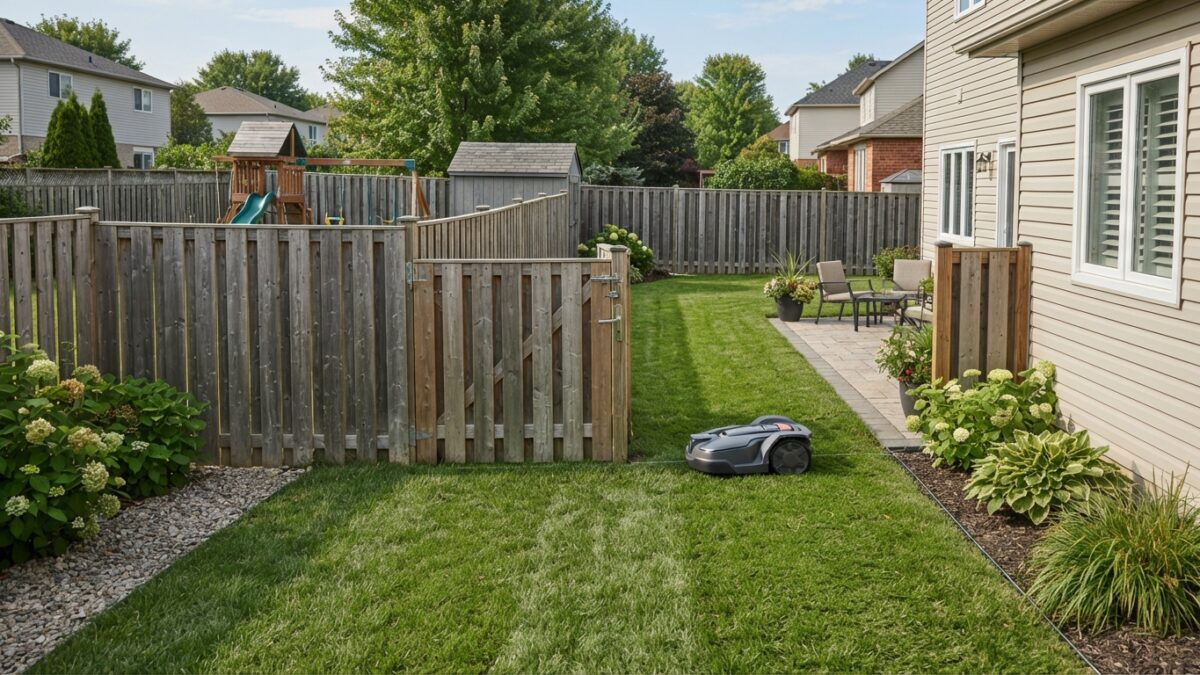
A fenced yard suits a robot mower well: the fence keeps children, pets and neighbors on the right side, and it defines a clear working area. What decides which mower fits is how the fence is built. Solid, flush-to-ground fences are easy. Chain-link with a low bottom rail, gaps under wood panels, or a gate that has to stay closed between the front and back yard all need thought. Manufacturers give specific border distances from raised fences (Worx recommends 26 cm from a step edge; Husqvarna’s Automower manual sets distances by obstacle height). For a front-and-back-yard fenced lot, Husqvarna’s Automower Fence Door and Segway’s MowGate are the two accessories that make it work automatically.
Fenced yards are the most common setup in suburban America. A robot mower behind a fence stays home, doesn’t stray onto a road, and is less likely to be stolen than one on an open lawn. But a fence isn’t just a box, it’s a boundary the mower interacts with every time it turns, and the details matter.
This guide covers the manufacturer distances, the chain-link and gap problems, gates, and how to choose between wired and wire-free for a fenced lot. MowReview quotes no prices and hasn’t tested these mowers. How we research explains why.
How close to the fence the mower can go
The rule for every brand is that the mowing boundary sits inside the fence, not right at it. That leaves an uncut strip along the fence, and it’s decided by the manufacturer’s stated border distance.
| Brand | Stated distance |
|---|---|
| Worx Landroid Classic | 26 cm (about 10 in) from a step, gravel or drop; 10 cm from a flat edge |
| Worx Landroid Vision | Recommends a magnetic strip along the fence or a 5 cm (2 in) grass-free path |
| Husqvarna Automower | Wire distance varies by obstacle height; the manual supplies a physical gauge and the operator’s manual states different distances depending on what’s next to the working area |
| Navimow (all US series) | Draw the boundary manually along the fence, allowing enough margin for the mower’s body plus its bumper |
| Mammotion LUBA / YUKA | Draw the boundary manually by driving the mower around the perimeter |
From each brand’s US installation guides and support documentation. For the uncut strip, our edge-cutting guide covers what’s left and how to fix it.
Gates: the biggest fenced-yard problem
Most American backyard lots are fenced only in back, with a gate leading to the front yard. That gate is the reason a lot of fenced-yard installs fail. Closed, it blocks the mower from mowing the front. Open, it lets the mower out, and sometimes the dog.
Manufacturers have solved this in two ways:
- Husqvarna Automower Fence Door: a purpose-built door that opens automatically as the Automower approaches and closes behind it. Husqvarna lists compatibility with the 410 iQ, 415X, 420 iQ, 430X and H, 440 iQ, 450X and H, and 520 and H. Fit depends on the gate dimensions, and one review found a small residential gate wouldn’t accept it.
- Segway MowGate: an auto-opening pet-safe gate for Navimow mowers. Same idea, different brand.
Without one, you have three options: keep the front and back as separate mowing zones and carry the mower between them; leave the gate open when the mower runs, if the yard is otherwise secure; or run the mower only in the back yard and cut the front by hand.
Chain-link and low rails
Chain-link fences are common on older suburban lots, especially in the Midwest and Northeast. The bottom rail sits an inch or two above the ground on many chain-link installs, and a robot mower’s front caster can wedge into it. Navimow’s own troubleshooting says “Small ruts, divots, holes, and even bumpy areas can stop the mower.” A raised fence rail is close cousin to a divot.
Before installing on a chain-link yard:
- Walk the fence line looking for the bottom rail and any raised gaps.
- Set the boundary back far enough that the mower doesn’t reach the rail.
- Fill any gaps under the fence with soil, edging or landscape timber.
Wire-free vs wired for a fenced yard
| Situation | Better option |
|---|---|
| Solid privacy fence in an open yard | Either works |
| Chain-link fence, complicated corners | Wire-free (no wire to route along uneven ground) |
| Tall fence with dense foliage above it | Wired or LiDAR-based (satellite signal is weakest here) |
| Yard with a gate you can’t automate | Wire-free is easier to relocate between zones |
| Front and back yards behind one gate | A wired Automower with a Fence Door, or a wire-free mower carried between zones |
Husqvarna’s EPOS wire-free installation guidance notes that tree crowns wider than about 13 feet block satellite signal in that area. A tall solid fence with an overhanging tree does the same. On a shaded fenced yard, a LiDAR mower like the Ecovacs GOAT A3000 or the Mammotion LUBA 3 AWD, or a wired Automower, usually outperforms an RTK-only mower.
The picks
Best for a front-and-back fenced yard
Husqvarna Automower 435X AWD
- BoundaryBuried wire, laid at model-specific distances
- Fence DoorCompatible
- Stated cutting height1.2 to 2.8 in
Husqvarna’s Automower Fence Door is the cleanest solution for a fenced yard split by a gate: the mower carries itself between front and back with no help from you. Wired setup also copes better with tall fences and overhanging trees than RTK-only mowers. Frost Guard and Rain Guard round out the year for the climates most Americans have.
Good for
- Front-and-back suburban lots with a gate
- Shaded fenced yards under trees
Less good for
- Anyone who doesn’t want to bury a wire
- Tall-cut grasses: it stops at 2.8 inches
- Gates too small for the Fence Door
Wire-free with LiDAR for shaded fenced lots
Mammotion LUBA 3 AWD
- BoundaryVirtual, drawn by walking the mower
- Navigation360° LiDAR, RTK, AI vision
- Stated max slope80%
No wire to route around a complicated chain-link corner, and LiDAR that isn’t stopped by a tall privacy fence. It’s sold in a standard version (1.0 to 2.7 inches) and H versions (2.2 to 4.0 inches), so it fits most Northern and Southern lawns behind fences. Up to 50 no-go zones per area let you exclude tricky corners.
Good for
- Chain-link or complicated fence corners without wire hassle
- Fenced yards under tree canopy
Less good for
- Buyers who don’t check the model number: standard vs H matters
- A polished app: PCWorld found connectivity “a little spotty”
- Front-and-back yards without a way through the gate
Compact, no wire, camera-based
Worx Landroid Vision
- BoundaryCamera-based; magnetic strip or grass-free path along the fence
- Stated cutting height1.57 to 3.54 in
- Rated for heatUp to 55°C (131°F)
A compact Vision-guided mower with no buried wire and no RTK antenna. Along the fence, Worx’s approach is a magnetic strip in the ground or a 2-inch grass-free strip the camera recognizes. That suits fences where digging a wire in isn’t practical.
Good for
- Smaller fenced yards without complicated shape
- Southern homes where the mower runs through heat
Less good for
- Thick grass: Bob Vila’s Florida tester found the Vision lost traction in thick lawn
- Leaves and debris in fall: Reviewed found it weak with leaves
- Vision’s edge along a fence: EasyLawnMowing measured an 8- to 10-cm uncut strip
A fenced-yard checklist
- Walk the fence line. Note bottom rails, gaps, warped panels, soft ground under drip lines and any dog holes.
- Decide the gate. Fence Door or MowGate for automatic, or accept two zones you carry between.
- Set the boundary inside the fence. Follow the manufacturer’s stated distance from raised edges, plus a couple of inches for margin.
- Add no-go zones for trap points. A raised rail, an outdoor faucet cluster, a downspout drain grate.
- Check pet safety. Robot mowers and dogs covers running the mower with dogs behind the same fence.
For yards with lots of edges, see robot mowers that cut closest to the edge. For a corner lot with fences on two sides, robot mowers for corner lots covers the extra complications.
Questions
How close to a fence can a robot mower cut?
With manufacturers’ recommended border distances, expect a strip of a few inches along a raised fence. Worx recommends setting the border at least 26 cm (about 10 inches) from a step or gravel edge, and 10 cm (about 4 inches) from a flat one. Husqvarna’s Automower manual gives model-specific wire distances that increase with obstacle height.
Will a robot mower fit through my gate to the front yard?
Only if the gate is open and wide enough. Husqvarna sells an Automower Fence Door that opens automatically as the mower approaches, and Navimow sells an equivalent MowGate. Without one, a closed gate blocks the route between front and back yards.
Can a robot mower get stuck in a chain-link fence?
Its wheels can get stuck in a low rail or a gap under it. Robot mower manufacturers say to keep the working area free of cracks, holes and traps. On a chain-link fence, check the bottom rail and any raised gaps before installing.
Will a robot mower escape through a gap under the fence?
If the gap is wider than the mower and inside the boundary, yes. Wire-free mowers stop at the map boundary you set, and wired ones stop at the buried wire. Set the boundary away from any gap the mower’s body could pass through.
Is a wired or wire-free mower better for a fenced yard?
Both work, but they solve different problems. Wire-free mowers save you routing wire around a complicated fence line but need clear sky for satellite navigation, which tall fences and shrubs can block. Wired mowers work under any canopy but need the buried wire kept away from the fence at the recommended distance.
Does a fence keep robot mower noise from the neighbors?
Solid fences reduce noise from a robot mower more than open ones, and mowers themselves are quiet. Manufacturer noise ratings are typically about 55 to 65 dB(A). For neighbor complaints, see our HOA rules guide.
The short version
Fenced yards suit a robot mower well, but the fence itself is where the setup goes wrong. Keep the boundary inside the fence at the manufacturer’s stated distance, check for gaps and low rails on chain-link, and solve the gate problem with a Fence Door or MowGate. The Husqvarna 435X AWD is the pick for a lot split by a gate, the LUBA 3 AWD suits complicated wire-free installs, and the Worx Landroid Vision fits smaller camera-based setups.
Fenced yards ask for edge planning too.
Check how each mower handles the strip along the fence.