How MowReview makes money: As an Amazon Associate, MowReview earns from qualifying purchases, at no extra cost to you. We don’t test mowers ourselves; we explain what manufacturers and independent testers report. How we research
Quick answer
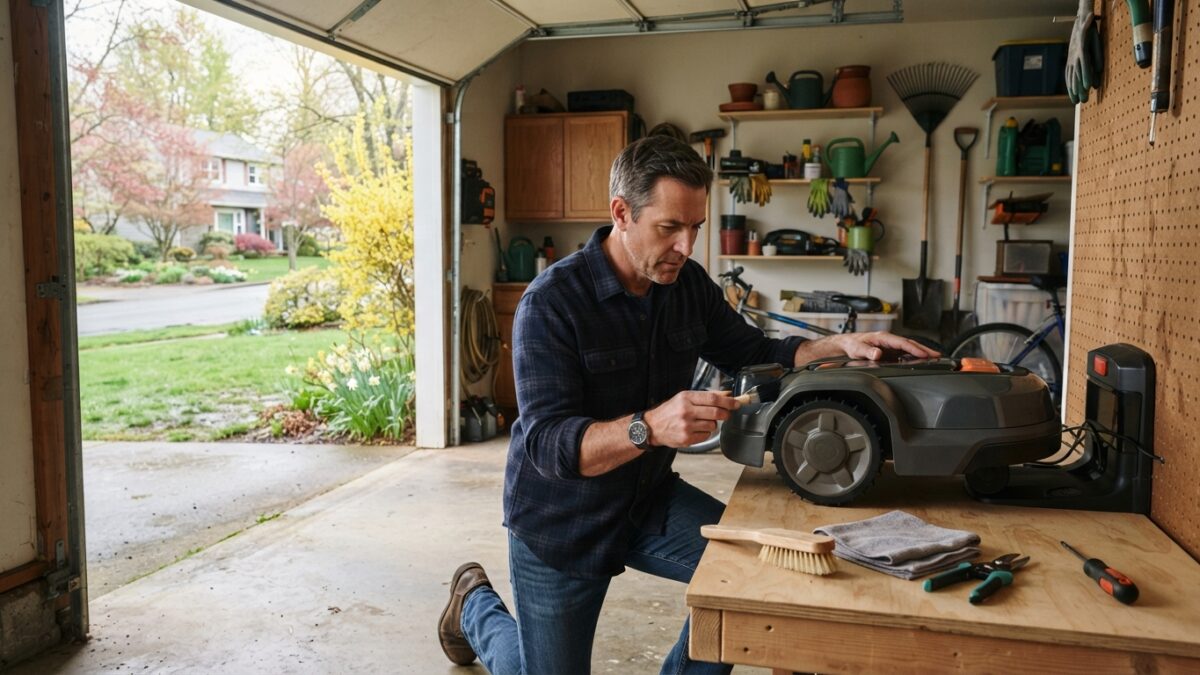
Cold shortens the life of a robot mower’s lithium battery. Don’t operate or charge it in freezing conditions, store it partly charged (manufacturers suggest somewhere between about 50% and 90%, so follow your manual) in a dry, frost-free place, and switch it fully off. Check the level once in midwinter and top up if it’s dropped too far. A well-treated battery lasts years; a frozen or flat one may not.
The battery is the part of a robot mower most likely to need replacing, and cold weather is one of the things that decides how soon. A little care over winter can add years to its life. Here’s what actually matters.
MowReview hasn’t tested these mowers. The guidance below comes from the manufacturers, who don’t entirely agree, so follow your own manual where they differ.
Why cold is hard on the battery
Robot mowers use lithium-ion batteries, the same chemistry as a phone or a laptop. Segway explains that these batteries are sensitive to extreme temperatures, and that operating or charging in freezing conditions can significantly reduce battery performance, shorten its lifespan, or even cause permanent damage.
Two separate things are going on. In the cold, the battery temporarily delivers less, so the mower runs for a shorter time. And charging a lithium battery below freezing can cause lasting damage to it. That’s why the advice isn’t just “don’t mow in winter,” it’s “don’t charge in the cold either.”
The temperatures to avoid
- Don’t charge below freezing. One winterizing guide is explicit: if possible, don’t charge the battery when the temperature is below 32°F.
- Don’t store it where it freezes. Husqvarna specifies storing the mower indoors, in a dry place above freezing.
- Don’t store it somewhere very warm either. Segway warns that a boiler room is often too warm, suggesting a cool but not cold spot, with around 10 to 15°C (50 to 59°F) as ideal.
The target is a dry, stable space that never freezes and never bakes. For most homes that’s an insulated garage, a utility room or a basement. If you don’t have one, our guide on storing a mower with no garage covers the alternatives, including bringing a removable battery indoors.
What charge level to store it at
This is where manufacturers genuinely disagree, so check your manual rather than following a single rule. The published advice ranges across:
| Source | Recommended storage charge |
|---|---|
| Segway (winterizing guide) | About 80 to 90%, then switch fully off |
| Segway (cold-weather article) | Around 50 to 70% |
| Husqvarna | Fully charge, then switch off |
| General lithium best practice | A middle charge, never full or empty for long |
The one point every source agrees on: never store it flat. A deeply discharged lithium battery left for months can drop too low to recover. Beyond that, a partial-to-full charge with the mower switched fully off (not on standby, which keeps draining it) is the safe zone. When in doubt, follow the figure in your own manual.
Check it once in midwinter
Segway suggests checking the charge level around mid-January, and if it has dropped below 40%, recharging for an hour or two. It’s a five-minute job that prevents the battery from slowly draining to a damaging level over a long winter. If your storage space is above freezing, you can charge it there; if not, bring the mower or battery somewhere warmer first.
If your battery is removable
Some mowers have a battery you can take out. Where that’s the case, it’s often recommended to remove it and store it separately indoors, which lets you keep the battery in ideal conditions even if the mower body has to live somewhere colder. Check your manual for whether this applies to your model and how to do it safely.
Winter is also the time to plan a smoother season ahead and to look at any accessories worth having: see use the winter break to plan and accessories worth buying.
A note on battery lifespan
Even well cared for, the battery is a wearing part. Husqvarna gives a typical battery lifespan of 2 to 5 years, and sells replacements. Good winter habits sit at the longer end of that range; freezing, deep discharge and charging in the cold push it toward the shorter end. When the time comes, a replacement battery is far cheaper than a replacement mower, so it’s worth checking that replacements are available for any model you buy.
Don’t confuse cold-weather drop with a fault
A mower that suddenly seems to run for less time as the weather cools usually isn’t broken. Lithium batteries simply deliver less in the cold, and it’s a sign the season is ending. Rather than worrying, take it as the cue to clean the mower and store it for winter. If it’s struggling to get back to the dock, that has its own simple causes: see won’t return to the dock in cold weather.
Questions
What charge should I leave my robot mower battery at over winter?
Manufacturers vary: Segway suggests roughly 80 to 90% in one guide and 50 to 70% in another, while Husqvarna says to charge fully. Follow your own manual. The universal rule is never to store it flat, and to switch the mower fully off rather than leaving it on standby.
Can I charge my robot mower in freezing weather?
Better not to. Charging a lithium battery below freezing can cause lasting damage, and one winterizing guide advises against charging below 32°F. If you need to top up the battery in winter, do it somewhere above freezing.
How long do robot mower batteries last?
Husqvarna gives a typical lifespan of 2 to 5 years. Good winter storage, avoiding freezing, deep discharge and cold charging, helps it last longer. Replacement batteries are available and much cheaper than a new mower, so check they’re offered for your model.
Sources
- Segway Navimow: Cold and wet weather guidance (lithium sensitivity, storage 50–70%)
- Segway Navimow: Winterizing checklist (80–90% charge, ideal storage temperature, midwinter check)
- Husqvarna US support: Temperature ranges for use, charging and storage
- Husqvarna: Automower support guide by season (battery lifespan 2–5 years, full charge before storage)
- Garden Tool Expert: Winterizing a robot mower (don’t charge below 32°F)
Battery care is part of proper winter storage
The full routine, from cleaning to where the dock goes, is in one place.