How MowReview makes money: As an Amazon Associate, MowReview earns from qualifying purchases, at no extra cost to you. We don’t test mowers ourselves; we explain what manufacturers and independent testers report. How we research
Quick answer
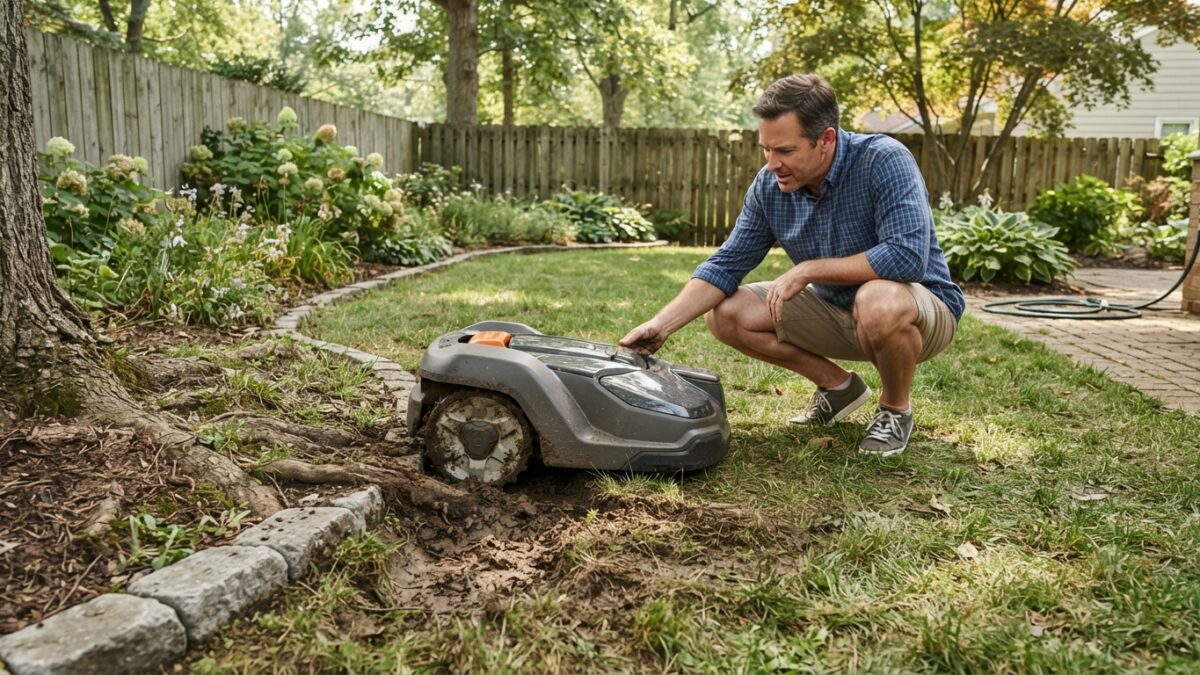
Find out where it happens before you change anything. Most mowers get stuck in the same few spots, and the cause is usually a hollow, an exposed root, a soft or slippery patch, a raised edge, or a gap that’s too narrow. Nearly every fix is free: fill the hollow, raise the cutting height, firm the surface, or draw a small no-go zone around the trouble spot.
A mower that gets stuck once a month is a minor annoyance. One that strands itself every few days quickly stops being worth having. The good news is that this is almost always a yard problem rather than a mower fault, and yard problems are fixable.
No purchase is suggested on this page, because buying something is rarely the answer.
Step 1: Find the pattern
Before changing anything, work out where it happens. Most apps log where the mower stopped, or you can note it yourself over a week or two.
- Same spot every time? Something physical is there. Go and look.
- Different spots, but always after rain? A traction problem.
- Different spots, all over? Look at cutting height, blades and grass length first.
- Always in the same passage between areas? A width or surface problem.
Then walk out and stand where it stopped. The cause is usually visible within a few seconds.
The six common causes
1. A hollow, dip or molehill
The most common one. A wheel drops into a depression and loses grip, or the mower grounds out. Molehills, old post holes, animal digging and settled ground all do this.
Fix: fill and level with topsoil, then reseed. It’s a ten-minute job that solves the problem permanently.
2. Exposed tree roots
Roots near the surface catch the underside of the mower. How-To Geek found the Ecovacs GOAT A3000 less happy on uneven lawns with holes, and roots present the same problem.
Fix: raise the cutting height so the mower rides higher, or mark a no-go zone around the root area. Don’t cut roots to solve a mowing problem, since that harms the tree.
3. Thick grass, especially at edges
Dense growth loads the blades and the drive wheels at once. Bob Vila found one two-wheel-drive mower slipping for traction in thick St. Augustine along the edges of a Florida yard.
Fix: raise the cutting height and mow more often so less is removed each time. If it’s only at the edges, trim those separately for a few weeks and let the mower handle the open lawn.
4. Wet or slippery ground
Damp grass on any slope reduces grip. Areas that stay wet, such as shaded ground or a spot under a downspout, are the usual culprits.
Fix: schedule mowing for the drier part of the day, and mark persistently boggy patches as no-go zones. If drainage is the underlying issue, that’s worth solving for the lawn’s sake anyway.
5. A step, lip or raised edge
Patio edges, paving slabs that have lifted, and the lip where a path meets the lawn. Segway’s X430 listing gives an obstacle height of up to 2.8 inches and notes performance may be limited above that. Other models differ, so check yours.
Fix: measure the lip. If it exceeds the mower’s stated obstacle height, either ease the transition with soil or a ramped edge, or keep the mower away from it with a no-go zone.
6. A passage that’s too narrow
Side gates and gaps between beds. PCWorld saw one mower struggle in gaps only a little wider than the machine, and Bob Vila found another sometimes needed help in narrow sections.
Fix: widen the gap if you can, even by a few inches. Otherwise treat the areas as separate zones. Our guide to multiple zones covers this.
The general fixes, in order of effort
| Try this | Helps with | Effort |
|---|---|---|
| Raise the cutting height | Roots, bumps, thick grass, grounding out | One tap in the app |
| Mow more often | Thick grass overloading the mower | A schedule change |
| Add a small no-go zone | One persistent trouble spot | A minute in the app |
| Change the blades | Struggling in normal grass | Ten minutes |
| Fill hollows and level bumps | The most common physical cause | An afternoon |
| Firm up a soft passage | Gravel, mud, bark chips | An afternoon |
Before you lift it out
Stop the mower with its stop button and follow the manual’s procedure for disabling it before picking it up or reaching underneath. Wear gloves. The blades stay sharp when it’s off.
When it isn’t the yard
A few cases point to the mower rather than the ground:
- It stops in open, flat, clear lawn. That’s more likely a positioning problem than a physical one, and it usually looks like wandering or wavy lines too. See RTK mower losing signal.
- It hits things it should have seen. That’s obstacle detection rather than traction, and what “AI” really means explains how much to expect from it.
- A wheel doesn’t turn freely. Grass and string wrap around axles. Clean them and check they spin.
- It struggles everywhere, in grass it used to handle. Check the blades, then the battery’s runtime.
- It started after an update or a remap. Check the boundary hasn’t shifted over a hard edge, and contact support if so.
The honest limit
Some yards ask more than a particular mower can give. If your lawn is genuinely steep and your mower is a two-wheel-drive model rated for 30%, no amount of levelling will fix that mismatch. In that case the problem isn’t a stuck mower, it’s the wrong mower for the ground, and our slope guide explains what the all-wheel-drive models do differently.
Questions
Why does my robot mower stop in the same spot every time?
Something physical is there. Go and look at that spot: the usual causes are a hollow, an exposed tree root, a raised lip where the lawn meets a path, or ground that stays soft. Filling a dip or raising the cutting height fixes most cases.
Should I fill in the holes in my lawn?
Yes, if a mower keeps getting caught in them. Topsoil and reseeding solve the problem permanently, and a level lawn is better for the grass too. As a temporary measure, raise the cutting height or mark the area as a no-go zone.
Does raising the cutting height really help?
Often, yes. A higher setting lifts the body clear of roots, bumps and uneven ground, and removes less grass at a time so the mower works less hard. It’s the first thing to try because it costs nothing and takes seconds.
Sources
- Amazon listing: Segway Navimow X430 (obstacle height and performance limits)
- How-To Geek: Ecovacs GOAT A3000 LiDAR Pro review (uneven lawns and holes)
- Bob Vila: The best robotic lawn mowers of 2026, tested (traction in thick grass, narrow sections)
- PCWorld: Ecovacs GOAT A3000 review (narrow gaps)
- Segway Navimow: Maintenance guidance (debris jamming wheels, dull blades)