How MowReview makes money: As an Amazon Associate, MowReview earns from qualifying purchases, at no extra cost to you. We don’t test mowers ourselves; we explain what manufacturers and independent testers report. How we research
Quick answer
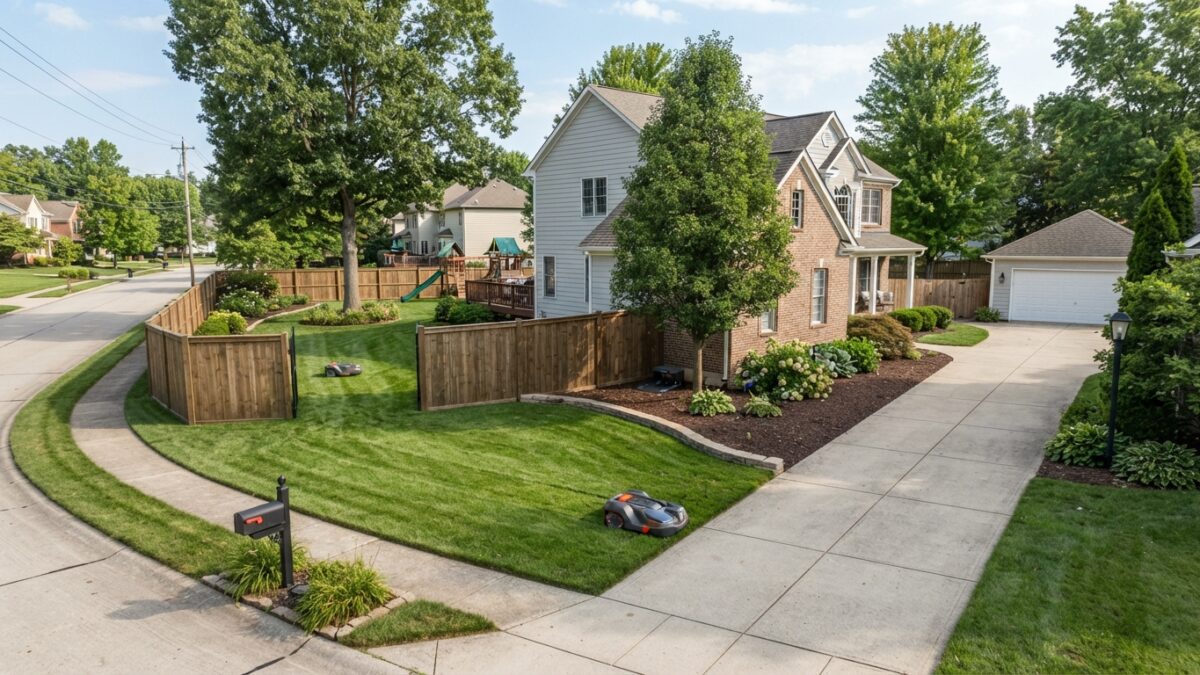
One robot mower can usually handle a front and back yard, as long as the areas together fit within its rated lawn size and it can physically travel between them. Most wire-free mowers let you map several zones in the app. The thing that stops them is rarely coverage, it’s the route: a narrow gate, a gravel path, a step or a driveway crossing.
Very few American lots are one clean rectangle of grass. There’s usually a front lawn, a back lawn, a strip down the side, and something in between them that a mower has to get past. This guide is about that in-between part, which is where multi-zone setups succeed or fail.
How multi-zone mowing works
With a wire-free mower, you map the whole property once, then mark separate work areas within it. You can usually set a different schedule and cutting height for each. The mower drives between them along a route you define, often called a channel or passage.
With a boundary-wire mower, each area needs wire around it, plus a guide wire the mower follows between areas, which is more installation work.
The five things that actually stop a mower between zones
1. The gap is too narrow
This is the most common problem. A side gate, a path between beds, the space between the house and the fence. Measure the narrowest point and compare it with the mower’s width, allowing clearance on both sides. PCWorld saw one mower struggle in gaps only slightly wider than the machine, and Bob Vila found another sometimes needed help in narrow sections of the test yard.
2. The surface changes
Gravel, bark chips, loose stones and soft mud are all harder for a mower to cross than grass or a smooth path. Where a passage crosses one of these, expect to firm it up or lay a smoother strip.
3. There’s a step or a lip
Segway’s listing for the X430 gives an obstacle height of up to 2.8 inches, and says performance may be limited above that. A raised patio edge or a step down to the lower lawn can stop a mower that’s otherwise perfectly capable. Check your own thresholds against the mower’s stated figure.
4. A gate is closed
An obvious one that catches people out. If the route runs through a gate, it has to be open at mowing time. Some owners use an automatic opener; most just schedule the front and back for different days and leave the gate open on the right one.
5. The route loses signal
Side passages are often the shadiest, narrowest parts of a property, hemmed in by a house wall and a fence. That’s the worst case for satellite positioning, which Ecovacs explains is weakened by obstructions and by signals bouncing off nearby metal and glass. A mower that’s fine in both lawns can still lose its place in the corridor between them.
Walk the route before you buy
Take the walk your mower would have to take, from the charging station to the furthest corner of the far lawn. Note the narrowest point, every change of surface, every step, every gate, and how much sky you can see along the way. That walk tells you more than any spec sheet.
What if the mower can’t get between them?
You have three options:
- Improve the route. Widening a gap, firming a gravel strip or easing a step is often cheaper than a second mower.
- Move it yourself. Some owners carry the mower between lawns and dock it in each. This works, but check the weight first. Gear Diary measured the Segway Navimow X430 at 63.7 lb, which is not something to carry twice a week.
- Use two mowers. Two smaller mowers, each with its own dock, can cost less than one flagship and remove the problem entirely.
Sizing for multiple zones
Add every area together and compare the total with the mower’s rated lawn size, then leave margin on top. Multi-zone properties eat into real coverage: the mower spends time traveling between areas rather than cutting, and the routes are often the least signal-friendly parts of the yard.
See what size robot mower you need for how to measure each area.
Practical setup tips
- Put the dock in the larger lawn, in a spot with good sky view and mains power nearby.
- Schedule zones on different days rather than asking the mower to do everything at once.
- Map generous no-go zones around beds and ornaments in the smaller areas, where there’s less room for error.
- Watch the first few crossings. If the mower hesitates in the passage, that’s where to make a physical change.
Questions
Can a robot mower cross a driveway?
Many can cross a smooth, flat driveway as part of a mapped route, though gravel is harder than concrete or asphalt, and a raised lip may exceed the mower’s obstacle height. Also think about traffic: a driveway in regular use is a place you may not want an unattended mower crossing.
How narrow a gap can a robot mower get through?
It varies by model, and manufacturers state a minimum passage width. Measure your narrowest point and allow clearance on both sides. Testers have seen mowers struggle in gaps only slightly wider than the machine itself, so don’t plan to the exact millimeter.
Is it better to buy two smaller mowers?
Sometimes. If your areas are truly separated, by a gate that stays shut, a step or a road, two smaller mowers with their own docks can cost less than one large machine and avoid the crossing problem altogether.
Sources
- Amazon listing: Segway Navimow X430 (obstacle height, performance limits)
- PCWorld: Ecovacs GOAT A3000 review (narrow gaps)
- Bob Vila: The best robotic lawn mowers of 2026, tested (narrow sections)
- Ecovacs: LiDAR vs. RTK robot lawn mowers (obstructions and reflected signals)
- Gear Diary: Segway Navimow X430 review (weight)
- Husqvarna: Automower 450X NERA (work areas and stay-out zones)
Add up every area before you shop
Front, back and side strips all count toward one mower’s capacity.