How MowReview makes money: As an Amazon Associate, MowReview earns from qualifying purchases, at no extra cost to you. We don’t test mowers ourselves; we explain what manufacturers and independent testers report. How we research
Quick answer
Most HOA rules don’t mention robot mowers at all, because they were written before these machines existed. The rules that can still catch you are about visible equipment, permanent installations, noise hours and lawn appearance. Read your own covenants and ask your board in writing before you buy. MowReview can’t tell you what your association allows, and neither can any national guide.
This is one of those questions where an honest answer is more useful than a confident one. Community rules vary enormously between associations, there’s no central register of them, and local ordinances differ too. What we can do is tell you which rules tend to apply and exactly what to ask.
This page has no product recommendations. Nothing about an HOA question is solved by buying something.
If your community contracts its own lawn care, it’s also worth reading whether a robot mower is worth it in the first place.
Why robot mowers usually aren’t mentioned
Most covenants and architectural guidelines were drafted before wire-free robot mowers reached American yards in any number. So there’s rarely a rule saying yes or no. Instead, existing general rules may or may not be read as covering them, which is why asking beforehand is worth the ten minutes.
The four rules that usually matter
1. Visible equipment and structures
The most common sticking point. A robot mower needs a charging station, and satellite-guided models often need a reference antenna mounted somewhere with a clear view of the sky. Many associations have rules about visible equipment, antennas or anything fixed in a front yard.
Worth knowing: the placement rules work against you here. The antenna wants the most open, highest spot, which is often exactly the position an HOA would rather not see. Check this before you buy, because moving the antenna later usually means remapping.
2. Noise and operating hours
Many communities set quiet hours, and some restrict lawn equipment to particular times. Robot mowers are quiet by lawn-equipment standards, and Segway rates its i-series at 58 dB(A), but a rule on operating hours may apply regardless of volume.
In practice this rarely causes problems, because you should be scheduling daytime mowing anyway: Oxford researchers recommend daytime-only mowing to protect wildlife active after dark.
3. Lawn appearance standards
Some associations require lawns to be maintained to a standard, with tidy edges. Many robot mowers leave a strip along walls, fences and beds, so if your community is strict about edging, plan for a trimmer or occasional service visits.
4. Front-yard use and unattended machines
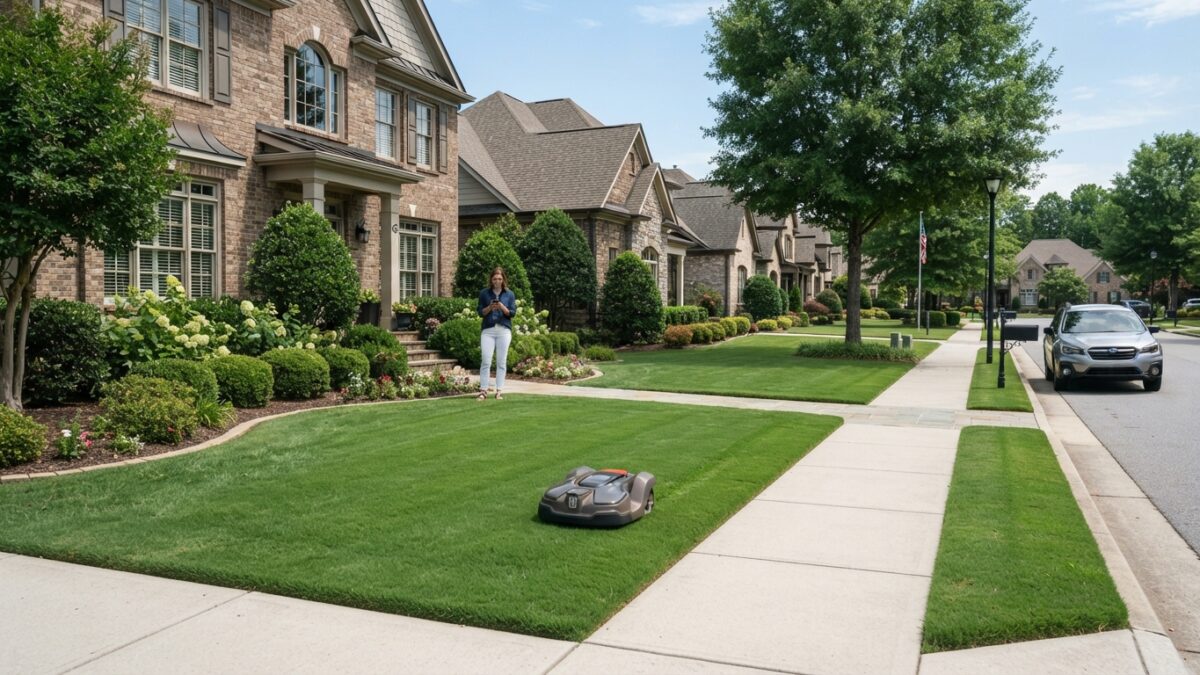
A machine running unattended in a front yard, near a sidewalk where neighbors and children pass, is the situation most likely to prompt questions. Some associations may have a view on it even where nothing is written down.
What to ask your board, in writing
Email is better than a conversation, because it gives you a record. Five questions:
- Do any covenants or architectural guidelines cover robotic lawn equipment?
- Does a charging station in the yard require approval, and are there rules about where it can be visible from?
- Does a small mounted antenna count as an antenna or satellite installation under our rules?
- Are there operating hours for lawn equipment?
- Is there anything about unattended equipment operating in a front yard?
If approval is needed, most associations have an architectural review process, and applying before you buy is far easier than after installation.
Check local ordinances too
Separately from your HOA, your city or county may set noise ordinances or quiet hours that apply to lawn equipment. Your municipality’s website usually publishes these, and a daytime schedule keeps you clear of nearly all of them.
Renting, or in a community with contracted lawn care
Two situations worth flagging:
- If you rent, ask your landlord before installing anything, particularly a mounted antenna or a station needing an outdoor socket.
- If your community contracts lawn care collectively, a robot mower may duplicate a service you’re already paying for through your dues, and the crew may not expect a machine on the lawn. Worth checking who’s responsible for your grass before spending anything.
Also worth reading
If your community keeps large lots, it’s worth comparing a robot mower with a riding mower. In the South, also see what warm-season grasses demand.
Neighbors
Not a rule, but worth a thought. A robot mower running regularly next to a shared boundary is new to most people. Mentioning it beforehand, and keeping to daytime hours, prevents most complaints. If your yards aren’t fenced, make sure your mapped boundary sits comfortably inside your own property line.
Questions
Can my HOA ban a robot lawn mower?
It depends entirely on your association’s governing documents, which vary from community to community. Most don’t mention robot mowers specifically, but general rules on visible equipment, installations, noise hours or lawn standards may apply. Read your covenants and ask your board in writing before buying.
Does the charging station or antenna need HOA approval?
Possibly, if your rules cover visible equipment, antennas or fixed installations. This is the question most worth asking in advance, because the antenna needs an open position with clear sky view, which is often the most visible spot available, and moving it later usually means remapping the lawn.
Are robot mowers too noisy for a close community?
They’re quiet compared with gas equipment; Segway rates its i-series at 58 dB(A). The more likely issue isn’t volume but timing, if your community or municipality sets hours for lawn equipment. A daytime schedule usually satisfies both.