How MowReview makes money: As an Amazon Associate, MowReview earns from qualifying purchases, at no extra cost to you. We don’t test mowers ourselves; we explain what manufacturers and independent testers report. How we research
Quick answer
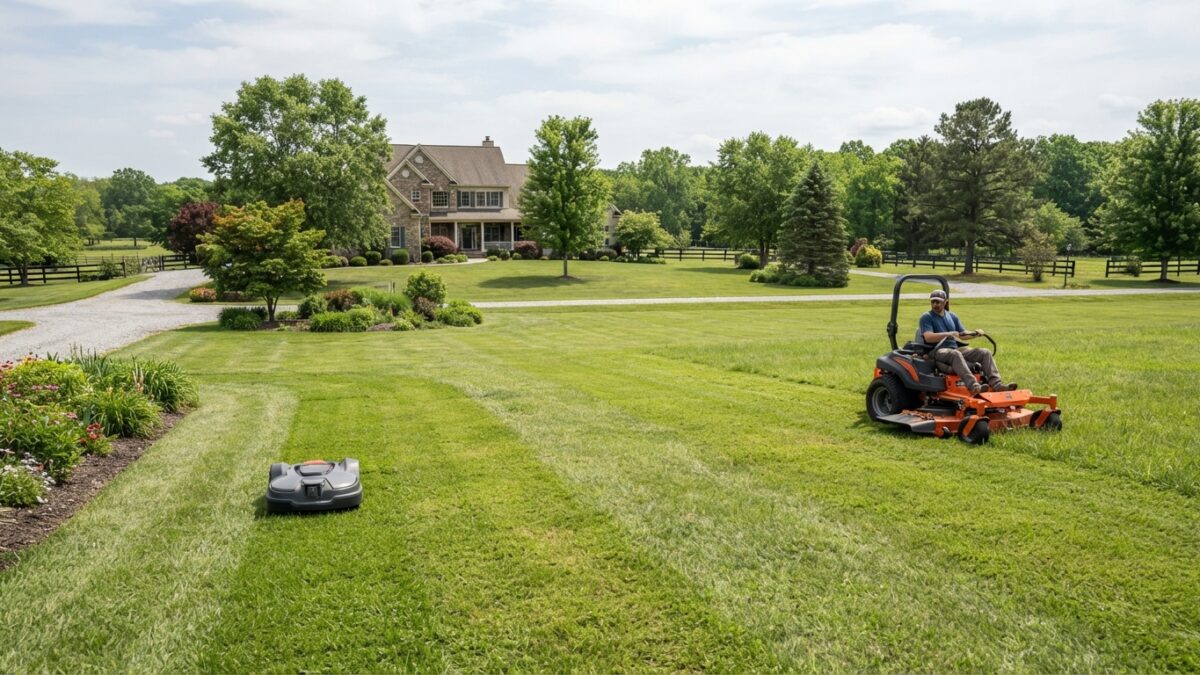
A robot mower can replace a riding mower on a large lawn if your grass is within its rated area, currently up to about 1.5 acres for a single machine, and it can reach every part. A riding mower still wins on very large properties, rough ground, tall or neglected grass, and anywhere you need to collect clippings or tow equipment. Many owners of big properties keep both.
If you already own a riding mower, this isn’t really a question about machines. It’s about whether you want to spend the hours on the seat. Here’s where each one genuinely wins.
Coverage: the hard limit
The largest single robot mower we cover is rated for 1.5 acres, according to How-To Geek’s figure for the Segway Navimow X450. Several models sit around 1.25 acres. Beyond that, one robot mower isn’t enough, and the options are two mowers working separate areas or a robot for the lawn near the house with another method for the rest.
A riding mower has no such limit. It cuts whatever you drive it over, for as long as you keep going.
And remember that these ratings are best cases. On a big property with trees, slopes and separate areas, real coverage is lower. Measure your grass properly first.
Time: the reason people switch
A riding mower is fast, but it needs you in the seat the whole time. A robot mower is slow and needs nobody. Gear Diary found the Navimow X430 completed a large yard faster than any robot mower it had tested, which is still slower than a lawn tractor, but it happened while its owner was doing something else.
The right comparison isn’t how long each takes. It’s how many of your hours each takes.
Slopes
This one surprises people. All-wheel-drive robot mowers are rated for around 80% to 84%, which is roughly 39 to 40 degrees, steeper than most homeowners would be comfortable taking a riding mower across. Riding mowers have their own slope limits, set out in their manuals for good safety reasons, and a rollover is a serious risk.
If part of your property is a steep bank, a robot mower may genuinely be the safer way to cut it. See our guide to mowers for hills and steep slopes.
Where the riding mower still wins
- Very large properties. Above about 1.5 acres of grass, no single robot mower covers it.
- Tall or neglected grass. Robot mowers cut a little and often. They aren’t designed to take a meadow back down.
- Collecting clippings. Robot mowers mulch. If you need bagging, that’s a riding mower job.
- Towing and attachments. Aerators, spreaders, carts and trailers all need a tractor.
- Rough ground and debris. Testers have found robot mowers struggle with holes, exposed roots and bumpy terrain.
- No dependence on signal or apps. A tractor starts when you turn the key.
Where the robot mower wins
- Your time. The whole job disappears from your week.
- Lawn condition. Frequent light cutting keeps grass at an even height, with fine clippings returning to the soil.
- Noise. Segway rates its i-series at 58 dB(A), a different world from a gas tractor.
- No fuel, oil or seasonal engine service.
- Steep banks, where all-wheel-drive models are rated higher than most people would ride.
- Physical ease. No climbing on, no vibration, no hours in the sun.
| Robot mower | Riding mower | |
|---|---|---|
| Maximum area | Around 1.5 acres per machine | Effectively unlimited |
| Your time per week | Almost none | The full mowing time |
| Tall or overgrown grass | Not designed for it | Handles it |
| Steep banks | AWD models rated to about 39–40° | Limited by the manual and by safety |
| Bagging and towing | No | Yes |
| Storage | Small, but must come indoors for winter | Needs a shed or garage bay |
| Running costs | Blades, electricity, battery in time | Fuel, oil, filters, blades, servicing |
The answer most big-property owners land on
Keep both, and give each the work it’s good at. The robot mower takes the lawn around the house, where tidiness matters and where you’d otherwise mow most often. The riding mower handles the far acreage, the rough ground, the seasonal cleanups and anything that needs towing.
That usually means buying a smaller robot mower than you first assumed, since it only covers the area near the house, which also costs less.
Before you compare anything, measure
On a large property, the gap between lot size and actual mowed grass is often huge. Woodland, driveway, outbuildings and paddock all come off the total, and plenty of people find their real lawn is well within a robot mower’s range. See how to measure your lawn.
Questions
Can a robot mower replace a lawn tractor?
On a lawn within its rated area, yes, for routine mowing. It can’t take down tall grass, collect clippings or tow attachments, so if you rely on the tractor for those, you’ll still want it.
Can I use both?
Yes, and it’s a common arrangement on large properties. The robot handles the lawn near the house, and the riding mower handles the outer acreage and seasonal work. It often means you can buy a smaller, cheaper robot mower than you expected.
Are robot mowers safer than riding mowers on slopes?
All-wheel-drive robot mowers are rated for grades of around 80% to 84%, roughly 39 to 40 degrees, and nobody is sitting on them. That said, follow the manufacturer’s slope guidance for any mower, keep a robot out of areas steeper than its rating, and never stand below one working on a bank.
Sources
- How-To Geek: Segway Navimow X430 review (X450 coverage)
- Gear Diary: Segway Navimow X430 review (speed on a large yard)
- Amazon listing: Segway Navimow X430 (slope rating)
- TechRadar: Mammotion LUBA 3 AWD 3000 review (slope rating)
- How-To Geek: Ecovacs GOAT A3000 LiDAR Pro review (uneven ground)
- Amazon listing: Segway Navimow i110N (noise level)
- Husqvarna US support: Winter storage guide (indoor storage requirement)
Measure your grass before you decide
On a big property, the real mowed area is usually far smaller than the lot, and often well within a robot mower’s range.