How MowReview makes money: As an Amazon Associate, MowReview earns from qualifying purchases, at no extra cost to you. We don’t test mowers ourselves; we explain what manufacturers and independent testers report. How we research
Quick answer
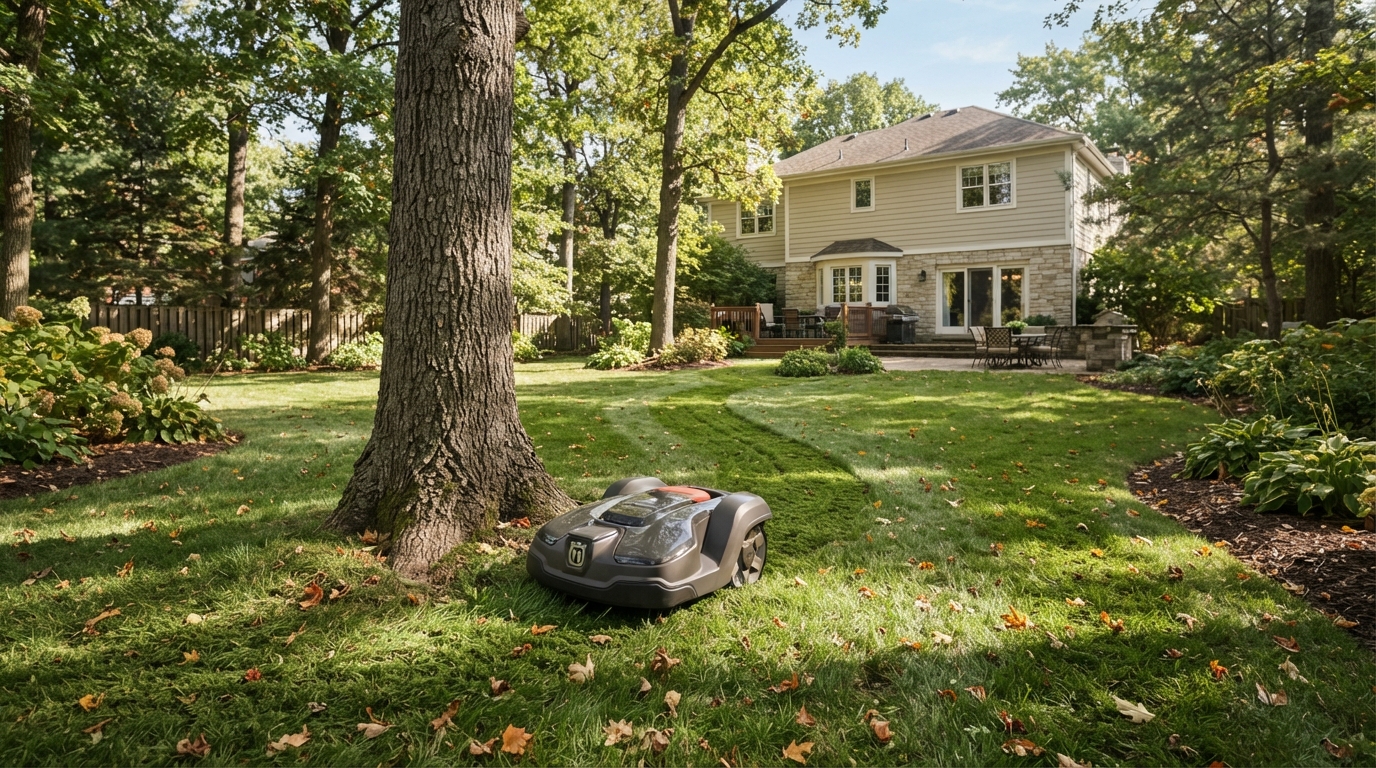
Under heavy tree cover, satellite-only mowers lose their place. Choose a mower that can also see the ground: the Ecovacs GOAT A3000 LiDAR navigates entirely without satellites, and the Mammotion LUBA 3 AWD combines laser scanning and cameras with satellite positioning so it has a fallback. Walk your yard at midday first: the shadiest spots are where any mower will struggle.
Trees are the single most common reason a wire-free robot mower disappoints its owner. The mower works beautifully on the open lawn, then mows crooked lines under the oak, or stops with a signal warning at the shady end of the yard.
This guide explains why that happens, which types of mower avoid it, and how to judge your own yard before you spend anything. MowReview hasn’t tested these mowers. Specifications come from manufacturers, test observations belong to the named testers, and every pick includes a real drawback.
Why trees break satellite navigation
Most wire-free mowers use RTK: satellite positioning corrected by a small reference antenna on your property, accurate to a couple of centimeters in the open. It only works while the mower can see enough sky.
Ecovacs, which sells RTK mowers itself, explains the problem plainly: when a mower moves under dense tree cover, leaves, branches and trunks reduce how much open sky it can use to receive those signals. Nearby metal and glass make it worse by bouncing signals around, which the industry calls multipath.
The result in your yard is wavy lines, missed strips, a mower that pauses and waits, or one that stops and reports a signal problem.
A ten-minute test before you buy
Stand in the shadiest part of your lawn around midday and look straight up. If you can see a wide band of open sky, an RTK mower will probably cope. If you’re looking at a closed canopy of branches, plan for a mower that doesn’t depend on satellites alone. Do this in summer, when the leaves are out, not in winter.
The three approaches, and how they cope with shade
| Approach | How it finds its way | Under heavy trees |
|---|---|---|
| RTK only | Satellites, corrected by an antenna in your yard | Weakest. Needs sky view. |
| RTK + cameras | Satellites, with cameras filling gaps | Better. Cameras help where signal dips, but light and shadow affect them. |
| LiDAR (laser scanning) | Measures distances to build a 3D map of the yard | Strongest. Doesn’t use satellites at all, and works in shade. |
| Boundary wire | A physical wire around the lawn | Unaffected by trees, but you have to install the wire. |
There’s a fourth option people forget: a traditional boundary-wire mower doesn’t care about tree cover at all. If your yard is heavily wooded and fairly simple in shape, a wired mower can be the most reliable answer, and usually the cheapest. The work is in laying the wire. PCWorld recommends hiring a professional to bury it.
Best for heavy shade
Ecovacs GOAT A3000 LiDAR
- Stated lawn size3/4 acre
- Stated slope50% (27°)
- NavigationTwo LiDAR sensors + AI camera
- Antenna neededNone
The GOAT A3000 sidesteps the tree problem entirely. PCWorld describes a 360-degree laser sensor on top plus a forward-facing one with a camera, and notes this removes the need for a satellite antenna altogether. For a yard under a mature canopy, that’s the most direct solution available. Gear Diary found the LiDAR Pro version one of the best set-it-and-forget-it mowers it had used.
Good for
- Lawns under mature trees
- Yards hemmed in by buildings, where satellite signals bounce
- Owners who don’t want an antenna in the yard
Less good for
- Hills: its 50% rating is well below the all-wheel-drive mowers
- Narrow gaps: PCWorld saw it struggle in spots only a little wider than the mower
- Bumpy ground: How-To Geek found it less happy on uneven lawns with holes
Best for shade plus slopes
Mammotion LUBA 3 AWD
- Stated lawn size0.37 to 1.25 acres, by version
- Stated slope80% (39°)
- NavigationLiDAR + network RTK + cameras
Wooded yards are often uneven too, with roots, banks and dips. The LUBA 3 uses three positioning methods at once, so laser scanning and cameras can carry on where satellite signal fades, and its all-wheel drive handles the ground underneath. PCWorld’s tester ran it on a yard with exposed tree roots, a protruding rock and bare dirt, and found it far more capable than expected.
Good for
- Shaded yards that are also hilly or rooty
- Properties with a mix of open lawn and tree line
Less good for
- A smooth start: PCWorld found the app and setup weren’t always easy
- Show lawns: one reviewer found its turning method can scuff turf
- Simple, flat, shaded lawns, where it’s more mower than the job needs
If you already own an RTK mower that’s struggling
Don’t replace it yet. Moving the reference antenna to the most open spot you have, higher and clear of the roof line, fixes a lot of problems. Our guide to an RTK mower losing signal covers the fixes in order, and none of them involve buying a new mower.
What about mowing under the trees themselves?
Tree cover affects more than navigation. Roots near the surface can catch a mower, and thin grass in deep shade grows slowly and may not need frequent cutting. If you have exposed roots, raise the cutting height and consider marking the worst patches as no-go zones in the app.
Questions
Do GPS robot mowers work under trees?
Partly. Ecovacs explains that leaves, branches and trunks reduce how much open sky the mower can use, and nearby metal and glass make it worse by reflecting signals. Scattered trees are usually fine. A closed canopy is where satellite-only mowers struggle, and where laser or camera navigation, or a boundary wire, works better.
Is LiDAR better than RTK for a shaded yard?
For heavy shade, yes, because LiDAR measures the yard itself instead of relying on satellites. PCWorld notes the Ecovacs GOAT A3000’s dual-LiDAR system removes the need for a satellite antenna entirely. The trade-off is that LiDAR mowers currently tend to have lower slope ratings.
Would a boundary-wire mower be better for my wooded yard?
It’s worth considering. A wire doesn’t care about tree cover at all, and wired mowers usually cost less. The work is in installing the wire, and PCWorld recommends paying a professional to bury it.
Sources
- Ecovacs: LiDAR vs. RTK robot lawn mowers (tree cover, multipath)
- PCWorld: Ecovacs GOAT A3000 review (dual LiDAR, no antenna, narrow spots)
- Gear Diary: Ecovacs GOAT A3000 LiDAR Pro review (slope rating)
- How-To Geek: Ecovacs GOAT A3000 LiDAR Pro review (uneven lawns)
- PCWorld: Mammotion LUBA 3 AWD review
- TechRadar: Mammotion LUBA 3 AWD 3000 review (navigation, slope)
- The Robot Mowers: Mammotion LUBA 3 AWD review (turf scuffing)
- PCWorld: Segway Navimow i110N review (second antenna, slope caution)
- Amazon listing: Segway Navimow i-series (EFLS navigation claims)
- PCWorld: Best robot lawn mowers (professional boundary wire installation)
Shade is one factor. Check the others.
Tree cover narrows your options, but lawn size and slope decide the rest of the shortlist.