How MowReview makes money: As an Amazon Associate, MowReview earns from qualifying purchases, at no extra cost to you. We don’t test mowers ourselves; we explain what manufacturers and independent testers report. How we research
Quick answer
Most lawns get better under a robot mower, because cutting little and often keeps within the one-third rule and the clippings go back instead of being collected. But robot mowers do add traffic, and Clemson extension guidance names traffic as probably the leading cause of soil compaction in lawns. Damage shows up in four specific places: the pinch points every route passes through, the path back to the dock, slopes where wheels slip, and anywhere the ground is wet. All four are preventable, and most are repairable with a fork and some seed.
This question splits into two that usually get confused. Does a robot mower cut the grass in a way that harms it? Almost always no — it’s better than weekly mowing. Does driving a small wheeled machine over the same lawn several times a week cause wear? Yes, in predictable places, and that’s worth understanding before it happens rather than after.
First, the ways it improves the lawn
Worth establishing, because the damage discussion is meaningless without it.
- It obeys the one-third rule almost by accident. Ohio State extension guidance is never to remove more than a third of the leaf blade at once, because exceeding it risks scalping that can severely damage or kill turf. A mower taking a fraction off daily is structurally incapable of breaking that rule once it’s keeping pace.
- The clippings go back. The same extension guidance notes that collecting clippings removes most of the nitrogen you applied to the lawn. Robot mowers mulch by design, so that nitrogen stays.
- No missed weeks. The weekly-mow cycle means the lawn is always either slightly too long or freshly scalped. Daily cutting removes both extremes.
- Denser turf over a season. Frequent light cutting encourages lateral growth, which is why many owners notice the lawn thickening in year one.
Now the four places damage actually appears
1. Pinch points
Anywhere the mower has to pass through a gap — between a bed and a fence, through a gateway, past the corner of a patio — every route funnels through the same few square feet. That strip takes many times the traffic of the open lawn, and it thins first.
Prevention: widen the gap if you can. Husqvarna’s own guidance recommends at least 6 ft 6 in between boundary wires for a passage without a guide wire, dropping to 24 in with one — useful for judging whether your gap is marginal. A wider gap spreads the traffic across more grass.
2. The route to and from the dock
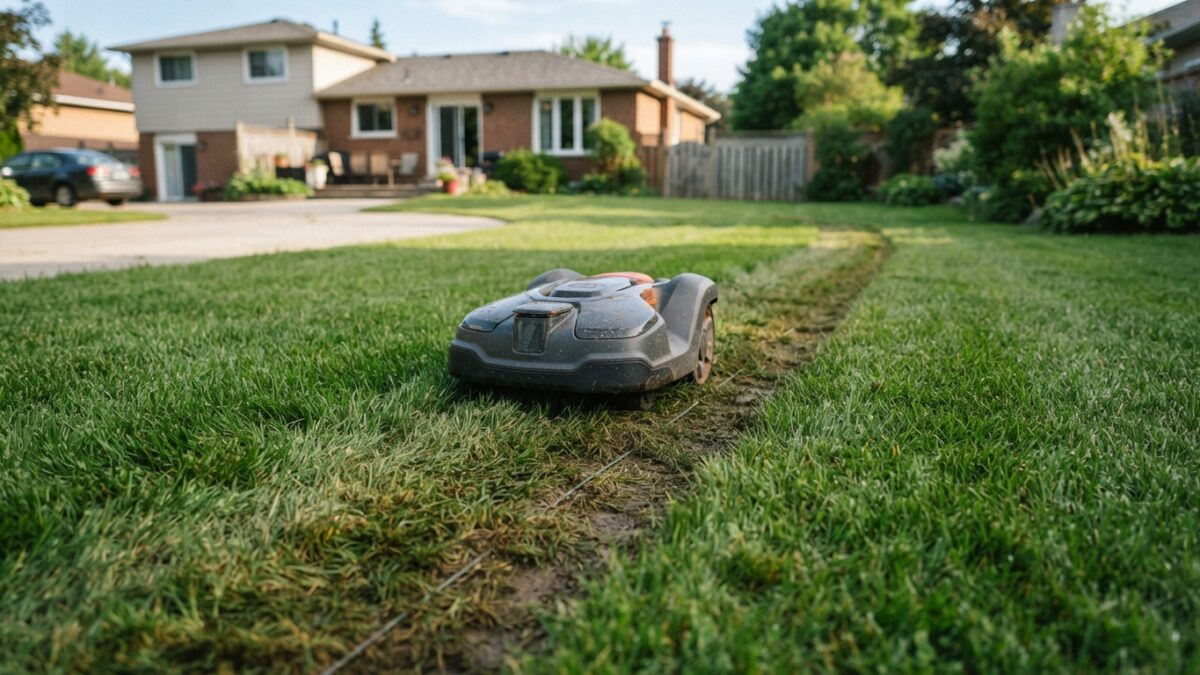
Every cycle ends at the dock, so the ground immediately around it gets the most traffic on the lawn. On wire-guided mowers that follow a guide wire home, the wear can appear as a distinct line.
Prevention: site the dock on a hard surface or at the lawn edge rather than out in the middle of the grass. If your model can return along different routes or has multiple guide wires, use them. Some owners simply accept the immediate dock surround as a mulched or gravelled area.
3. Slopes
Wheels slip most where the grip is worst, and slip tears turf rather than compressing it. A slope that’s fine in June may mark badly in a wet April.
Prevention: keep the mower off wet slopes, keep the cutting height up on banks, and be honest about whether the slope is within the mower’s rating — slope ratings explained covers why published figures flatter real performance.
4. Wet ground, anywhere
This is the big one. Clemson extension guidance identifies traffic — human activity, pet runs, vehicle movement — as probably the leading factor in soil compaction — pet runs included, which is worth knowing if you have a dog sharing the lawn with the mower — and notes that poorly drained, heavy clay soils with heavy traffic compact most readily and need more cultivation than lighter soils with less traffic. Saturated soil has no structural resistance, so wheels displace it rather than rolling over it.
Prevention: keep it off sodden ground. Our guide to robot mowers in the rain and on wet grass covers the rain sensor decision, which is largely a decision about this.
Wear and compaction are two different problems
Wear injury is mechanical damage to the grass plant — torn leaves, crushed crowns, thinning. Compaction is damage to the soil beneath it, squeezing out the air the roots need. They often appear together but need different fixes: wear is repaired by seed and rest, compaction by aeration. Clemson’s screwdriver test tells you which you have — if a screwdriver pushes easily into the soil, compaction isn’t the problem; if it meets heavy resistance, or the ground feels concrete-like underfoot, it is.
What about stripes and tracks in the grass?
Faint directional marks after mowing are not damage. They’re the grass lying in the direction the mower travelled, exactly like the stripes a roller mower makes deliberately, and they disappear as the grass stands back up.
Two distinctions worth making:
| What you see | What it is | Action |
|---|---|---|
| Faint lines that fade within a day or two | Grass lying in the mowing direction | None |
| Repeating pattern always in the same place | The mower is following the same routes | Vary the mowing pattern or start point if your model allows |
| Visible wheel indentations in the soil | Wet-ground traffic | Keep it off soft ground; topdress the ruts |
| Thin, bare or yellowing strip | Wear injury from concentrated traffic | Overseed and reduce traffic through that point |
| Hard ground, poor growth, water sitting on the surface | Soil compaction | Core aerate |
| Scalped patches on high points | Uneven ground, not traffic | Level it — see preparing the lawn |
Six things that prevent nearly all of it
- Level the lawn before the season. Scalping on bumps is the most visible “damage” robot mowers get blamed for, and it’s a ground problem. Getting the lawn ready covers the method.
- Don’t over-schedule. More hours does not mean a better lawn; past the point where the mower keeps pace, extra hours are pure traffic. Most owners run far more than they need.
- Vary the pattern. If your model lets you change mowing direction or starting point, use it. Concentrated repeat routes are what create worn strips.
- Keep the cutting height up. Taller grass protects its own crowns and the soil beneath, and shades out the thin patches that traffic starts.
- Stay off wet ground. The single highest-value rule.
- Aerate once a year. Clemson recommends core aeration as the most effective approach, with tines spaced 2 to 3 inches, and suggests going over the lawn twice — once in one direction, then perpendicular. Timing matters: cool-season grasses are best aerated in fall, when there is less heat stress and less risk of annual weeds invading, while warm-season grasses are best aerated in late spring and summer while actively growing.
How to repair what’s already there
A worn or thinning strip
- Loosen the surface with a fork or hand rake, breaking up any compaction in the top inch or two.
- Overseed with a grass matched to the rest of the lawn, or plug or sprig it if you have a warm-season lawn that doesn’t seed well.
- Topdress lightly and keep the surface moist while it establishes.
- Set the strip as a no-mow zone if your model supports it, or lift the mower off that area for a few weeks.
- Then deal with the cause — widen the pinch point, or change the route — or you’ll be repairing it again next year.
Wheel ruts
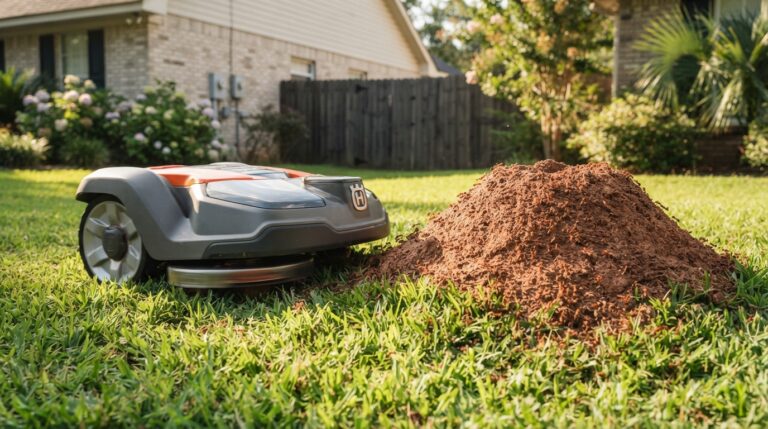
Shallow ruts up to about an inch: topdress with a sandy soil mix, work it in with the back of a rake, and let the existing grass grow through. Deeper ruts: cut an H-shape, peel the turf back, add soil underneath, firm it and lay the turf back. Both jobs are best done as growth starts, so the lawn recovers quickly.
Compacted areas
Core aeration, at the right time of year for your grass type, is the answer — and repeat annually if the soil is heavy clay, which Clemson notes needs more cultivation than lighter soils. Topdressing with compost after aerating helps over several seasons.
If you have a boundary wire, know where it runs before you aerate
Husqvarna specifically warns about damaging boundary wires while loosening compacted soil. Aerating tines and forks find buried wire reliably. Map it, or mark it, before you start.
The honest summary of the trade-off
A robot mower gives you a lawn that is cut correctly and fed by its own clippings, at the cost of more traffic than a weekly mow. On a reasonably level, free-draining lawn that is a clear net gain, and most owners see the lawn improve. On heavy clay, on slopes, or in a wet climate, the traffic side of the ledger is heavier, and the difference between a good outcome and a marked-up lawn comes down almost entirely to keeping the machine off soft ground and not running it more hours than the grass needs.
Questions
Do robot mowers leave tracks in the lawn?
Faint directional marks are normal and fade as the grass stands up — that’s the same effect that produces deliberate stripes on a rolled lawn. Marks that persist in the same place are a sign the mower is following the same routes repeatedly, or that the ground was soft when it ran.
Will a robot mower compact my soil?
It adds traffic, and Clemson extension guidance names traffic as probably the leading cause of compaction in lawns, with heavy clay soils most at risk. On a free-draining lawn the effect is usually minor. On clay, or on ground that is often wet, annual core aeration is worth planning for.
Why is there a worn path where my robot mower goes?
Because every route through that point carries the whole lawn’s traffic. It happens at gaps between obstacles and around the charging station. Widen the pinch point, vary the mowing pattern or start point if your model allows, and overseed the worn strip once you’ve reduced the traffic.
Is a robot mower better or worse for the lawn than a normal mower?
Better, in most cases. Cutting little and often stays within the one-third rule Ohio State extension recommends, and the clippings are returned rather than collected, which keeps most of the nitrogen in the lawn. The offset is extra wheel traffic, which matters mainly on heavy or wet soils.
How do I fix ruts left by a robot mower?
For shallow ruts, topdress with a sandy soil mix, rake it into the grass and let the turf grow through. For deeper ones, cut an H-shape in the turf, fold it back, add soil beneath, firm it and lay the turf back down. Do either as growth starts so the lawn recovers quickly.
When should I aerate a lawn that a robot mower runs on?
Clemson extension recommends aerating cool-season grasses in fall, when heat stress and weed invasion are lower, and warm-season grasses in late spring and summer while they are actively growing. Core aeration with tines 2 to 3 inches apart is the most effective method, going over the lawn twice in perpendicular directions.
The short version
The cutting is good for the lawn. The driving is what to manage. Watch the four places wear appears — pinch points, the dock surround, slopes and anywhere wet — level the ground before the season, don’t run more hours than the grass needs, vary the pattern where you can, keep the height up and the machine off soft ground, and aerate once a year at the right time for your grass. Do that and the lawn ends the season better than it started.
Prevention beats repair
Nearly all of this is decided before the season starts, by the state of the ground and where the dock sits.