How MowReview makes money: As an Amazon Associate, MowReview earns from qualifying purchases, at no extra cost to you. We don’t test mowers ourselves; we explain what manufacturers and independent testers report. How we research
Quick answer
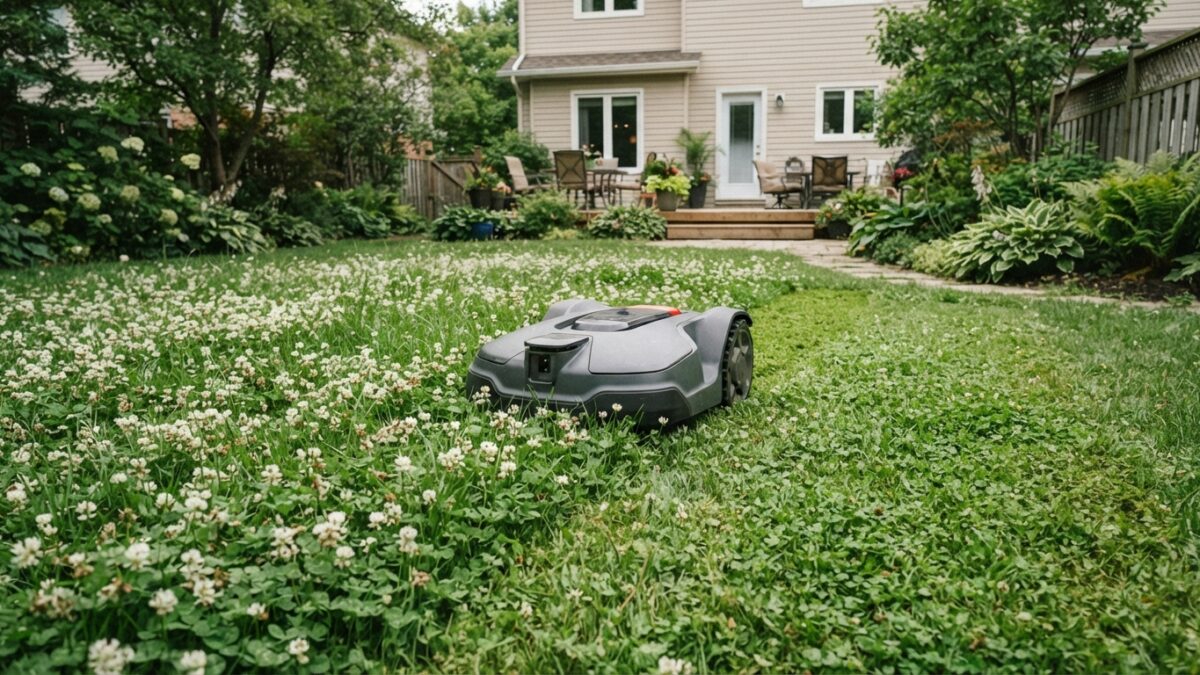
Yes, a robot mower works on a clover or micro clover lawn. Purdue says white clover tolerates close mowing, so the mower won’t hurt the plants. What a daily robot schedule takes away is the flowers. If you just want a green, low-input clover-and-grass lawn, run the robot normally. If you want a flowering “bee lawn,” the University of Minnesota recommends mowing at 3 inches or higher, about every 2 to 3 weeks, and pausing while it’s in full bloom. That calls for a mower that reaches 3 to 4 inches, such as the Mammotion LUBA 3 AWD H versions or the Segway Navimow X3, and a schedule set to run far less often than the default.
Clover lawns are having a moment. Homeowners are sowing micro clover into their grass for a greener lawn with less fertilizer, and extension services in the Midwest and Northeast now publish guides to “bee lawns” that mix low-growing flowers into turf. At the same time, robot mowers are designed to trim a little every day, which is the opposite of what a flowering lawn wants.
The two can work together. It depends on which kind of clover lawn you’re after, and on setting the mower up differently from a plain grass lawn. This guide explains how. MowReview quotes no prices and hasn’t tested these mowers. How we research explains why.
First, decide what kind of clover lawn you want
| Green clover-and-grass lawn | Flowering bee lawn | |
|---|---|---|
| Main goal | Green color, less fertilizer, tolerance of dry spells | Flowers for pollinators |
| Mowing height | Your grass’s normal height | 3 in or higher (University of Minnesota) |
| Mowing frequency | A normal robot schedule is fine | About every 2 to 3 weeks; skip while in full bloom (University of Minnesota) |
| Robot mower fit | Good | Workable with a tall-cutting mower and a sparse schedule |
What extension services say about clover
- It tolerates mowing. Purdue says white clover “tolerates close mowing” and spreads by creeping stems. A robot mower won’t kill it.
- It feeds the lawn. Clover adds nitrogen to the soil. The University of Maryland says micro clover “may reduce one nitrogen application per year,” and the University of Minnesota says white clover doesn’t need nitrogen fertilizer.
- It doesn’t like traffic. The University of Minnesota says white clover “has poor traffic tolerance,” and the University of Maine says clover “will crush more easily than turfgrass” and is not recommended for heavy-traffic areas.
- It’s slippery when wet. The University of Maine notes clover is “quite slippery when wet.”
- Micro clover has limits. The University of Maryland says micro clover has fewer flowers than Dutch white clover, “does not tolerate high heat and drought,” starts to die back when cool-season grass goes dormant in summer, and needs reseeding to persist. Most broadleaf herbicides kill it.
- The mix. An Extension answer citing Penn State and Maryland trials recommends micro clover at 5 to 10 percent by weight with Kentucky bluegrass or tall fescue.
What daily mowing does to flowers and bees
This is where robot mowers and clover lawns pull in different directions.
- Less mowing, more flowers. A USDA Forest Service and UMass Amherst study of suburban lawns in Springfield, Massachusetts, found lawns mowed every three weeks had up to 2.5 times more flowers than lawns mowed every week. Bee numbers were highest on lawns mowed every two weeks.
- Frequent robotic mowing can reduce clover. A Norwegian research project, summarized by the USGA, found robotic mowing on golf fairways cut at about 0.6 inch reduced the spread of clover by 30 percent in some grasses and almost 60 percent in red fescue, compared with reel mowing. Home lawns are cut far higher, so the effect is likely smaller, but it’s a sign that constant mowing doesn’t favor clover.
- A manufacturer-funded counterpoint. A University of Hohenheim study run with STIHL reported “constant flowering” on robot-mown plots, as plants grew outward rather than up, and recommended the highest cutting height. It comes from STIHL’s own website, so weigh it accordingly.
The practical conclusion: a robot mower on its default daily schedule will keep a clover lawn green and neat, but most flowers will be cut off before bees can use them. To get flowers, change the height and the schedule.
How to set up a robot mower for a bee lawn
- Raise the height to 3 inches or more. That’s the University of Minnesota’s minimum for bee lawns. Many robot mowers can’t do it: Husqvarna’s 450X NERA, for example, stops at 2.4 inches. Check the U.S. listing’s stated maximum.
- Mow every 2 to 3 weeks, not every day. Most apps schedule by day and time, so allow one or two days every other week. Expect the mower to work harder on those days.
- Pause during full bloom. The University of Minnesota says to hold off while flowers are in full bloom. White clover blooms from late May to October, peaking in June in Minnesota.
- Or split the lawn. Keep the areas you walk and play on as regular mown lawn, and make a clover or bee-lawn area a separate zone or a no-go area mowed only occasionally. Husqvarna’s Rewilding Mode does something similar automatically, leaving 10 percent of the lawn unmown. Robot mowers and multiple zones explains how zones differ between brands.
- Remember the bees. The University of Maine warns that bees on clover flowers are a hazard for bare feet. Waiting until a bloom has finished before mowing, as Minnesota recommends, also avoids running the mower through bees at work.
- Mow in daylight. Research at the University of Oxford found hedgehogs are vulnerable to robot mowers at night, and GARDENA advises daytime-only mowing to protect wildlife. America has no hedgehogs, but toads and other small animals are active after dark too.
Robot mower makers recommend the opposite
Segway’s lawn-care guide recommends mowing daily or every other day in summer, and warns that grass left too long can’t be cut evenly. That’s sound advice for a pure grass lawn. On a bee lawn, accept a slightly shaggier look after each two-to-three-week gap. The trade-off is the flowers.
The picks
Tall cut, handles weeds and flowers
Mammotion LUBA 3 AWD (H version)
- Stated cutting height (H)2.2 to 4.0 in
- Stated max slope80%
- AppScheduling, zones and no-go areas
The H version reaches 4 inches, a full inch above the bee-lawn minimum, and PCWorld found it dealt easily with tall weeds poking above the grass: “It crushed the dandelions. Literally.” That matters on a lawn you leave for two or three weeks between mowings. Its zones and no-go areas let you keep a play area mown and a clover area wild.
Good for
- Bee lawns and flowering clover kept at 3 to 4 inches
- Lawns split into mown and wilder zones
Less good for
- Buyers who miss the H: the standard version stops at 2.7 inches
- Carrying: PCWorld found it “not fun to lift” at about 40 pounds
- Owners who want a smooth app: PCWorld found connectivity “a little spotty” and the app “glitchy”
Automatic unmown patches with Rewilding Mode
Husqvarna Automower 435X AWD
- Stated cutting height1.2 to 2.8 in
- Rewilding ModeLeaves 10% of the lawn unmown
- Stated max slope70%
Husqvarna’s Rewilding Mode, set up in the Automower Connect app, leaves a tenth of the lawn unmown so plants there can grow and flower. It’s available on the 435X AWD and several NERA models. It’s the simplest way to get a patch of flowering clover without managing zones and schedules yourself, while the rest of the lawn stays neat.
Good for
- Clover-and-grass lawns with a dedicated wild patch
- Owners who want a dealer to install and service it
Less good for
- Mowing the whole lawn as a bee lawn: it stops at 2.8 inches, below the 3-inch minimum
- Impatient owners: PCWorld found the lawn looked rough for the first week
- Anyone expecting blades to last: Husqvarna says they typically last 3 to 6 weeks
Smaller robots handle clover too. Tom’s Guide’s reviewer found the compact Navimow i110N went “fighting through clovers and crabgrass” without getting caught up. Its range tops out at 3.6 inches, enough for a bee lawn on a small lot.
Wet clover and wheel wear
Clover is softer and more slippery than grass. Robot mower makers say wet grass reduces wheel traction: Segway says wheels can’t keep enough grip on slippery, wet grass, and Mammotion says moisture reduces traction on slopes. Put the two together and a clover lawn is more likely to show wheel marks on dewy mornings or after rain. Use the rain sensor or rain delay, and schedule clover areas for later in the day. Robot mowers in rain and wet grass covers the settings, and will a robot mower damage my lawn? covers wear paths.
Micro clover is usually mixed into tall fescue, which has its own height needs. See robot mowers for tall fescue.
Questions
Can you use a robot mower on a clover lawn?
Yes. Purdue says white clover tolerates close mowing, so a robot mower won’t harm the clover itself. What you lose with daily mowing is the flowers, so if you want a flowering lawn for bees, raise the cutting height and mow far less often.
How high should you mow a clover or bee lawn?
The University of Minnesota recommends mowing bee lawns at 3 inches or higher, about every 2 to 3 weeks, and holding off while the flowers are in full bloom. Robot mowers that reach 3 inches or more include the Mammotion LUBA 3 AWD H versions and the Segway Navimow X3 series, both up to 4 inches.
Will a robot mower kill micro clover?
Mowing isn’t the main threat. The University of Maryland says micro clover starts to die back when cool-season grass goes dormant in summer heat and needs reseeding to persist, and most broadleaf herbicides kill it. A robot mower set to a sensible height won’t wipe it out.
Do robot mowers reduce clover in a lawn?
On golf turf, yes. A Norwegian research project summarized by the USGA found robotic mowing on fairways cut at about 0.6 inch reduced the spread of clover by 30 to almost 60 percent compared with reel mowing. Home lawns are cut much higher, so the effect is likely smaller, but frequent mowing doesn’t favor clover.
How often should a robot mower run on a clover lawn?
It depends on what you want. For a tidy clover-and-grass lawn, a normal robot schedule is fine. For flowers, a USDA Forest Service study found lawns mowed every three weeks had up to 2.5 times more flowers than weekly-mowed lawns, and bee numbers peaked when lawns were mowed every two weeks.
Is clover slippery for a robot mower?
It can be when wet. The University of Maine says clover is quite slippery when wet and crushes more easily than grass, and robot mower makers say wet grass reduces wheel traction. Use the rain delay and avoid mowing clover early on dewy mornings.
The short version
A robot mower won’t hurt clover, but a daily schedule removes the flowers. For a green clover-and-grass lawn, mow as normal. For a bee lawn, follow the University of Minnesota: 3 inches or higher, every two to three weeks, and a pause in full bloom. The LUBA 3 AWD H and the Navimow X3 reach 4 inches. Husqvarna’s Rewilding Mode leaves a flowering patch automatically. Keep it off wet clover, and mow in daylight.
Clover is one choice. Check the others.
Lawn area, slope and trees decide the rest of the shortlist.