How MowReview makes money: As an Amazon Associate, MowReview earns from qualifying purchases, at no extra cost to you. We don’t test mowers ourselves; we explain what manufacturers and independent testers report. How we research
Quick answer
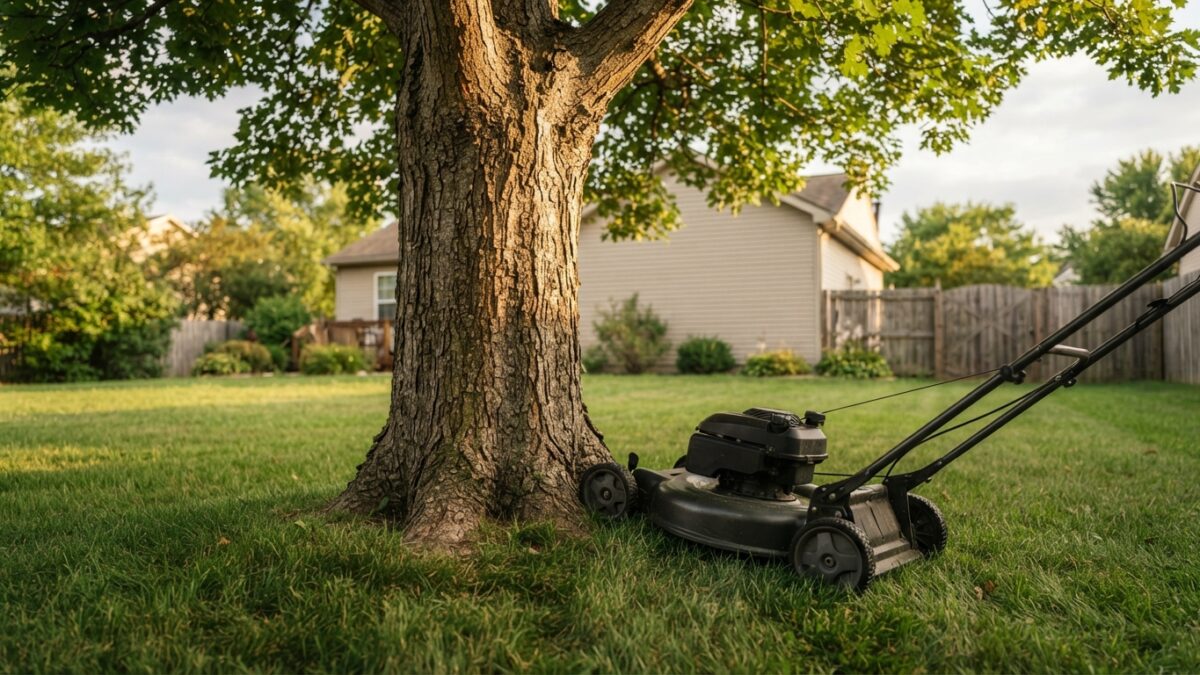
The best way to mow around a tree is not to mow near it at all. Replace the grass at the base with a ring of mulch, 2 to 3 inches deep as Purdue Extension recommends, so the mower never needs to touch the trunk. Keep string trimmers away from bark, which Iowa State Extension says they can strip and girdle. Trim any grass by the trunk with hand shears. Fit trunk guards on young, thin-barked trees such as maples and birches. Mower and trimmer wounds are permanent, and repeated strikes can kill a tree.
Many trees in American yards die slowly from the bottom up. A mower deck bumps the trunk every week, a string trimmer chews away a ring of bark, and years later the tree declines from what looks like disease. Iowa State Extension has a name for it: mower blight.
This guide covers why the damage matters, which trees are most at risk, and eight tips from Purdue and Iowa State extension experts for mowing without hurting them. MowReview quotes no prices and hasn’t tested the products mentioned. How we research explains why.
Why a few bumps matter
Purdue Extension’s urban forestry specialist, Lindsey Purcell, explains that the root flare, where the trunk widens into the roots, is the usual injury site. Bark protects the tissue that carries water and food, and “any damage to this transport system can affect tree health and the tree could die.” Three things make it serious:
- Wounds are permanent. Trees don’t heal bark wounds the way skin heals. They seal them off, and decay fungi can enter and spread into healthy wood.
- Damage adds up. Iowa State Extension warns: “Repeated collisions with a tree may girdle the trunk and result in its death.”
- Girdling kills. Purdue says damage that circles the base ultimately kills the tree.
Which trees are most at risk
Purdue says bark can be “less than 1/16 of an inch on young, smooth-barked trees such as maples and birches,” and that newly planted trees are the most commonly and seriously affected. Thick-barked mature oaks tolerate an occasional bump; a three-year-old red maple doesn’t. Iowa State adds that string trimmers can girdle shrub stems too.
8 tips for mowing around trees
1. Give every tree a mulch ring
Purdue recommends “a 2″ to 3″ layer of mulch on the root zone of the tree,” which doubles as a visual cue to keep equipment away. Iowa State suggests 2 to 4 inches of shredded bark, wood chips or similar material. Make the ring wide enough that your mower deck can’t reach the trunk from the edge.
2. Spread mulch, don’t pile it
Purdue’s advice is to spread mulch over the root zone. Keep the layer within the recommended depth and pull it back from direct contact with the bark, rather than heaping it up the trunk.
3. Keep string trimmers off the bark
Iowa State is direct: string trimmers “should not be used around trees and shrubs.” Their spinning line strips bark in seconds, and repeated trimming is how many trees get girdled.
4. Use grass shears near the trunk
Where grass grows right up to a trunk, Iowa State suggests trimming it with grass shears instead of a mower or trimmer. It takes a minute per tree and removes the risk entirely.
5. Stay several inches away when you mow
If you haven’t mulched yet, Iowa State says to “stay several inches away from the trunk when mowing the lawn.” Leave a few inches of longer grass rather than pushing the deck against the bark.
6. Fit trunk guards on young trees
Purdue suggests “trunk guards or similar devices” for extra protection, and says white, expanding tree guards can help trees withstand equipment contact and reduce winter injury.
7. Watch the surface roots
Raised roots near the trunk get scalped and gouged by mower blades. Raise the deck around them, or cover them with the mulch ring so the mower never crosses them.
8. Teach your robot mower the same rule
A robot mower bumping a trunk hundreds of times a season does the same damage. Map a no-go zone around each tree or let the mulch ring be the boundary. Robot mowers and mulched beds explains how robots treat mulch, and robot mowers and fruit trees covers orchards and fallen fruit.
Already damaged?
Look for bark that’s missing or loose at the base, especially in a band at mower or trimmer height. A small wound on a healthy tree will usually be sealed off by the tree. Damage that wraps much of the way around the trunk is serious, and a certified arborist can tell you whether the tree is likely to survive.
The picks
For young, thin-barked trees
Spiral tree trunk guards
- TypeWhite plastic, expanding spiral
- Common sizeAbout 24 in tall
- UseWrap around the lower trunk
Purdue Extension says white, expanding tree guards can help trees withstand equipment contact and reduce winter injury. They’re the cheapest insurance a young maple or birch can get.
Good for
- Newly planted and young trees
- Smooth-barked species such as maples and birches
Less good for
- Replacing a mulch ring: a guard covers only the trunk, not the root flare or surface roots
- Forgetting: check guards each season as the trunk thickens
Instead of a string trimmer
Fiskars grass shears
- TypeHand grass shears
- UseGrass at the trunk base
- PowerNone
Iowa State Extension’s recommended tool for the grass right next to a trunk. No spinning line, no bark damage.
Good for
- A few trees without mulch rings yet
- Tidying around posts, shrubs and young trees
Less good for
- Many trees: it’s hand work, so mulch rings are faster in the long run
- Long edges, where a trimmer used away from bark is quicker
For the mulch ring
Shredded hardwood mulch
- Depth2 to 3 in (Purdue); 2 to 4 in (Iowa State)
- PlacementOver the root zone, off the bark
- RenewTop up as it breaks down
Iowa State lists shredded bark and wood chips as suitable materials. A mulch ring also cuts grass competition for water and nutrients, as Purdue notes.
Good for
- Every lawn tree, new or established
- Making a clear boundary for mowers and robots
Less good for
- Piling deep: keep it within the recommended depth
- Windy, sloped spots where it washes off: firm it down or edge the ring
Questions
Can a lawn mower damage a tree?
Yes. Purdue Extension says mower and trimmer wounds at the base of the trunk are permanent, let decay fungi in, and can girdle and kill a tree if the damage circles the trunk. Iowa State Extension calls this mower blight.
What is mower blight?
Iowa State Extension’s term for damage from repeated mower and string trimmer strikes at the base of trees. The bark is bruised or torn, wood decay fungi can get in, and repeated collisions may girdle the trunk and kill the tree.
How deep should mulch be around a tree?
Purdue Extension recommends a 2 to 3 inch layer over the root zone, and Iowa State Extension says 2 to 4 inches. The mulch also acts as a visual cue to keep mowers away.
Should I use a string trimmer around trees?
Iowa State Extension says string trimmers should not be used around trees and shrubs, because they can strip bark and girdle stems. It suggests trimming grass near the trunk with grass shears instead.
Which trees are most at risk from mowers?
Young, thin-barked trees. Purdue Extension notes bark can be less than 1/16 inch thick on young, smooth-barked trees such as maples and birches, and says newly planted trees are the most commonly and seriously affected.
Do tree trunk guards work?
They add protection. Purdue Extension suggests trunk guards or similar devices, and says white, expanding tree guards can help trees withstand equipment contact and reduce winter injury.
The short version
Don’t let mowers or trimmers touch bark. Ring every tree with 2 to 3 inches of mulch, trim near trunks with shears, guard young thin-barked trees, and set no-go zones for a robot mower. A tree can’t heal a wound the way you can, so preventing it is the only real fix.
Lots of trees?
Which robot mowers navigate best under a canopy.