How MowReview makes money: As an Amazon Associate, MowReview earns from qualifying purchases, at no extra cost to you. We don’t test mowers ourselves; we explain what manufacturers and independent testers report. How we research
How to Blow Out a Sprinkler System Yourself: PSI Limits, Steps and the Mistakes That Crack Pipes
Quick answer
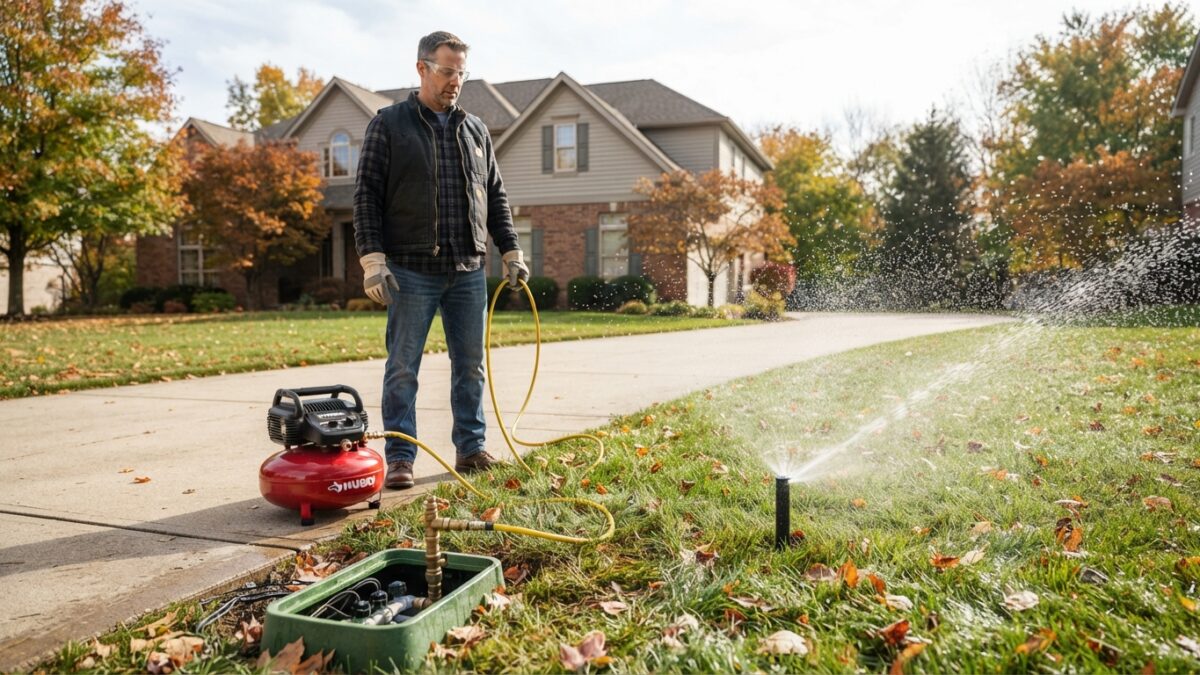
To blow out a sprinkler system, shut off the water supply, connect an air compressor downstream of the backflow preventer, open one zone, and blow it out in bursts of two minutes or less until only a fine mist comes from the heads. Then repeat on every zone. Keep pressure at or below 80 psi for rigid PVC pipe and 50 psi for flexible black poly pipe, per Colorado State University Extension. Never blow air through the backflow preventer itself. The catch: Rain Bird recommends a compressor delivering 185 cfm or more, far beyond most home units, so many homeowners rent a large compressor or hire a pro.
Water left in sprinkler lines over winter freezes, expands and splits pipes, fittings and valves. The damage doesn’t show until spring, when you turn the system on and find a geyser in the lawn. Colorado State University Extension puts it plainly: fall winterizing is “much less costly and much less labor intensive” than repairing freeze damage in spring.
This guide covers the pressure limits, a step-by-step blowout, the mistakes that cause damage, and whether your compressor is up to the job, using Colorado State Extension and Rain Bird guidance. MowReview quotes no prices and hasn’t tested the products mentioned. How we research explains why.
The numbers that matter
| Setting | Guidance | Source |
|---|---|---|
| Pressure, rigid PVC pipe | No more than 80 psi | Colorado State Extension |
| Pressure, flexible poly pipe | No more than 50 psi | Colorado State Extension |
| General pressure ceiling | Air should not exceed 50 psi | Rain Bird |
| Compressor airflow | 185 cfm or greater, continuous | Rain Bird |
| Compressor size | About 50 to 70 gallons | Rain Bird |
| Time per burst | No more than 2 minutes | Rain Bird |
| Passes per zone | At least two, until only a fine mist appears | Rain Bird; Colorado State |
Rain Bird’s guide also mentions regulating a compressor to 75 to 85 psi depending on line size, alongside its 50 psi ceiling. When guidance differs, use the lower number for your pipe type.
Step by step
- Pick a dry day before the first hard freeze.
- Shut off the water supply to the system. Colorado State notes the stop-and-waste valve may be in a basement, crawlspace or an underground valve box as deep as about 5 feet. Don’t force it.
- Relieve pressure by briefly running one zone from the controller.
- Connect the compressor to the blowout port downstream of the backflow preventer, using a blowout adapter. Set the regulator to your pipe’s limit before you start.
- Open one zone before starting the air. Rain Bird stresses this so pressure doesn’t build against closed valves and blow heads apart.
- Blow the zone in bursts of two minutes or less. Water sprays, then sputters, then turns to mist.
- Move to the next zone, then come back for a second pass on each one, as both Rain Bird and Colorado State advise.
- Shut off the compressor before disconnecting, and never close every zone while the compressor is still feeding air.
- Deal with the backflow preventer. For a pressure vacuum breaker, Colorado State says to leave its ball valves and test cocks half-open over winter. Rain Bird recommends insulating valve boxes and backflow preventers.
- Set the controller to off or rain mode for winter.
Five mistakes that cause damage
- Blowing air through the backflow preventer. Colorado State says pressure vacuum breakers and reduced pressure devices “must never be blown out with compressed air,” because the heat can melt their rubber seals.
- Too much pressure. Colorado State says excess pressure can blow nozzles off. Flexible poly pipe takes much less than PVC.
- Running air too long. Rain Bird says compressed air heats up and can damage components. Keep bursts under two minutes.
- Trusting drain valves alone. Colorado State doesn’t recommend gravity-based manual or automatic drains, because there’s no way to see that the lines are empty.
- Adding antifreeze. The American Red Cross warns against it unless directed, because it’s dangerous to people, pets, wildlife and landscaping.
Is your compressor big enough?
Rain Bird recommends 185 cfm or more. A typical home pancake or hot-dog compressor delivers a small fraction of that. It may push some air through the lines but leave water in the low spots. If yours is small, rent a towable compressor, blow out one zone at a time with frequent pauses to let the tank recover, or book a professional. Either way, wear eye protection, keep pets indoors (Colorado State notes the noise can startle them), and don’t stand over heads or valves while air is running, as Rain Bird warns.
Do you need to winterize at all?
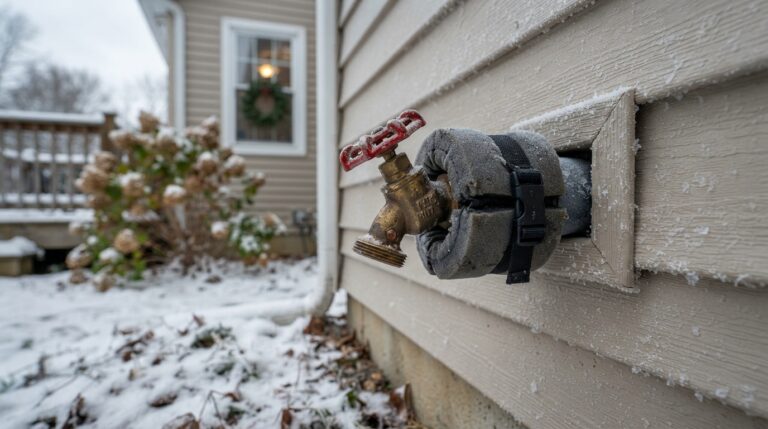
If your ground freezes, yes. In the warmest parts of the South, many systems stay in use year-round, but lines can still freeze in a hard cold snap. If you’re unsure, follow your installer’s instructions. The Red Cross advises draining sprinkler supply lines according to the manufacturer’s or installer’s directions. Your outdoor faucets need attention too: see how to keep an outdoor faucet from freezing, and robot mowers and sprinkler systems if you run both.
The picks
To connect a compressor to the system
Sprinkler blowout adapter
- TypeHose-thread to air-coupler fitting
- ConnectsBlowout port or hose bib downstream of backflow
- UseEvery fall
The fitting that links a standard air hose to your irrigation system’s blowout port. Rain Bird’s steps assume one. Most screw onto a garden-hose thread and take a standard quick coupler.
Good for
- Systems with a hose-thread blowout port
- Owners winterizing every year
Less good for
- Systems without a blowout port downstream of the backflow preventer
- Matching couplers: check it fits your compressor hose’s coupler style
To protect the backflow preventer
Insulated backflow preventer cover
- TypeInsulated pouch or bag
- FitsAbove-ground backflow assemblies
- WhenAfter blowout, all winter
Rain Bird recommends insulating backflow preventers after winterizing. The device is the most exposed and most expensive part of many systems, and it sits above ground in the wind.
Good for
- Above-ground backflow preventers in cold climates
- Systems you can’t fully drain
Less good for
- Replacing the blowout: insulation slows freezing but doesn’t remove trapped water
- Sizing by guesswork: measure the assembly’s height and width first
Required by both guides
ANSI Z87.1 safety glasses
- RatingANSI Z87.1 impact-rated
- WhyAir, water and grit under pressure
- UseAny compressed-air job
Colorado State Extension and Rain Bird both call for eye protection during a blowout, and Rain Bird warns that excess pressure can cause flying debris. Impact-rated glasses are cheap insurance.
Good for
- Blowouts, mowing and string trimming
- Any job with flying debris
Less good for
- Unrated sunglasses: look for the Z87 marking on the frame
- Standing over heads anyway: Rain Bird says to keep clear of components
Questions
What PSI should I use to blow out sprinklers?
Colorado State University Extension says to keep compressor pressure between 40 and 80 psi, with no more than 80 psi for rigid PVC and 50 psi for flexible black polyethylene pipe. Rain Bird’s guidance says air should not exceed 50 psi.
Can I blow out sprinklers with a small air compressor?
Often not well. Rain Bird recommends a compressor that can supply 185 cubic feet per minute or more, roughly a 50 to 70 gallon unit, which is far more than typical home compressors deliver. A small compressor may move air through the lines without clearing all the water.
How long should I blow out each sprinkler zone?
In short bursts. Rain Bird says not to blow any zone for more than two minutes at a time, because compressed-air heat can damage components, and to repeat at least twice per zone until only a fine mist comes from the heads.
Should I blow air through the backflow preventer?
No. Colorado State University Extension says pressure vacuum breakers and reduced pressure backflow devices must never be blown out with compressed air, because the heat can melt their internal rubber seals. Connect the compressor downstream of the backflow device.
Can I just drain my sprinkler system instead of blowing it out?
Colorado State University Extension doesn’t recommend relying on gravity-based manual or automatic drain valves, because there’s no way to confirm the lines are empty. It calls compressed-air blowout the reliable method.
Should I put antifreeze in my sprinkler lines?
No. The American Red Cross warns against putting antifreeze in water lines unless directed, because it’s dangerous to people, pets, wildlife and landscaping.
The short version
Water off, compressor connected downstream of the backflow preventer, one zone open, bursts under two minutes, two passes per zone, and pressure at or below 80 psi for PVC and 50 psi for poly pipe. Never blow through the backflow device, and skip the antifreeze. If your compressor is a small home unit, rent a bigger one or call a pro.
Winterizing the yard
More cold-weather jobs before the first hard freeze.