How MowReview makes money: As an Amazon Associate, MowReview earns from qualifying purchases, at no extra cost to you. We don’t test mowers ourselves; we explain what manufacturers and independent testers report. How we research
Quick answer
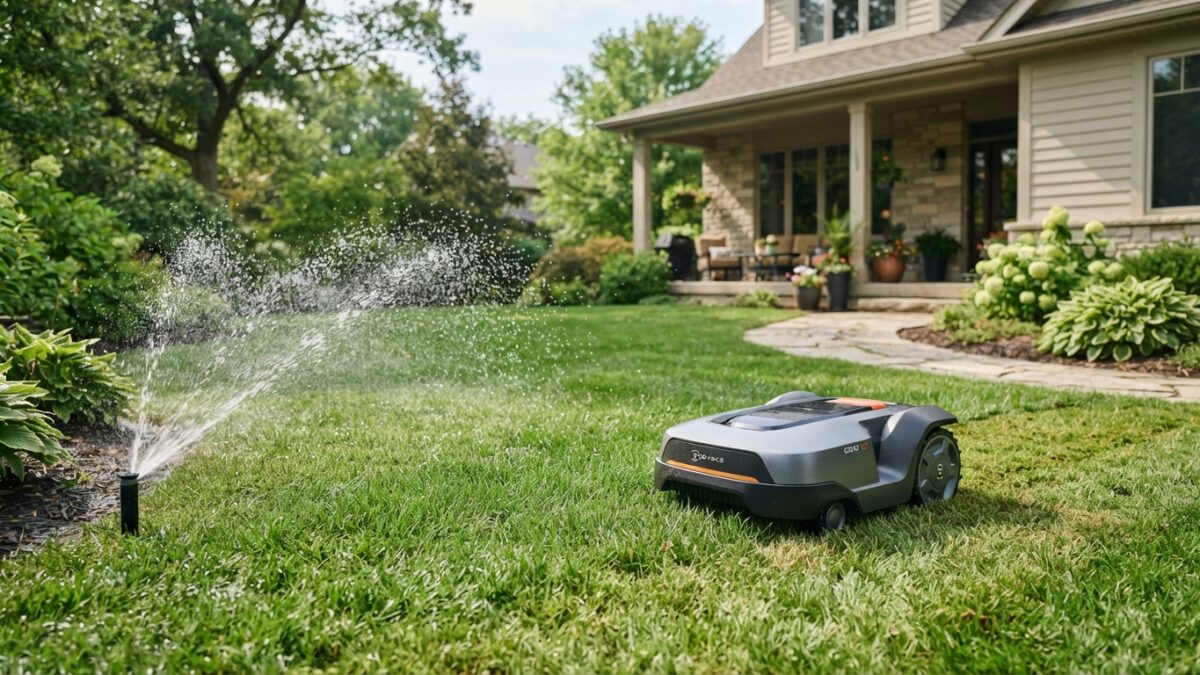
A robot mower and an in-ground sprinkler system get along fine once you separate their schedules. Water early in the morning, the window Iowa State extension recommends, roughly 5 to 9 a.m. Then let the mower start in the late morning or afternoon, when the grass has dried. Make sure every sprinkler head sits flush with the soil and retracts fully, because a head that sticks up is something the mower will hit several times a week. And keep an eye on the zones that stay wet, because those are where a robot mower leaves ruts.
In much of the US, particularly the South, Southwest, Texas and California, an automatic sprinkler system is standard on a suburban lawn. It’s also something most robot mower guides never mention. Sprinklers and robot mowers are both automated, both on timers, and both working the same patch of grass unsupervised. Until you set them up properly, they get in each other’s way.
This guide covers the three places they clash: the schedule, the heads, and the wet ground irrigation leaves behind.
1. Separate the schedules
This is the most important step, and it costs nothing.
Iowa State University extension recommends watering lawns early in the morning, between 5 and 9 a.m. Water soaks deeper then, less is lost to evaporation, and the leaves dry quickly afterwards. It advises against late-afternoon and evening watering because foliage that stays wet overnight encourages fungal disease.
That happens to suit a robot mower too. As our wet-grass guide explains, wet grass cuts raggedly, the clippings clump instead of mulching, and wheels slip on soft ground. So the ideal day on an irrigated lawn looks like this:
| Time | Sprinklers | Robot mower |
|---|---|---|
| 5 to 9 a.m. | Running, per extension advice | Docked |
| 9 to 11 a.m. | Off | Docked while the grass dries |
| Late morning to afternoon | Off | Mowing |
| Evening | Off, to avoid overnight disease | Docked or finishing up |
| Overnight | Off | Docked, which also protects wildlife and keeps camera features working |
Both controllers have to agree on this. Watch out for what happens when either one changes on its own: a smart irrigation controller that adds an extra watering cycle during a heatwave, or a mower that reschedules itself after a rain delay. Check both apps after any big weather event.
Can the two talk to each other?
Sometimes. Gardena, part of the Husqvarna group, says its smart system lets you coordinate your mowing and irrigation cycles and use real-time weather data to inform both. Most mixed setups, though, pair one brand of mower with a different brand of controller that knows nothing about it. For those, separating the time windows is simpler and more reliable than any integration.
2. Deal with the sprinkler heads
A robot mower meets every sprinkler head on the lawn several times a week. A head standing proud of the soil gets hit, and so does a pop-up head that sticks up because grit has jammed it. Either way the head is damaged, the mower is jolted, the blades get chipped and the cut around the head is poor.
Check every head before the mower starts
- Run each zone and watch it. A pop-up should rise, water and then drop all the way back down. Any head that stays up needs cleaning or replacing.
- Check the height with the system off. The top of each head should sit level with the soil. Heads settle over the years, and turf builds up around them, so some will now be too high and some buried too deep.
- Lower anything that stands proud. Dig around the head and reset it on its riser so it sits flush. Adjustable risers make this easy.
- Raise anything sunk too deep. A buried head doesn’t damage the mower, but it waters badly, and the dry patch it causes is easy to mistake for mower damage.
- Replace fixed or impact heads in the mowing area. Heads that stay above ground are a permanent obstacle. Change them for pop-ups, or map a keep-out zone around them.
If a head keeps getting hit
The quickest fix is a small keep-out zone around it in the app. You can also raise the cutting height slightly across the lawn. A mower that avoids obstacles at a distance is better around heads than one that only detects on contact. Still, no mower should be expected to “see” something that sits almost flush with the grass.
Boundary wires and sprinkler lines share the same few inches of soil
Before a boundary wire goes in, find out where the sprinkler pipes and valve boxes are. Pegging or burying wire through a lateral line makes a leak that’s hard to find. Digging a sprinkler repair later is also a common way to cut the boundary wire. Mark both on a simple sketch of the lawn and keep it with the mower’s paperwork.
3. Watch the zones that stay wet
Irrigation seldom soaks a lawn evenly. Low spots gather runoff. Heads overlap and double-water some strips. Shaded areas dry slowly. A broken head leaves one patch permanently soggy. These are the places where a robot mower leaves wheel marks, because saturated soil gives way under repeated traffic. Clemson extension guidance names traffic as probably the leading cause of soil compaction in lawns.
- Walk the lawn two hours after watering. Anywhere still soft underfoot is a problem zone.
- Fix the irrigation first. A leaking head or a badly aimed nozzle is the usual cause. Correct it, and the mower problem often disappears.
- Shorten the run time for that zone if it’s getting more water than it needs.
- Water deeply, not often. Iowa State recommends about 1 to 1.5 inches a week for most lawns, in one or two sessions rather than a little every day. Frequent shallow watering encourages shallow roots and keeps the surface soft.
- Keep the mower off a problem area while you fix it, using a temporary keep-out zone.
If ruts have already formed, will a robot mower damage my lawn? covers how to repair them.
4. Protect the dock and the mower from the spray
Robot mowers are built to be rained on, but a sprinkler aimed straight at the dock every morning adds up over a season:
- Water and grit build up on the charging contacts, and corroded contacts are a common cause of docking trouble.
- Wet clippings collect around a dock that never gets the chance to dry.
- Soil around the dock stays soft, so the mower struggles to line up and the approach gets rutted.
Put the dock where no head sprays it directly, or adjust the nearest head’s arc to miss it. Husqvarna’s battery guidance also recommends a shaded, cool spot for the charging station, and you can pick one that is both shaded and dry.
5. The regional picture
| Region | What to watch |
|---|---|
| Texas, Southwest | Watering restrictions often set specific days and hours. Plan the mower around those, not the other way round. |
| Florida, Gulf Coast | Irrigation plus summer storms means the lawn is rarely dry. Keep the mowing window short and the cutting height up. |
| California | Drought rules and smart controllers change schedules without warning. Check both apps after any change. |
| Southeast | Clay soils on irrigated lawns compact easily. Wet zones are the main risk. |
| Midwest, Northeast | Irrigation is mostly a midsummer supplement. Check the heads each spring as part of the spring restart. |
Questions
Can a robot mower run on a lawn with sprinklers?
Yes. Water in the early morning, the 5 to 9 a.m. window Iowa State extension recommends, and let the mower start once the grass has dried. Make sure every head sits flush and fully retracts, because a raised head gets hit several times a week.
Will a robot mower break my sprinkler heads?
Only the ones that stick up. Heads that sit level with the soil and retract fully are rarely a problem. Heads standing proud, pop-ups that jam open and fixed impact heads all get hit repeatedly. Reset them flush, clean or replace any that stick, and map a keep-out zone around anything you can’t lower.
What time should sprinklers run if I have a robot mower?
Early morning, which is also the best time for the lawn. Iowa State extension recommends 5 to 9 a.m. to reduce evaporation and let the leaves dry, and advises against evening watering because it raises disease risk. Schedule the mower for late morning onwards.
Why does my robot mower leave ruts near the sprinklers?
Because those areas stay wet. Overlapping heads, low spots and leaking heads keep some patches soft, and repeated wheel traffic on saturated soil leaves marks. Fix the irrigation cause first, then keep the mower off the area until it firms up.
Can a boundary wire go over sprinkler pipes?
It can run across them, but find out where the lines and valve boxes are first. Pegs and burial tools can puncture a lateral line, and later sprinkler repairs are a common way to cut the wire. A simple sketch showing both saves trouble for years.
Should the sprinkler spray the charging station?
Better not. Daily spray adds water and grit to the charging contacts, where corrosion causes docking trouble, and keeps the ground around the dock soft. Put the dock out of the spray pattern, or adjust the nearest head’s arc.
The short version
Water early and mow later. Set every sprinkler head flush and make sure the pop-ups retract. Find the wet zones and fix the irrigation behind them, and keep the dock out of the spray. Set up that way, the two automated systems stay out of each other’s way, and the lawn gets deep morning watering and a dry afternoon cut.
Part of getting the yard right
Sprinkler heads are one item on the list of things to sort before a robot mower starts work. The rest are in the preparation guide.