How MowReview makes money: As an Amazon Associate, MowReview earns from qualifying purchases, at no extra cost to you. We don’t test mowers ourselves; we explain what manufacturers and independent testers report. How we research
Quick answer
Check these ten things before you buy: your measured grass area, your steepest slope, your tree cover, your narrowest passage, how many separate lawn areas you have, your grass type, the mower’s weight, how it’s set up, the warranty, and who will service it locally. The first four rule out most of the market on their own.
Robot mowers are usually sold on features. Almost none of those features matter if the mower doesn’t fit your yard. This checklist is in order of importance, and it names no winners, because the right mower depends entirely on your answers.
Work through it with a notepad. It takes about half an hour, most of it outdoors.
1. Your measured grass area
Measure the grass the mower will cut, not your lot. Leave out the house, driveway, patio and beds. Then buy a mower rated comfortably above that number, because stated lawn sizes are best cases. Consumer Reports recommends one small model for a lawn noticeably smaller than its maker claims.
Write down: your grass area in square feet. How to measure it.
2. Your steepest slope
One steep bank can rule out a mower that suits everything else. Ratings are given in percent, not degrees, and a 100% grade is 45 degrees. Leave margin: manufacturer ratings assume good conditions, and Mammotion’s own buying guide admits they don’t always match real performance.
Write down: your steepest grade as a percentage. How to measure it.
3. Your tree cover
Stand in the shadiest part of the lawn at midday, in summer, and look up. A closed canopy is a problem for mowers that navigate by satellite, because as Ecovacs explains, leaves, branches and trunks reduce how much open sky the mower can use.
Write down: open sky, scattered trees, or closed canopy. What to do about shade.
4. Your narrowest passage
The gap the mower must pass through between lawn areas: a side gate, a path between beds, a gap between the shed and the fence. Measure the tightest one and compare it against the mower’s width. PCWorld saw one mower struggle in gaps only a little wider than the machine itself.
Write down: the narrowest gap in inches.
5. How many separate lawn areas you have
Front, back, side strips, anything split by a driveway or path. Most wire-free mowers handle several zones in the app, but they still have to physically get between them, or be carried. Add all the areas together when you compare lawn sizes.
6. Your grass type
Thick warm-season grasses are harder work. Bob Vila’s testing on a Florida property specifically named St. Augustine as a challenge, and found one two-wheel-drive mower slipping for traction in thick grass along edges.
Write down: your grass type, if you know it. Your county’s Cooperative Extension office can identify it if you don’t.
7. The mower’s weight
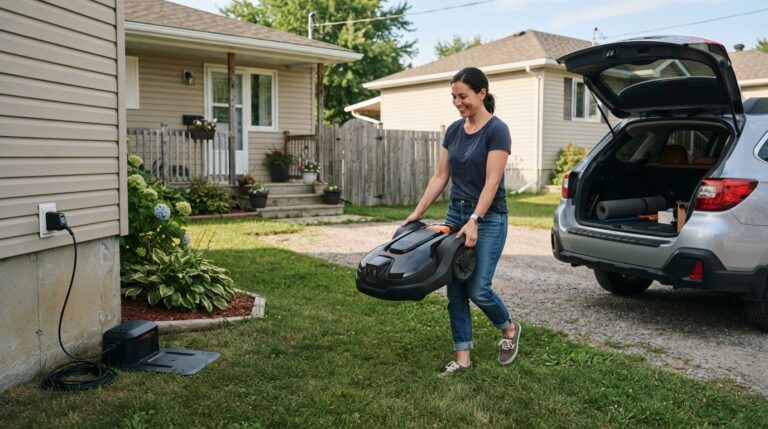
Rarely on anyone’s list, and it matters more than most specs for many owners. You’ll lift it out of the box, into storage each winter, and off the occasional stuck spot. Gear Diary measured the Segway Navimow X430 at 63.7 lb, the heaviest it has tested. PCWorld puts the Mammotion LUBA 3 AWD at a little over 40 lb. Reviewed found a flagship Mammotion arrived as a two-person lift needing several hours to assemble.
Ask yourself: can you comfortably lift this, on your own, at the end of the season?
8. How it’s set up
| Type | What setup involves | Suits |
|---|---|---|
| Boundary wire | Pegging or burying a wire around the whole lawn. PCWorld recommends hiring a professional to bury it. | Simple lawns, heavy shade, tighter budgets |
| Wire-free, self-installed | Walking the lawn edge once with a phone app, then editing no-go zones on screen | Most buyers, if you’re comfortable with an app |
| Dealer-installed | Someone does it for you, and services it later | Anyone who’d rather not handle any of it |
See wire vs. wire-free for the full comparison.
9. The warranty
Warranties vary by brand and model. Segway’s i110N listing states a three-year warranty, for example. Check what’s covered and for how long, and pay particular attention to the battery, since that’s the part most likely to need replacing.
10. Who will service it
The question people forget until something breaks. A dealer-sold mower usually comes with a local service contact. Buying online often means support runs through the manufacturer’s app instead. One UK reviewer notes that Mammotion mowers bought directly or through Amazon are supported through the app, and that dealers can’t help with those units.
Three more worth a thought
Noise, if neighbors are close. Segway rates its i-series at 58 dB(A). Edge cutting, since many mowers leave a strip along walls and beds, though some newer models add a trimmer. Connectivity, because some mowers rely on a cellular or network connection, and Segway notes performance may be limited where signal is weak.
Turning your answers into a shortlist
- Filter by lawn size first, choosing a rating above your measured area.
- Then filter by slope, leaving margin below the rating.
- If you have heavy shade, filter to mowers that use laser or camera navigation, or a boundary wire.
- Check what’s left against your narrowest gap and the weight you can handle.
Usually two or three mowers survive. Our main buying guide works through the current options by yard type.
Questions
Which specification matters most?
Lawn size and slope rating, in that order, because they decide whether a mower can do the job at all. Everything else is about how pleasant it is to live with.
Should I buy from a dealer or online?
Online is usually simpler and offers more choice, but support may run entirely through the manufacturer’s app. A dealer can install the mower and service it locally, which suits anyone who would rather not do the setup or troubleshooting themselves.
Is it worth waiting for next year’s models?
There’s always a newer model coming. The more useful question is whether current mowers already meet your yard’s requirements on size, slope and navigation. If they do, waiting mostly costs you a season of not mowing.
Sources
- House Digest: Consumer Reports’ best robotic lawn mower for small yards (2026)
- Mammotion: Best robot lawn mower 2026 (slope ratings vs. real performance)
- Ecovacs: LiDAR vs. RTK robot lawn mowers (tree cover)
- PCWorld: Ecovacs GOAT A3000 review (narrow gaps)
- Bob Vila: The best robotic lawn mowers of 2026, tested (St. Augustine, traction)
- Gear Diary: Segway Navimow X430 review (weight)
- PCWorld: Mammotion LUBA 3 AWD review (weight)
- Reviewed: Best robot lawn mowers (assembly)
- PCWorld: Best robot lawn mowers (professional wire installation)
- Amazon listing: Segway Navimow i110N (warranty, noise)
- The Robot Mowers: Mammotion LUBA 3 AWD review (dealer support)
Got your ten answers?
Take them to the buying guide and see which mowers survive the filter.