How MowReview makes money: As an Amazon Associate, MowReview earns from qualifying purchases, at no extra cost to you. We don’t test mowers ourselves; we explain what manufacturers and independent testers report. How we research
Quick answer
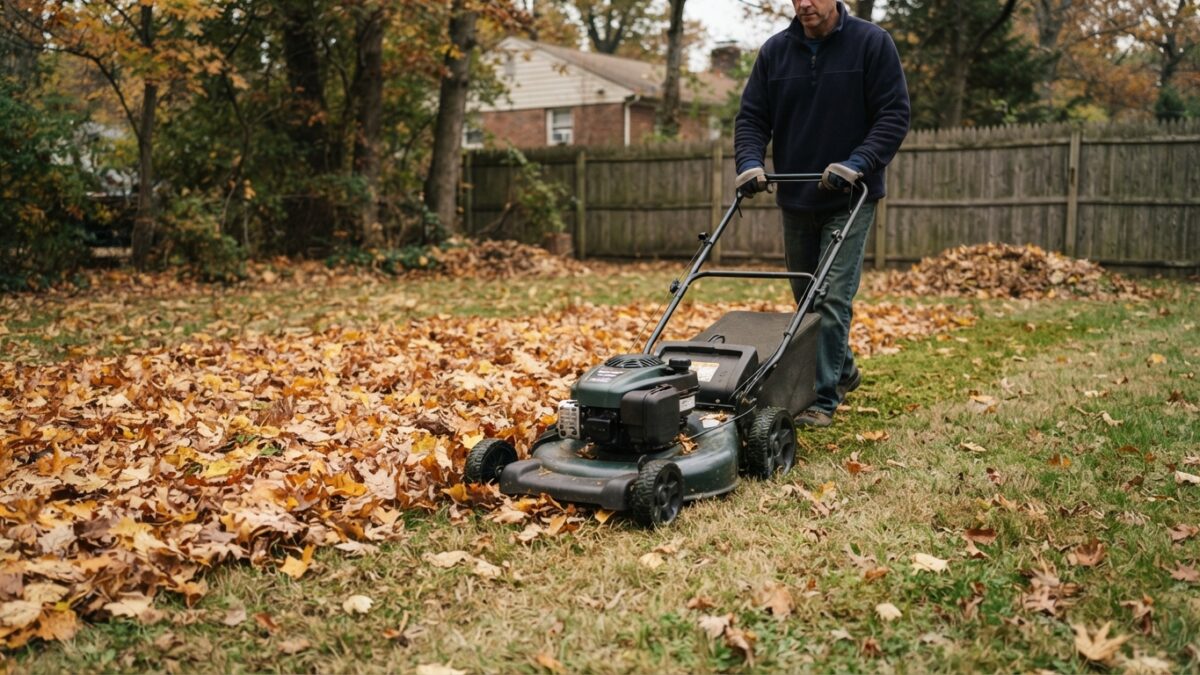
A rotary lawn mower can usually mulch more leaves than you’d think. Virginia Cooperative Extension cites Michigan State University research showing up to 6 inches of leaves can be mulched at a time, depending on the mower. The real limit isn’t depth but light: after you mow, you should still see grass blades through the leaf pieces. If the chopped leaves form a mat that hides the grass, mow again or remove the excess, because Michigan State’s researchers warn that covered turf can become matted and die.
Every fall, the same question comes up: rake and bag, or just mow over the leaves? University turf researchers have studied this for more than thirty years, and the answer is mostly good news for anyone who hates raking. But there is a point where mulching stops helping, and it’s worth knowing where it is.
This guide covers what the research found, the simple rule for how many leaves is too many, how to mulch with an ordinary mower, and what to do when the pile is deeper than your mower can handle. MowReview quotes no prices and hasn’t tested the products mentioned. How we research explains why.
What the research found
Michigan State University’s turfgrass researchers, Thomas Nikolai and Paul Rieke, began a leaf-mulching study in 1990 at the university’s Hancock Turfgrass Research Center. They mulched 0, 50 or 100 pounds of dry leaves per 1,000 square feet into Kentucky bluegrass each November with a rotary mower.
| What they measured | What they found |
|---|---|
| Turf color and density | No negative impact at the rates tested |
| Disease | No differences observed |
| Thatch, pH, phosphorus, potassium | No statistical differences in 1993 soil samples |
| Weeds (maple leaves) | Fewer broadleaf weeds and less crabgrass in 1995 |
| Oak leaves | No harm, but fewer benefits than maple |
| How fast leaves broke down | Usually within a few weeks |
Source: Nikolai and Rieke, Michigan State University, reported in GCM magazine. The researchers also mulched 400 pounds per 1,000 square feet, about 18 inches deep, into one plot, which “looked fine” the next spring, but they published no formal data on that rate.
A Purdue study cited by Virginia Cooperative Extension found something similar. Up to 4,000 pounds of maple leaves per acre in one application had no harmful effects on turf quality, color, growth, thatch, soil pH, weeds or disease. Mulched leaves didn’t replace fertilizer, though. The lawn still needed its usual nitrogen.
How many leaves is too many
The researchers put the limit in plain terms. “It’s vital to have green grass leaves exposed to the sun after the tree leaves have been mulched,” they wrote. “If they aren’t, the plants will become matted and die.”
That gives you a simple test you can do from the porch:
- Grass visible through the leaf pieces: you’re fine. Leave them.
- Grass partly hidden: mow again. A second pass chops leaves smaller, so they settle down between the grass blades.
- A brown mat covering the lawn: too many. Bag some with the mower, or rake the excess onto flower beds or the compost pile.
Purdue Extension gives the same warning from the other direction: leaves mowed into turf are encouraged, but heavy leaf cover left in place can cause turf loss.
How to mulch leaves with an ordinary mower
- Clear sticks and limbs first. Virginia Cooperative Extension says a rotary mower isn’t a chipper or stump grinder.
- Mow when leaves are slightly moist, not soaked. Moist leaves limit dust. Very wet leaves strain the engine and break down poorly.
- Set the deck at your normal mowing height. Michigan State’s plots were mowed at 3 inches.
- Close the side discharge or use the mulching plug, so the leaves circulate under the deck longer.
- Go over the lawn twice if needed. Virginia Cooperative Extension says multiple passes may be needed to chop leaves fully.
- Mow little and often. Mulching once a week while leaves fall is easier than tackling one deep layer in November.
- Wear eye protection and a dust mask, as the extension guide advises, and keep blades sharp and filters clean if you mulch often.
Which leaves don’t mulch well
Virginia Cooperative Extension says pine needles don’t work for mulching into a lawn. Michigan State found oak leaves did no harm but gave fewer benefits than maple. Large, tough leaves such as magnolia take more passes.
What about robot mowers?
Robot mowers cut a little every day, so they handle a light scattering of leaves well. They aren’t built to chew through a deep layer, and most can’t tell a pile of leaves from an obstacle. Robot mowers and fall leaves covers how to manage a robot through leaf season, and the robot mower fall checklist covers the rest of autumn.
The picks
You don’t need special equipment to mulch leaves, but these three help when your mower struggles or the pile is too deep.
For better mulching with your current mower
Oregon Gator G3 mulching blade
- TypeReplacement mulching blade
- FitModel-specific lengths and center holes
- UseMulching, bagging or side discharge
Oregon markets the Gator G3 as an upgrade over a standard blade, with an aggressive angle that increases airflow for mulching, fewer bag stops and cleaner side discharge. Fitting one is a cheap way to improve leaf mulching without a new mower.
Good for
- Owners whose stock blade leaves leaf pieces too large
- Lawns where you’d rather not buy a separate leaf tool
Less good for
- Buying without checking fit: blades are sold by length and mounting, so match your mower’s model
- Huge leaf volumes: Tractor Supply’s listing makes no specific claim about leaves
For deep piles you’ve already raked
WORX WG430 electric leaf mulcher
- PowerCorded electric
- Stated reduction11:1
- CuttingTrimmer line
A tub-style shredder that turns raked leaves into fine mulch for beds or compost. Bob Vila’s reviewer found it fast, and it handled acorns, pine cones and twigs without noticeably slowing.
Good for
- Yards that produce more leaves than the lawn can absorb
- Gardeners who want leaf mulch for beds
Less good for
- Small storage spaces: Bob Vila calls it a single-task machine that spends most of the year stored
- Allergy sufferers: the reviewer found it produced a lot of dust
- Long sessions: swapping full bags meant taking the unit apart, and the cord is only 1 foot long
For beds, corners and patios
Toro UltraPlus 51621 blower, vacuum and mulcher
- PowerCorded electric
- Stated reduction16:1
- ModesBlow, vacuum, mulch
Blows leaves out of beds and corners where a mower can’t reach, then vacuums and shreds them into a bag. Bob Vila’s reviewer found it lightweight and quiet, and the tube didn’t clog with a few sticks mixed in.
Good for
- Small and midsize yards with beds and hard surfaces
- Owners who want one tool for blowing and collecting
Less good for
- Large yards: Bob Vila says it’s not designed for huge quantities of leaves
- Freedom of movement: the power cord limits where you can go
- Quick switching: changing from blower to vacuum means swapping tubes
Questions
How many leaves can you mulch with a lawn mower?
More than most people expect. Virginia Cooperative Extension cites Michigan State research showing up to 6 inches of leaves can be mulched at a time, depending on the mower. Michigan State’s studies used up to 100 pounds of dry leaves per 1,000 square feet each year with no harm to the turf.
Is it bad to leave mulched leaves on the lawn?
Not if the grass is still visible. Michigan State’s researchers found no negative effect on turf color or density at the rates they tested, but warned that green grass leaves must be exposed to the sun after mulching, or the turf can become matted and die.
How do I know if I’ve mulched too many leaves?
Look down after you mow. If you can see grass blades through the leaf pieces, you’re fine. If the lawn is covered by a mat of chopped leaves, mow again to cut them smaller, or bag or rake the excess.
Does mulching leaves reduce weeds?
Possibly, with maple leaves. Michigan State researchers found plots that received maple leaves had fewer broadleaf weeds and less crabgrass in 1995. Oak leaves caused no harm but gave fewer benefits.
Do I need a mulching mower to mulch leaves?
No. Virginia Cooperative Extension says almost any rotary mower can do it, though mulching mowers and blades are designed for it. Multiple passes may be needed to chop leaves fully.
Should leaves be wet or dry when mulching?
Slightly moist is best. Virginia Cooperative Extension says moist leaves limit dust, but leaves that are too wet strain the engine and don’t break down well.
The short version
Mow the leaves into the lawn. University research shows it does no harm and may help, as long as you can still see grass after you’ve mowed. Go over the lawn twice when the layer is thick, mow little and often through leaf season, and only bag or rake when the chopped leaves form a mat.
Getting the lawn ready for winter?
Fall jobs for your lawn and your mower, in one place.