How MowReview makes money: As an Amazon Associate, MowReview earns from qualifying purchases, at no extra cost to you. We don’t test mowers ourselves; we explain what manufacturers and independent testers report. How we research
Quick answer
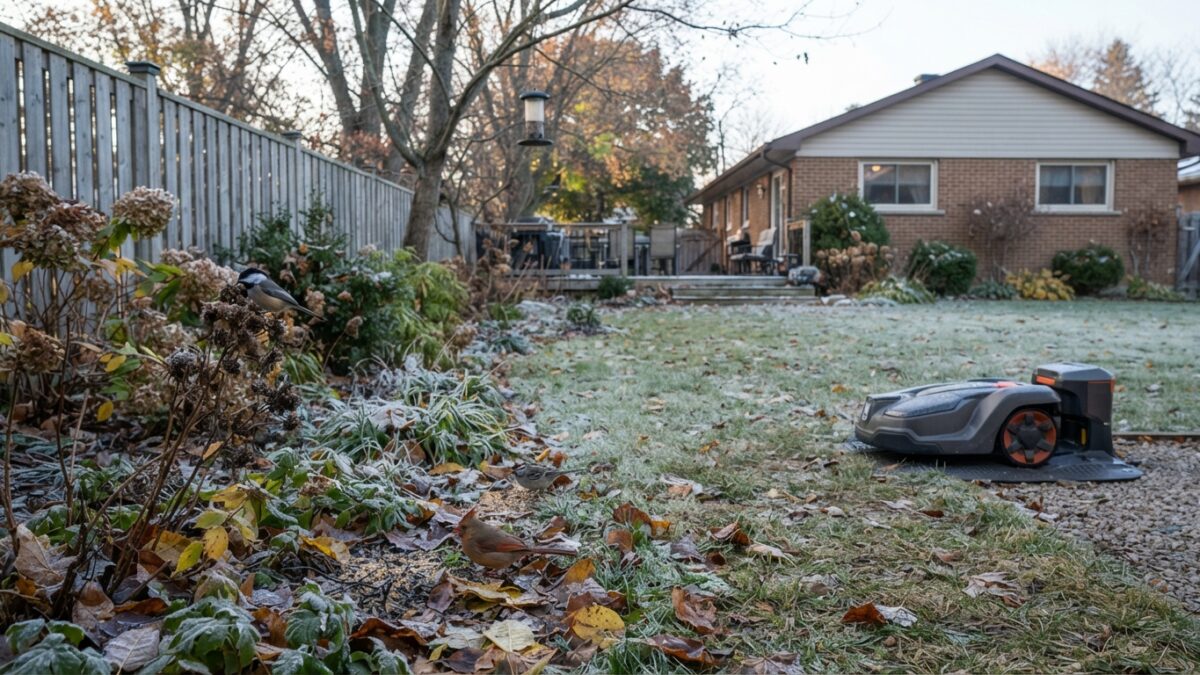
Robot mowers can harm ground-feeding birds and other small wildlife, and obstacle detection can’t be relied on to prevent it. The fixes are simple: mow in daylight only, walk the lawn before mowing, leave a wild corner or a pile of leaves as winter cover, and stop mowing altogether once growth ends. In fall and winter, a paused mower and a little untidiness do more for wildlife than any sensor.
Robot mowers are wonderful for keeping a lawn tidy and less wonderful for the creatures living in it. As the weather cools and wildlife looks for food and shelter, a machine that runs on its own becomes something worth thinking about. The good news is that the steps that protect wildlife are easy, and most of them cost nothing.
This page has no product recommendations, because protecting wildlife isn’t a thing you buy.
What the research actually shows
The clearest evidence comes from the University of Oxford, where researchers built a safety test for robotic mowers using a dummy hedgehog. In one test a mower avoided the dummy; when the test was repeated, the result couldn’t be reproduced, and the researchers concluded the mower may have avoided a larger obstacle by chance rather than detecting the animal.
The practical lesson is blunt: don’t rely on a mower to spot and avoid wildlife. Camera-based obstacle detection helps with toys and hoses; it is not a guarantee for a small, still animal.
The researchers made two recommendations that generalize to any yard: check the lawn for vulnerable wildlife before mowing, and run mowers only in daylight, because many small animals are active after dark. They named hedgehogs, young animals, fledgling birds and amphibians. In American yards the equivalents include ground-feeding and ground-nesting birds, rabbits, toads, and any small creature that shelters in longer grass.
Why fall and winter matter more
As the season turns, your lawn becomes more important to wildlife, not less:
- Birds feed at ground level. Robins, sparrows, juncos and others forage on lawns for insects and seeds, especially when food is scarce.
- Leaf litter is habitat. The layer of leaves and stems you might rake away shelters insects that birds and other animals rely on through winter.
- Cover is scarce. A tidy, closely cut lawn offers nothing. A wilder patch offers food and shelter.
Six habits that protect wildlife
- Mow in daylight only. The single most important one. Set a daytime schedule and never let the mower run at night, when animals are most active and least visible.
- Walk the lawn before each mow. A quick look for birds feeding, and for anything sheltering in the grass, takes a minute and prevents most harm.
- Leave a wild corner. Mark part of the yard as a no-go zone in the app and let it grow. It becomes a refuge, and it costs you nothing but a corner.
- Don’t clear every leaf. Leaving some leaf litter under hedges and in borders keeps the insects that feed birds through winter. Our guide to robot mowers and fall leaves covers how to handle the rest.
- Raise the cutting height. Longer grass shelters more life than a close cut, and it’s better for the lawn going into winter anyway.
- Stop when growth stops. Once the grass isn’t growing, the mower has no reason to run, so put it away. A stored mower is the most wildlife-friendly mower there is.
Some mowers now build this in
Manufacturers have started adding wildlife-aware settings. Segway, for example, describes an animal-friendly mode that defaults to daytime mowing to protect nocturnal animals. Treat that as a helpful default rather than a substitute for the habits above, since detection still isn’t reliable.
If you also feed the birds
Plenty of people run a robot mower and keep a bird feeder or a bird bath. They work together fine, with two small adjustments: put feeders and baths inside a no-go zone so the mower keeps its distance, and expect more ground-feeding birds beneath a feeder, which is another reason to keep to a daytime schedule and glance over the lawn first.
Thinking of buying at this time of year? See should you buy a robot mower in winter.
The honest limit
A robot mower is a machine with spinning blades that runs unsupervised. No setting makes it perfectly safe for wildlife, just as no car is perfectly safe for wildlife. What you can do is stack the odds heavily in the animals’ favor: daylight only, a look before mowing, some cover left standing, and the mower put away once winter arrives. Done together, those turn a real risk into a small one.
Much of this overlaps with keeping children and pets safe, which we cover in are robot mowers safe around kids and pets.
Questions
Do robot mowers kill birds and wildlife?
They can harm ground-feeding and ground-sheltering animals, and obstacle detection can’t be relied on to prevent it, as Oxford research on a dummy hedgehog showed. The risk is much reduced by mowing in daylight only, checking the lawn first, leaving some cover, and stopping once growth ends.
Should I stop mowing in winter to help wildlife?
Once the grass stops growing there’s no reason to mow, and pausing is genuinely good for wildlife, which relies on lawns and leaf litter for food and shelter in the cold months. Store the mower for winter and let a wilder corner stand.
Can I keep a bird feeder if I have a robot mower?
Yes. Put the feeder and any bird bath inside a no-go zone so the mower stays clear, and keep the mower on a daytime schedule, since more birds will feed on the ground nearby. A quick look over the lawn before mowing handles the rest.