How MowReview makes money: As an Amazon Associate, MowReview earns from qualifying purchases, at no extra cost to you. We don’t test mowers ourselves; we explain what manufacturers and independent testers report. How we research
Quick answer
Wait until new sod has rooted, usually about 2 to 4 weeks after it’s laid. Check with the tug test: pull gently on a corner, and if it resists, it’s rooted. Ideally, make the first cut with a light push mower once the grass is about a third taller than its normal height. Then start the robot at its highest setting and lower it over a few weeks. On a newly seeded lawn, wait longer: until the seedlings are a third above their target height, and preferably mowed a couple of times, before letting a robot mower drive over them every day. And schedule the robot around the heavy watering new sod needs, because wet, soft ground is where wheels rut and sod shifts.
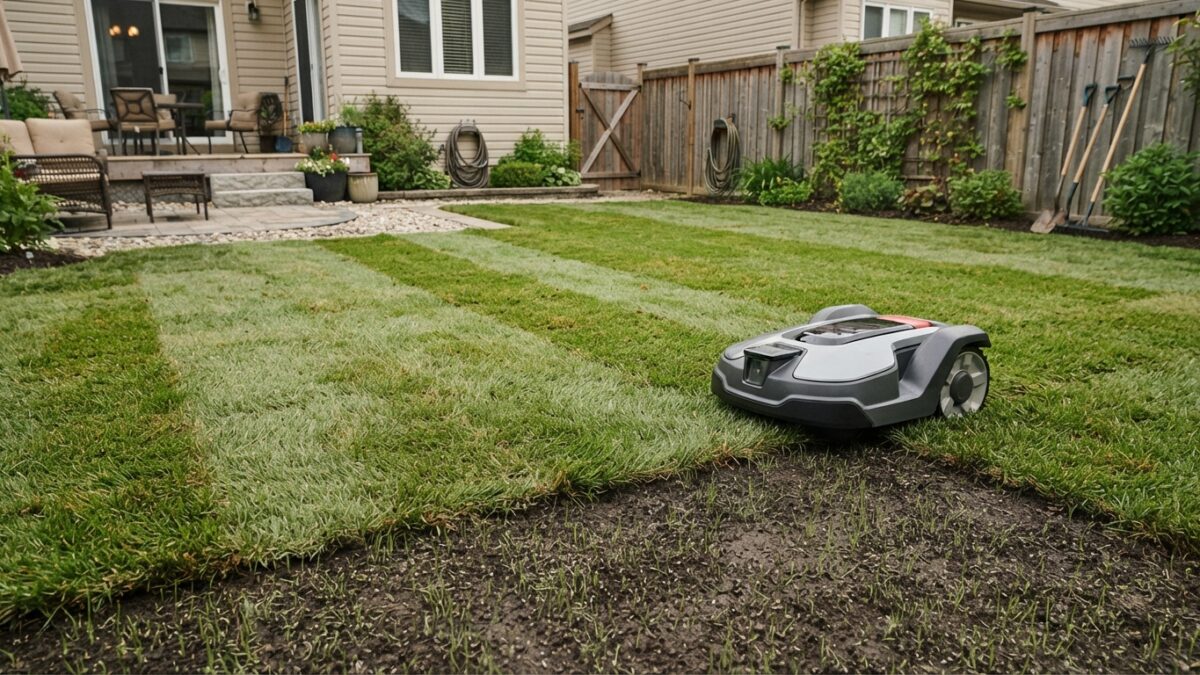
A new lawn and a new robot mower often arrive together: a new build, a renovated yard, or a homeowner who decided that if they’re paying for sod, they might as well stop mowing it themselves. It’s a good combination, but the first month matters. A robot mower crosses the same ground over and over and turns on the spot at every boundary. On sod that hasn’t rooted, that can shift pieces, open seams and leave ruts.
This guide gives you the timings from extension services, what robot mower makers say, a week-by-week plan, and which mowers are lightest on a new lawn. MowReview quotes no prices and hasn’t tested these mowers. How we research explains why.
How long new sod takes to root
| Source | Rooting time and first mowing |
|---|---|
| UF/IFAS (Florida) | Established three to four weeks after sodding; start mowing once roots have pegged down and the edges no longer lift when pulled |
| UGA (Georgia) | Firmly rooted in about 2 weeks; mow when grass reaches 1.5 times its recommended height |
| Clemson (South Carolina) | Don’t mow until the sod is firmly rooted and securely in place |
| LSU AgCenter | Mow once rooted, and only when the soil isn’t saturated, “to avoid rutting” |
| Purdue (Indiana) | Usually well rooted in about 10 days; keep people off for three to four weeks; mow slightly higher than normal at first |
| Penn State | Rooting may take up to 4 weeks; keep traffic off until well rooted |
| University of Minnesota | Tug test after about 10 to 14 days |
| Colorado State | Roots establish within two to three weeks |
Sources: UF/IFAS LH013; UGA B1533; Clemson HGIC Lawn Establishment; LSU AgCenter Sod Installation and Establishment; Purdue AY-28-W; Penn State Extension Lawn Establishment; University of Minnesota Extension; Colorado State PlantTalk 1517.
Warm-season sod laid in summer roots fastest. Rutgers notes that rooting slows in very hot weather, and cool-season sod laid in spring or fall can take the full four weeks. Go by the tug test, not the calendar.
The tug test
Gently pull up on a corner or edge of a piece of sod. The University of Minnesota says that if it resists, it has rooted and can be treated as an established lawn. UF/IFAS describes the same check: the grass should no longer “lift” when you pull at the edges. Test several spots, including sunny edges and any slope.
New seed takes longer
A seeded lawn is more fragile than sod for longer. Extension advice:
- Clemson: start mowing when seedlings are one-third taller than their normal height, and keep a sharp blade “to avoid pulling these seedlings out of the soil.”
- UGA: mow at 1.5 times the recommended height, avoid heavy use for the first 3 weeks, and don’t mow wet seedlings, which can be pulled up and rut the soil.
- NC State: for tall fescue, mow back to 3 inches when it reaches 4.5 inches.
- Texas A&M: dull mowers “can dislodge or damage young seedlings.”
For a seeded lawn, make the first two or three cuts with a conventional mower and bring the robot in once the grass is thick and anchored. That’s usually a few weeks after sod would be ready. The same applies when overseeding an existing lawn, or sowing micro clover into it; robot mowers on clover lawns covers clover. Robot mowers for tall fescue covers fall overseeding.
What robot mower makers say
- Sunseeker: “It is generally best to wait until the sod is fully rooted before allowing automated mowing equipment to operate.” It suggests a lightweight push mower or reel mower for the first cut, and warns that mowing on soft soil “can leave wheel marks, create ruts, or shift the sod.”
- Husqvarna: cut the grass to no more than 3.9 inches before installing an Automower. For the first weeks after a new installation, its manual says to set the cutting height to maximum, to avoid damaging the boundary wire while it settles into the lawn.
- Mammotion: its manual recommends a cutting height above 2 inches for initial use, and trimming only a third of the grass height at a time.
- Segway Navimow: the grass should be 3.6 inches or shorter when you map the lawn. It also advises against mowing after watering or heavy rain, when wheels slip.
A week-by-week plan
| When | What to do |
|---|---|
| Before the sod goes down | Decide where the charging station and any RTK antenna will go. Both need firm, flat ground. If you’ve chosen a wired mower, plan the wire route now. |
| Weeks 1 to 2 | Watering is heavy and frequent. Keep the robot boxed or parked. Stay off the sod as much as you can. |
| Around week 2 to 3 | Tug test. If it’s rooted and the grass is about a third above its target height, make the first cut with a light push mower on a dry day. |
| After the first cut | Map the lawn (Navimow asks for grass 3.6 in or shorter). Set the robot to its highest cutting height. |
| Weeks 3 to 6 | Run the robot on a light schedule, on dry ground. Lower the height a step at a time over a few weeks until you reach your target. |
| Ongoing | Watch seams, edges and the area in front of the dock for wear or shifting. |
Working around the watering
New sod needs a lot of water. UF/IFAS recommends several short watering sessions a day for the first 7 to 10 days, then daily watering, then two or three times a week. NC State says to keep the top 1.5 inches of soil moist, which may mean light watering two or three times a day for up to three weeks.
That’s exactly the soft, wet ground robot mowers struggle on. Segway says to avoid mowing after watering or heavy rain, because wheels slip, and Mammotion says soft ground causes wheel slip and marks. So once the robot starts, schedule it for the driest window of the day, well after the sprinklers run. Use the rain sensor or rain delay too: Worx’s Landroid Vision, for example, waits 180 minutes by default after its sensor dries. Robot mowers and in-ground sprinkler systems covers scheduling the two together.
Boundary wire and new sod
If you choose a wired mower, new sod is the easiest time to hide the wire. Robomow, a robot mower maker, says that after laying sod you have about a three-week window to slide the perimeter wire underneath before the roots grow in too firmly. Husqvarna says stapled wire disappears into an established lawn within a few weeks. A wire-free mower avoids the question entirely. Boundary wire vs. wire-free compares the two.
Does mower weight matter?
We found no manufacturer figures for wheel ground pressure, so weight is only a rough guide. But a lighter mower is easier on soft, freshly rooted sod, and easier to carry off it if the ground turns out wetter than you thought.
| Mower | Weight | Source |
|---|---|---|
| Mammotion YUKA mini | 23 lb | Mammotion |
| Segway Navimow i110N | 24 lb | Tom’s Guide |
| Ecovacs GOAT A3000 LiDAR | 36.16 lb | Ecovacs |
| Husqvarna Automower 435X AWD | 39 lb | Husqvarna |
| Mammotion LUBA 3 AWD | 41 lb | Mammotion |
| Segway Navimow X430 | 63.71 lb | PCWorld |
Light mowers for a new small lawn
Lightest here
Mammotion YUKA mini
- Stated weight23 lb
- Stated cutting height (U.S.)2.0 to 3.5 in
- Stated coverage0.15 acre (600H) or 0.2 acre (800H)
The lightest mower in this comparison, and TechRadar found it “compact and light enough that most able-bodied people should be able to carry it.” It gave TechRadar’s reviewer “neat, even cutting” that left the yard “looking far neater than if I’d cut it manually.” Its U.S. range starts at 2 inches, which suits the higher first cuts a new lawn needs, as well as St. Augustine, tall fescue and bluegrass sod kept at normal heights.
Good for
- Small new lawns up to about 0.2 acre
- Sod types kept at 2 inches or more
Less good for
- Bermuda or zoysia sod kept below 2 inches
- An easy setup: TechRadar found setup information lacking and the app “a bit unintuitive”
- Yards with weak Wi-Fi: TechRadar found the connection “could be patchy”
For larger new lawns you’ll need a bigger, heavier mower, and the waiting period matters more. Our main guide covers mowers for every size of yard, and getting your lawn ready for a robot mower covers the rest of the preparation.
Watch for these in the first month
- Seams opening. Clemson warns that sod shrinks as it dries and can leave gaps. A mower turning on a seam makes it worse. Top-dress gaps with soil.
- Drying edges. The University of Minnesota says to fill cracks with soil so edges don’t dry out, and LSU notes small pieces dry out fastest.
- Wear in front of the dock. The mower leaves and returns over the same strip every session. If it wears, move the dock or add a paver pad.
- Ruts on turns. If the wheels mark the lawn, the ground is too wet. Skip a session. Will a robot mower damage my lawn? covers wear paths.
Questions
How long should I wait before using a robot mower on new sod?
Until the sod has rooted, which extension services put at about 2 to 4 weeks. UGA says about 2 weeks, UF/IFAS says sod is established three to four weeks after laying, and Penn State says rooting can take up to 4 weeks. Use the tug test before starting the mower.
What is the tug test for new sod?
Gently pull up on a corner or edge of a sod piece. The University of Minnesota suggests doing it after about 10 to 14 days: if the sod resists, it has rooted and can be treated as an established lawn. If it lifts, give it more time.
Should the first cut on new sod be done by a robot mower?
Ideally not. Sunseeker, a robot mower maker, suggests a lightweight push or reel mower for the first cut and waiting until the sod is fully rooted before automated mowing. Extension services recommend letting new grass grow to about one-third to one-half above its target height before the first mow, and never removing more than a third.
When can a robot mower go on a newly seeded lawn?
Once the seedlings are tall and anchored enough to be mowed without being pulled out. Clemson says to start mowing when seedlings are one-third taller than their normal height, with a sharp blade, and UGA advises avoiding heavy use for the first 3 weeks.
Can I lay a boundary wire under new sod?
Yes. Robomow says that after laying sod you have about a 3-week window to slide the perimeter wire underneath before the roots grow in too firmly. If you’re choosing a wire-free mower, there’s no wire to lay.
What cutting height should a robot mower use on new sod?
Start high. Purdue recommends mowing new sod slightly higher than normal for the first few mowings to prevent scalping, Mammotion’s manual says to start above 2 inches, and Husqvarna’s manual says to set the cutting height to maximum for the first weeks after a new installation.
The short version
New sod needs about 2 to 4 weeks to root. Pass the tug test, make the first cut with a light push mower, then start the robot at its highest setting and lower it gradually. Seeded lawns need longer. Keep the robot away from the heavy watering schedule, run it only on dry ground, and watch seams, edges and the dock area for the first month. A light mower such as the YUKA mini or Navimow i-series is gentlest on a new small lawn.
New lawn, new mower?
Check the setup steps before the mower arrives.