How MowReview makes money: As an Amazon Associate, MowReview earns from qualifying purchases, at no extra cost to you. We don’t test mowers ourselves; we explain what manufacturers and independent testers report. How we research
Quick answer
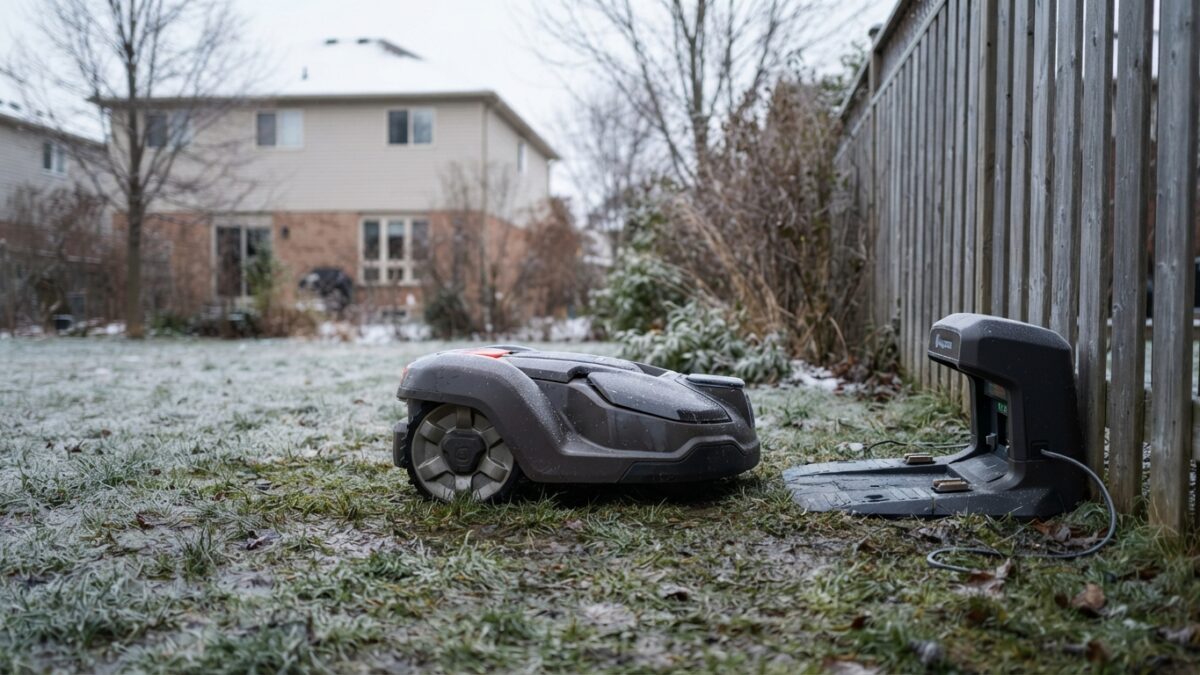
No, and you shouldn’t make one try. Robot mowers aren’t built to run in snow or on frosted grass: the cold harms the lithium battery, ice confuses the sensors, and mowing frozen or wet ground damages both the lawn and the mower. Grass stops growing around 40°F anyway, so there’s nothing to cut. Some models have a frost setting that parks the mower automatically when it gets too cold.
It’s a fair question, because a robot mower is designed to run on its own without you checking the weather. But winter is the one time you don’t want it out working, and the manufacturers agree.
MowReview hasn’t tested these mowers. The guidance below comes from the manufacturers’ own support pages.
Why not to run a mower in the cold
Three separate reasons, each enough on its own:
- The battery. Robot mowers use lithium-ion batteries, which Segway notes are sensitive to extreme temperatures, and warns that operating or charging in freezing conditions can significantly reduce battery performance, shorten its lifespan, or even cause permanent damage.
- The sensors. Segway also points out that ice, frost and snow can interfere with the mower’s sensors and cameras, disrupting GPS, RTK and vision-based positioning, which can make the mower misread its boundaries.
- The lawn. Frozen grass blades are damaged by anything driving over them, and Husqvarna notes that grass is extra sensitive to wear when the garden is covered with frost. Cold, wet or frozen ground also causes soil compaction and leaves marks.
There’s nothing to cut anyway
The clinching point is that in cold weather the grass isn’t growing. Husqvarna puts the threshold plainly: it’s usually not necessary to mow when it gets colder than about 40°F, because the grass more or less stops growing at that temperature. Segway gives a similar figure, noting that around 41°F grass growth slows considerably and mowing is generally unnecessary.
So running a mower in the cold risks the battery, the sensors and the lawn, to cut grass that isn’t growing. There’s no upside.
What some models do to protect themselves
Better mowers don’t rely on you to remember. Husqvarna’s Automowers offer a Frost Guard feature that automatically parks the mower when frost is forecast or detected. On models with a temperature sensor it uses that sensor; on connected models it uses the weather forecast, delaying or holding the mow when the temperature is around 41°F or below.
If your mower has a feature like this, turn it on for the shoulder seasons. It means an unexpected cold snap in fall or spring won’t send the mower out onto frosted grass while you’re not watching.
A parked mower on a cold morning may be working correctly
If your mower is sitting on its dock when it’s scheduled to run on a chilly morning, don’t assume it’s broken. Husqvarna notes this is often the Frost Guard setting doing its job. It will start again once the temperature rises.
So when do you actually stop for the year?
Not on a date, but on the grass and the temperature together:
- When growth has clearly stopped, which for most lawns lines up with daytime temperatures around 40°F.
- Before the first real frost, since freezing is hard on the battery. One winterizing guide advises getting the mower put away before the first real frost rather than after.
- As the season ends, Husqvarna suggests leaving the grass slightly longer, around 6 to 8 cm (roughly 2.5 to 3 inches), for better cold-weather protection.
At that point the mower comes in for the winter. Our winter storage guide covers the full routine, and there’s a separate guide if you don’t have a garage.
What about clearing snow?
A robot lawn mower is not a snow blower, and nothing about its design suits pushing snow. It has small cutting blades, low ground clearance and a battery that hates the cold. Don’t try it. If you’re curious how the two machines compare, that’s a question worth answering on its own, and mostly the answer is that they’re different tools for different jobs.
If your mower is having trouble getting back to its dock as it turns cold, that’s usually simple to fix: see robot mower won’t return to the dock in cold weather.
Warm-climate exception
If you’re in the South, where the grass may keep growing through a mild winter, the calendar doesn’t apply the same way. You mow while it grows and pause when it doesn’t, which may be only a short window. Our guide to running a robot mower year-round in the South covers that case.
Questions
Can a robot mower run in the snow?
No. Snow interferes with the sensors and cameras, the cold harms the lithium battery, and there’s no growing grass to cut. Robot mowers are designed to be stored indoors over winter, not run in freezing conditions.
Will frost damage my robot mower or lawn?
Mowing frosted grass damages the lawn, because frozen blades are harmed by driving over them, and Husqvarna notes grass is extra sensitive to wear under frost. Operating or charging the mower in freezing conditions can also harm the battery. Use a frost setting if your model has one, and stop mowing before hard frosts arrive.
At what temperature should I stop using my robot mower?
Around 40°F is the common guide, because grass more or less stops growing at that point, according to Husqvarna and Segway. Stop before the first real frost to protect the battery, and store the mower indoors for the winter.
Sources
- Husqvarna US support: Temperature ranges for use, charging and storage (40°F growth threshold)
- Husqvarna US support: Automower Frost Guard options
- Husqvarna: Automower support guide by season (final grass length, frost)
- Segway Navimow: Can robotic mowers cope with cold and wet weather (battery, sensors, frozen ground)
- Segway Navimow: When robotic lawnmowers take their winter break (growth slows near 41°F)
Time to put it away?
Once the frosts start, the mower belongs indoors. Here’s how to store it so it starts cleanly in spring.