How MowReview makes money: As an Amazon Associate, MowReview earns from qualifying purchases, at no extra cost to you. We don’t test mowers ourselves; we explain what manufacturers and independent testers report. How we research
Quick answer
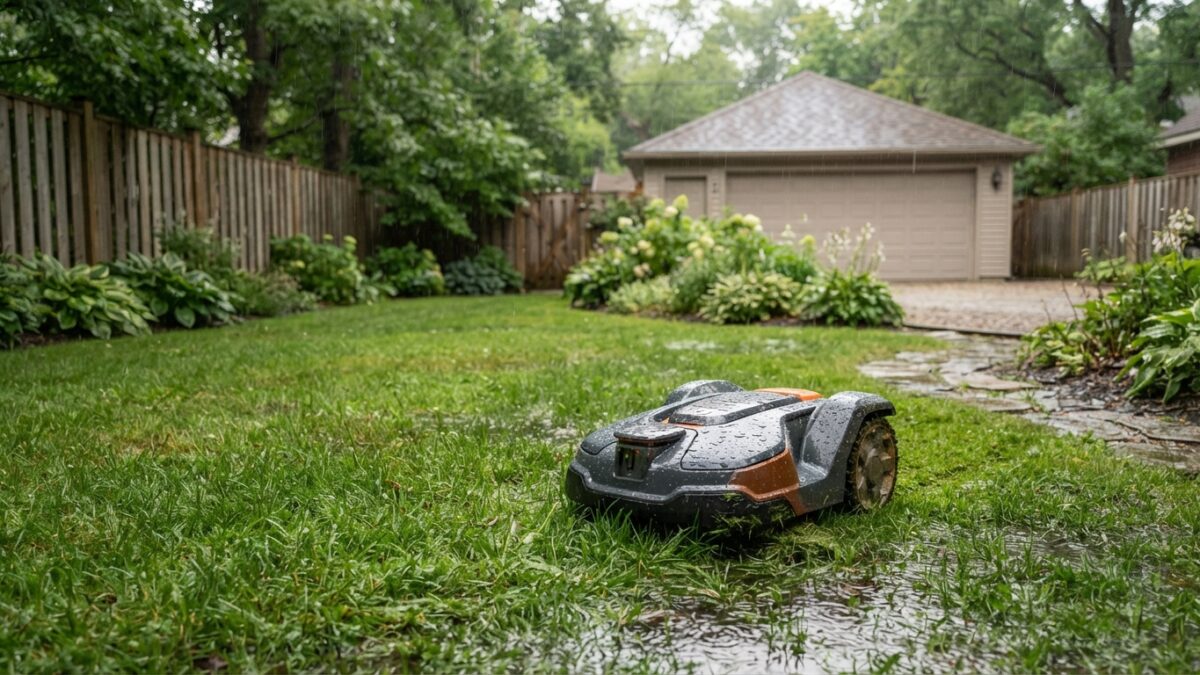
Yes, robot mowers are built to be rained on, and most will keep working through a shower. But working is not the same as cutting well. Wet grass bends instead of standing up, so the cut is ragged, clippings clump around the disc instead of mulching, and wet soil lets wheels slip and leave marks. A rain sensor, where fitted, is there to delay mowing rather than to make wet mowing work. The sensible setup is to let it run in light rain, keep it off standing water and mud, and accept a slightly untidy week rather than fighting it.
This is one of the most common questions from anyone considering a robot mower, and the honest answer has two halves that usually get muddled together: whether the rain harms the machine, and whether the machine does a good job in the rain. The first answer is reassuring. The second is not.
The machine is fine. The cut isn’t.
Robot mowers are designed to live outdoors and to be rained on. They dock outside, they work unsupervised, and manufacturers build them accordingly. Mammotion’s own guidance puts it plainly: wet grass does not automatically damage a properly designed robot mower.
But the same guidance is equally clear that water resistance is not permission to mow in the wet, and that repeated operation in unsuitable conditions increases grass buildup, cleaning work, and traction and cutting problems. That distinction is the whole subject.
What an IP rating does and doesn’t tell you
IP figures describe how well an enclosure resists water and solid particles getting in. Mammotion makes the point directly: an IP rating does not by itself guarantee effective mowing in heavy rain. A mower can be thoroughly protected against water and still cut badly in it, because the problem is the grass, the soil and the clippings — not the electronics.
What actually goes wrong on wet grass
The cut gets ragged
Wet grass blades bend over and stick together rather than standing up to be cut. Mammotion describes the result as ragged or less clean grass tips and uneven-looking areas. Ohio State extension guidance makes the same point about mowing generally: wet turf is harder to cut cleanly and interferes with proper mulching.
On a robot mower this matters more than on a push mower, because the cutting mechanism is a small pivoting blade taking a tiny amount off the top. It relies on the grass presenting itself upright. Lying flat and slick with water, it doesn’t.
Clippings clump instead of mulching
Mulching is the main agronomic advantage of robot mowing — Ohio State extension notes that collecting clippings removes most of the nitrogen you applied to the lawn. Wet clippings undermine that: they stick together, accumulate around the cutting area, and build up under the deck, where they hold moisture against the machine and blunt performance until you clean them out.
Wheels slip and mark the lawn
This is the one that does lasting damage. Soft, saturated soil under repeated wheel traffic gives you slip, wheel marks and difficulty holding a planned path — worse on any slope. Clemson extension guidance identifies traffic as probably the leading cause of soil compaction in lawns, and notes that poorly drained heavy soils with heavy traffic compact most readily.
A robot mower is, by design, heavy traffic: the same small wheels crossing the same ground several times a week. Do that on wet clay through a rainy fortnight and you can see the result in the lawn by midsummer. Our guide to whether a robot mower damages your lawn covers that in detail.
It gets stuck more
Wet grass on a slope is where slope ratings stop meaning much. A mower rated for 30% on dry turf may spin on 20% when it’s wet, especially with a build-up of clippings on the tyres. If yours stops repeatedly in the wet and not otherwise, that’s the explanation — see why robot mowers get stuck and what slope ratings really mean.
What a rain sensor actually does
Rain sensors are widely advertised and widely misunderstood. They do not make a mower better at cutting wet grass. Their purpose, as Mammotion puts it, is generally to prevent the mower operating during unsuitable weather — they detect rain and delay the schedule, then resume once things dry.
That leads to a genuine split in how owners feel about them:
| Sensor pausing in rain | Mowing through the rain |
|---|---|
| Better cut quality, better mulching | Lawn never falls behind, even in a wet week |
| Less clumping under the deck | More cleaning, more often |
| Less wheel marking and compaction | Visible wheel marks in soft ground |
| Grass can get ahead of you in a wet spell | More stuck alerts, especially on slopes |
| Best for clay soils and any slope | Defensible on flat, free-draining sandy soil |
If your lawn is flat and sandy, mowing through light rain costs you little. If it’s clay, sloped, or both, let it pause.
Where to draw the line
Mammotion’s guidance is to avoid operating when there is standing water, mud, severe wheel slip or continuing heavy rainfall. That’s a good rule. In practice:
- Dew and light drizzle: fine. Most owners never think about it, and the mower catches up.
- Steady rain: let it pause if you can, particularly on slopes.
- Heavy rain, or the day after a downpour: keep it docked. This is when wheel marks are made.
- Standing water or squelching underfoot: definitely not. If your footprint fills with water, so will the ruts.
- Frost, not rain: a separate problem, and a worse one — frosted grass snaps rather than cuts. Snow and frost covers it.
The soft-ground test
Walk onto the lawn in ordinary shoes. If your heel leaves a visible dent, small wheels crossing that ground repeatedly will leave more than a dent. That simple test is more reliable than any weather app, and it’s the same test worth doing in spring before the mower comes out of storage.
Setting the schedule around weather
- Mow in the afternoon, not at dawn. Morning dew is the wettest the lawn gets on a dry day. Shifting the window a few hours later improves the cut for free.
- Leave the rain sensor on if you have a slope. This is the setting most worth defaulting to conservative.
- Cut the hours back in a wet spell, don’t add them. The instinct when the lawn looks untidy is to run it longer. On soft ground that makes the lawn worse, not better.
- Raise the cutting height in a wet season. Taller grass copes better with a ragged cut, and a higher disc is less likely to gather wet clippings.
- Plan around the season, not the week. In a Pacific Northwest spring or a Gulf Coast summer, wet is the normal condition, and the schedule should reflect that rather than being fought every few days.
Cleaning after a wet spell
This is the maintenance job that wet weather adds, and skipping it is what turns a wet fortnight into a blunt, badly-cutting mower.
- Turn it off before you touch the underside. Not paused — off, with the PIN or safety switch as your model requires.
- Scrape, don’t blast. Wet clippings pack hard around the disc. A brush, a plastic scraper and a damp cloth are the tools. High-pressure washing is the commonest way owners damage a robot mower — check what your manual permits before any hose goes near it.
- Check the blades. Wet grass and grit accelerate wear. Husqvarna puts main-disc blade life at 3 to 6 weeks of normal use, with frayed or whitened grass tips as the signal they’re due, and specifies new screws each time you change them.
- Check the wheels. Tread packed with mud is a large part of why it slipped in the first place.
- Check the charging contacts. Damp plus debris is how corrosion starts, and corroded contacts are a leading cause of docking trouble.
- Check the alarm still works. Lifting the mower to clean it triggers the lift alarm on most models, and owners who find that irritating often disable it and forget — see robot mower theft protection.
The full routine is in robot mower maintenance.
Regional reality check
| Region | The wet-weather problem | What to do differently |
|---|---|---|
| Pacific Northwest | Months of damp; ground stays saturated long after rain | Rain sensor on, shorter schedules, expect a spring pause |
| Southeast, Gulf Coast | Daily summer storms; growth is fastest when it’s wettest | Raise the height, mow in the morning gap before afternoon storms |
| Midwest, Northeast | Wet springs on heavy soils | Delay the spring start until the ground firms, not just warms |
| Texas, Southwest | Dry most of the year, then intense downpours | Dock it for a day or two after a storm rather than adjusting the season |
| Mountain West | Free-draining soils, quick recovery | Least affected; light rain is a non-issue |
| Florida | Wet season plus fast-growing warm-season grass | Higher cut, more cleaning, more frequent blade changes |
Questions
Can a robot mower be left outside in the rain?
Yes — they are designed to work and dock outdoors, and rain on the machine itself is not a problem. What is a problem is prolonged storage outdoors through winter: Husqvarna specifies indoor storage above freezing for the mower, though it notes some docking baseplates are built to stay outside.
Should I turn the rain sensor on or off?
On, if your lawn has any slope or heavy clay soil — the cut is better and you avoid wheel marking. Off is defensible on flat, free-draining ground where you would rather the lawn never fell behind, at the cost of more frequent cleaning.
Why is my lawn uneven after mowing in the wet?
Because wet grass bends and sticks together instead of standing up, so the blade misses some of it and tears the rest. Mammotion describes the result as ragged tips and uneven-looking areas. It grows out within a cut or two once conditions dry.
Will mowing wet grass damage my lawn?
The cutting won’t, but the wheels can. Clemson extension guidance identifies traffic as probably the leading cause of soil compaction in lawns, and saturated soil compacts far more easily than dry. Repeated passes over sodden ground are what leave marks and compacted strips.
Can I hose down my robot mower?
Check your manual first, because models differ and some explicitly prohibit it. High-pressure washing in particular is a common way to force water past seals. A brush, a plastic scraper and a damp cloth handle almost all of it.
Does mowing in the rain wear the blades faster?
Yes. Wet grass carries grit and soil onto the blades, and wet clippings pack around the disc. Expect to be changing blades nearer the 3-week end of Husqvarna’s stated 3-to-6-week range during a wet spell, and to be cleaning the underside more often.
The short version
Rain doesn’t hurt the mower. It hurts the cut, the mulching and — if the ground is soft — the lawn. Let it run in drizzle, let it pause in steady rain if you have slopes or clay, and keep it docked when there’s standing water or mud. Shift the schedule to the afternoon, raise the cutting height in a wet season, and clean the underside properly afterwards. A slightly untidy week is a much better outcome than a compacted, wheel-marked lawn.
Getting the most from the mower you have
Wet weather, wheel marks and worn blades are all the same conversation: how the mower and the lawn get along over a season.