How MowReview makes money: As an Amazon Associate, MowReview earns from qualifying purchases, at no extra cost to you. We don’t test mowers ourselves; we explain what manufacturers and independent testers report. How we research
Quick answer
In a yard with pets and children, the feature worth paying for is obstacle avoidance that detects things before the mower touches them. That means LiDAR plus AI camera recognition, not a bump sensor. Three strong options: the Ecovacs GOAT A3000 LiDAR, which Ecovacs says recognizes more than 200 obstacle types with a 3D ToF LiDAR and AI camera; the Mammotion LUBA 3 AWD, which EasyLawnMowing found picked out a football and a dog toy; and the compact Mammotion YUKA mini 2, which spotted a glove and a small ball. None of this replaces the basic rule, though: don’t mow while pets or children are out on the lawn.
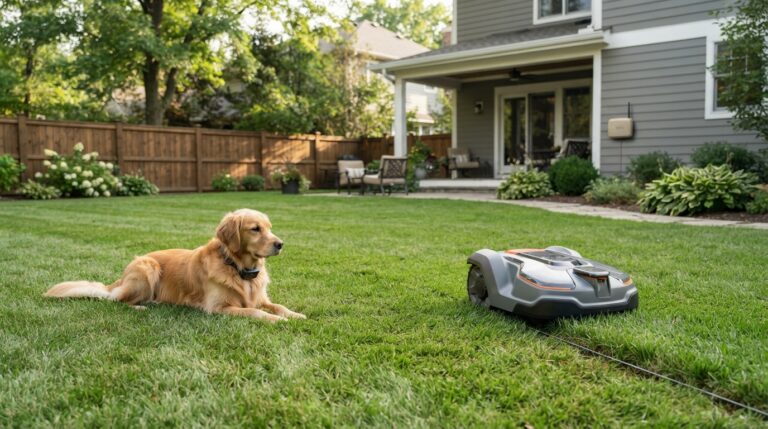
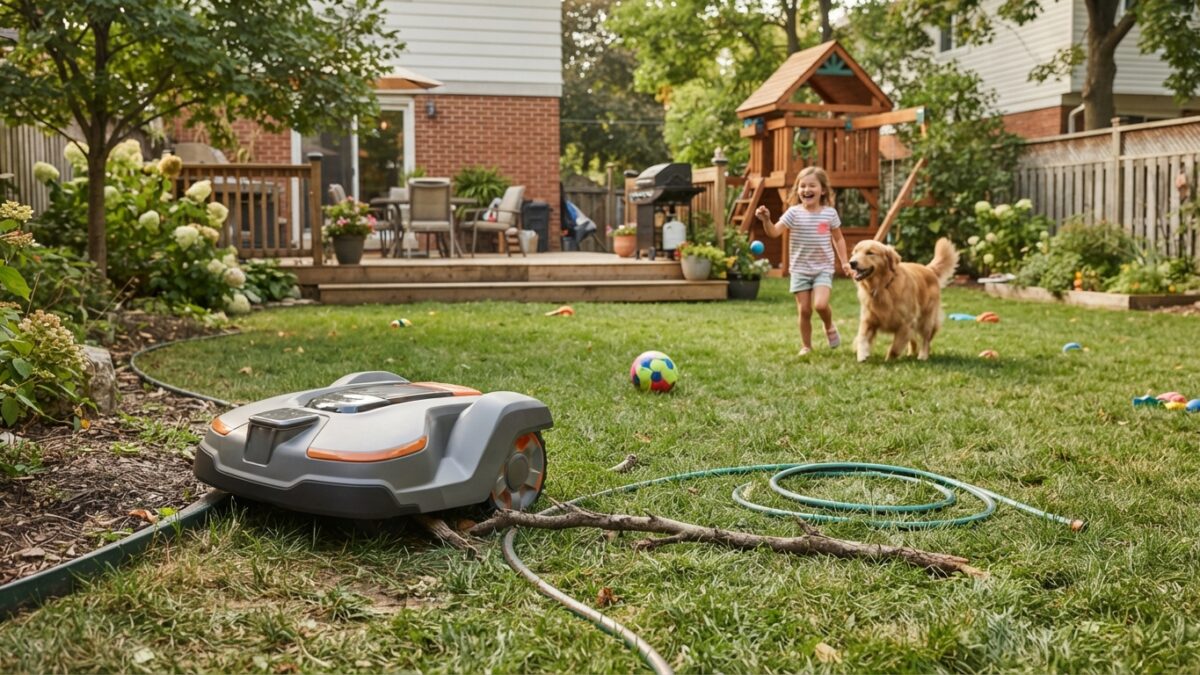
Older robot mowers find obstacles by bumping into them. That works for a tree trunk. It works badly for a tennis ball, a garden hose, a sleeping cat or a toddler’s toy truck, which get run over, pushed around or chewed up. Newer mowers use cameras and LiDAR to see objects before contact. For households with pets and children, that is the upgrade that matters most.
This guide explains how the detection technologies differ, what independent testing found, and what research says about the limits. MowReview quotes no prices and hasn’t tested these mowers. How we research explains why.
Why contact detection isn’t enough
The clearest evidence comes from Oxford University researchers who tested robotic mowers against 50 live hedgehogs. They found that every mower tested needed physical contact to detect the animal, and some failed to detect it at all. The results ranged from a light nudge and a change of direction to the mower running straight over the animal with its blades turning. The researchers recommended sensors that detect at a distance and blades that fold away when they strike something harder than grass.
Hedgehogs aren’t an American species, but the lesson carries over directly to a puppy asleep in the grass, a cat stalking along a flower bed, or a toy left out overnight. A mower that only “sees” by touch finds these things too late.
Detection technologies, compared
| Technology | How it works | Good at | Weak at |
|---|---|---|---|
| Bump sensor | Detects contact, then turns | Solid, tall obstacles | Anything soft, small, low or alive |
| AI camera | Recognizes objects in images | Identifying what things are | Darkness, glare, dirty lenses |
| LiDAR | Measures distance with laser pulses | Shape and position, day or night | Telling what an object is |
| LiDAR plus AI camera | Combines both | Detecting and identifying at a distance | Very low, flat objects in long grass |
The strongest systems combine both. LiDAR finds that something is there, and the camera works out what it is. That’s the common thread in all three picks below.
Cameras need light
Camera-based recognition depends on light. Husqvarna, for example, says its vision-based features don’t work at night on its 300-series models. For a pet household, that’s one more reason to run the mower in daylight only, when detection works best and when you can see the lawn.
The picks
Most detailed stated obstacle recognition
Ecovacs GOAT A3000 LiDAR
- Stated recognition200+ obstacle types
- Sensors360° LiDAR, 3D ToF LiDAR, 150° fisheye AI camera
- Stated coverageUp to about 0.75 acre
Ecovacs describes its AIVI 3D system as combining a 150-degree fisheye camera, AI algorithms and a forward-facing 3D time-of-flight LiDAR. It says the system recognizes more than 200 obstacle types. Two LiDARs plus a camera give it both distance and identification, the combination the Oxford researchers pointed toward.
Good for
- Family yards with toys, hoses and garden clutter
- Mid-size lawns up to about three-quarters of an acre
Less good for
- Steep yards: its stated slope limit is 50%
- Standard St. Augustine lawns at 4 inches, since its range stops at 3.6
- Buyers wanting independent confirmation: the 200-type figure is Ecovacs’ own claim
Independently tested with a dog toy
Mammotion LUBA 3 AWD
- Stated recognition300+ obstacle types
- Sensors360° LiDAR plus dual-camera AI vision
- Stated max slope80%
EasyLawnMowing’s hands-on review found it recognized small objects placed in its path, a football and a dog toy, and also avoided an unmapped bench and raised lawn lights. TechRadar reported its obstacle avoidance performed well at both standard and sensitive settings. That independent testing is the reason it’s here.
Good for
- Larger or sloped family yards
- Owners who want a sensitive setting for extra caution
Less good for
- Shady lawns, where TechRadar found the front tires could damage grass
- Muddy yards: TechRadar found the front wheels collect a lot of mud, which gets tracked back in by pets too
- Simple app setup: TechRadar reported occasional connectivity problems and interface quirks
Best for small family yards
Mammotion YUKA mini 2
- Sensors360° LiDAR plus AI vision
- Stated detection rangeUp to about 197 ft (LiDAR)
- Stated coverageAbout 0.25 acre
EasyLawnMowing tested it with a football, a glove and a small ball, and rated its avoidance of low-profile objects “excellent”. It detected and sidestepped the kind of small items that other models miss. For a smaller yard strewn with toys, that’s exactly the test that matters.
Good for
- Small suburban yards with children’s toys around
- Tight layouts with narrow paths
Less good for
- Lawns over about a quarter acre
- Changing cutting height per zone from the app, which EasyLawnMowing says isn’t possible
- Alerts away from Wi-Fi without the separately sold 4G module
What obstacle avoidance can’t do
These mowers are much better than bump-sensor models, but the limits are real:
- Test results use objects, not animals. A football or a dog toy is a reasonable stand-in, but no reviewer can test on a sleeping puppy, and none should.
- Low, flat things in long grass are the hardest case for any sensor. A small animal lying flat is exactly that case.
- Darkness, glare and dirt reduce camera performance. Keep lenses clean and run the mower in daylight.
- A stated number of obstacle types is a manufacturer claim, not a guarantee that every object is recognized every time.
So the household rules stay the same whatever you buy.
Rules for a pet and child household
- Mower out, pets and children in. Schedule mowing for when the lawn is empty, such as school hours or while the dog is indoors.
- Daylight only. Detection works best, and animals are most visible.
- Walk the lawn before a run to pick up toys, and to clear up after the dog, which otherwise gets spread across the lawn.
- Use the most sensitive detection setting the mower offers.
- Keep-out zones around sandboxes, play areas and anywhere pets like to lie.
- Teach children that the mower isn’t a toy, and never to pick it up or reach under it.
Are robot mowers safe? covers the built-in safety features, such as blades that stop when the mower is lifted, in more depth.
Questions
Which robot mower has the best obstacle avoidance?
Look for mowers combining LiDAR with AI camera recognition. The Ecovacs GOAT A3000 LiDAR states recognition of 200+ obstacle types, the Mammotion LUBA 3 AWD was found by EasyLawnMowing to detect a football and a dog toy, and the Mammotion YUKA mini 2 was rated excellent at avoiding small, low objects.
Will a robot mower detect my dog or cat?
Camera and LiDAR mowers are far more likely to than contact-only mowers, but no model guarantees it. Oxford research found the mowers it tested needed physical contact to detect an animal, and some failed entirely. Don’t mow while pets are on the lawn.
Do robot mowers run over kids’ toys?
Bump-sensor mowers often do. Models with LiDAR and AI vision can detect many toys before contact, and EasyLawnMowing found both the LUBA 3 AWD and the YUKA mini 2 avoided balls and similar objects. Picking up toys before a run is still the reliable fix.
Does obstacle avoidance work at night?
Camera-based recognition needs light. Husqvarna says its 300-series vision features don’t work at night. LiDAR works in the dark, but combined systems are at their best in daylight, so schedule mowing for the day.
Is LiDAR better than a camera on a robot mower?
They do different jobs. LiDAR measures distance and shape in any light, and a camera identifies what an object is. The best obstacle avoidance combines both, which is what all three models in this guide do.
Can I rely on obstacle avoidance instead of keeping pets inside?
No. Obstacle avoidance reduces the risk from forgotten toys and hoses, but it isn’t a substitute for keeping pets and children off the lawn while the mower runs. Schedule it for when the lawn is empty.
The short version
In a yard with pets and children, pay for LiDAR plus AI camera detection rather than a bump sensor. The GOAT A3000 LiDAR has the most detailed stated recognition, the LUBA 3 AWD has been independently tested with a dog toy and suits larger or sloped yards, and the YUKA mini 2 handled small toys well in a small yard. Then keep the rules anyway: daylight only, lawn empty, toys and dog mess picked up first.
How the navigation behind it works
Obstacle avoidance comes from the same sensors that do the navigation, so it’s worth understanding both.