How MowReview makes money: As an Amazon Associate, MowReview earns from qualifying purchases, at no extra cost to you. We don’t test mowers ourselves; we explain what manufacturers and independent testers report. How we research
Quick answer
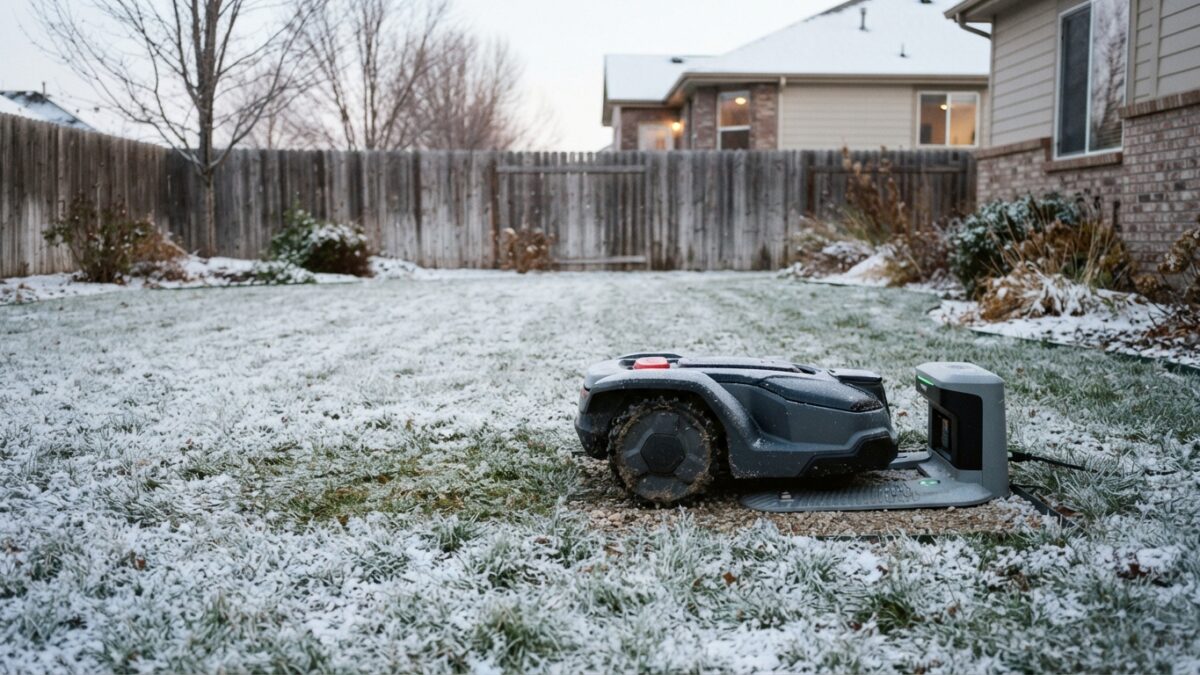
Going into winter, leave the grass slightly longer than in summer, around 2.5 to 3 inches, because longer blades protect the lawn in cold weather. Keep mowing while the grass grows, stop when it doesn’t (around 40°F), and stop before hard frost. Mulching a light leaf fall feeds the soil; a heavy layer needs clearing. This is about the lawn, not the mower, though the two line up.
Most winter robot mower guides are about the machine: clean it, store it, protect the battery. This one is about the lawn. What you do in the last few weeks of the season affects how the grass comes through winter and how it looks next spring.
The good news is that a robot mower’s natural habit, cutting a little and often, suits fall lawn care well. It just needs a few adjustments.
Raise the cut for winter
The most important change. Husqvarna’s seasonal guidance is to leave the grass slightly longer as the season ends, giving a recommended final length of 6 to 8 cm, which is roughly 2.5 to 3 inches, because longer grass provides better cold-weather protection for your lawn.
Longer grass going into winter does several things: it captures more of the weak winter light, it shades out late weeds, its deeper roots are hardier, and it’s less prone to disease than grass scalped short. Raise the height gradually over the last few weeks rather than in one jump.
The one exception: don’t leave it too long either
Very long grass left over winter can mat down under snow and encourage disease. “Slightly longer” is the aim, not “unmown.” The 2.5 to 3 inch range is a good target for most lawns; your county’s Cooperative Extension office can give a figure for your specific grass.
Keep mowing until growth actually stops
Don’t stop on a date. Husqvarna advises mowing as long as the grass is actively growing, and notes that growth more or less stops around 40°F. Segway gives a similar figure, adding that near 41°F the ground can also be hard or damp, which strains the mower and damages the lawn.
So the signal to stop is a combination: growth has clearly slowed, and daytime temperatures are dropping toward 40°F. At that point the last cut has effectively happened on its own, since the mower simply has less and less to do.
Mulching leaves into the lawn
A robot mower mulches as it cuts, dropping fine clippings back onto the lawn. Applied to a light scattering of leaves, that’s a genuine benefit: the chopped leaves break down and return organic matter to the soil, which is why many lawn guides recommend mulch-mowing a light leaf fall rather than bagging it.
The limit is depth. Once leaves cover the grass rather than sitting among it, they block light and hold moisture against the lawn, which causes problems over winter. At that point, rake or blow the heavy piles and let the mower handle the rest. Our guide to robot mowers and fall leaves covers this in full.
Stop before hard frost
Two reasons, one for the lawn and one for the mower:
- For the lawn: frozen grass blades are damaged by anything driving over them, and Husqvarna notes grass is extra sensitive to wear when covered with frost.
- For the mower: the lithium battery is harmed by freezing conditions, so it’s better to have the mower put away before the first real frost than after.
If your mower has a frost feature, turn it on for the shoulder season so an early cold snap doesn’t send it out onto frosted grass. More on that in do robot mowers work in snow and frost.
A simple end-of-season sequence
- Through fall, raise the cutting height a step at a time toward 2.5 to 3 inches.
- Keep the mower running while the grass grows, shortening sessions as growth slows.
- Mulch light leaf falls; clear heavy ones by hand.
- Watch for growth stopping and temperatures nearing 40°F.
- Stop before the first hard frost.
- Clean the mower, fit new blades, and store it indoors.
The mower side of that final step is in our winter storage guide, and the whole seasonal routine in the fall checklist.
What about overseeding and feeding?
Fall is a common time to overseed cool-season lawns and to apply a fall feed. Both affect mowing: new seed needs to be left undisturbed until it’s established, so pause the mower or set a no-go zone over seeded areas. Timing for overseeding and feeding varies by region and grass type, and your local Extension office is the reliable source. The mowing rule is simple: don’t drive over new seed until the young grass is rooted and long enough for your raised fall cutting height.
Keeping the lawn friendly to birds and other wildlife matters most in the cold months: see robot mowers and garden birds.
Southern lawns
Warm-season grasses follow a different calendar and brown off into dormancy rather than being mown to a winter height. If that’s your lawn, see running a robot mower year-round in the South and robot mowers for St. Augustine, Bermuda and zoysia.
Questions
How short should I cut my lawn before winter?
Slightly longer than in summer. Husqvarna recommends a final length of about 2.5 to 3 inches, because longer grass gives better cold-weather protection. Avoid scalping the lawn short going into winter, and avoid leaving it very long, which can mat under snow.
When is the last mow of the year?
When the grass stops growing, which happens around 40°F, and before the first hard frost. There’s no fixed date: it depends on your region and grass type. With a robot mower, the last cut tends to happen naturally as growth slows and there’s less to do.
Is it OK to mulch leaves into the lawn over fall?
A light scattering, yes. Chopped leaves break down and feed the soil, which is why mulch-mowing a light leaf fall is often recommended over bagging. A thick layer that covers the grass should be raked or blown away first, since it blocks light and traps moisture over winter.
Sources
- Husqvarna: Automower support guide by season (final grass length 6–8 cm, frost sensitivity)
- Husqvarna US support: Temperature ranges (growth stops near 40°F)
- Segway Navimow: When robotic lawnmowers take their winter break (hard or damp ground near 41°F)
- Segway Navimow: Cold and wet weather guidance (battery, frozen ground)
Lawn ready? Now put the mower away right
The last step of the season is storing the mower so it starts cleanly in spring.