How MowReview makes money: As an Amazon Associate, MowReview earns from qualifying purchases, at no extra cost to you. We don’t test mowers ourselves; we explain what manufacturers and independent testers report. How we research
Quick answer
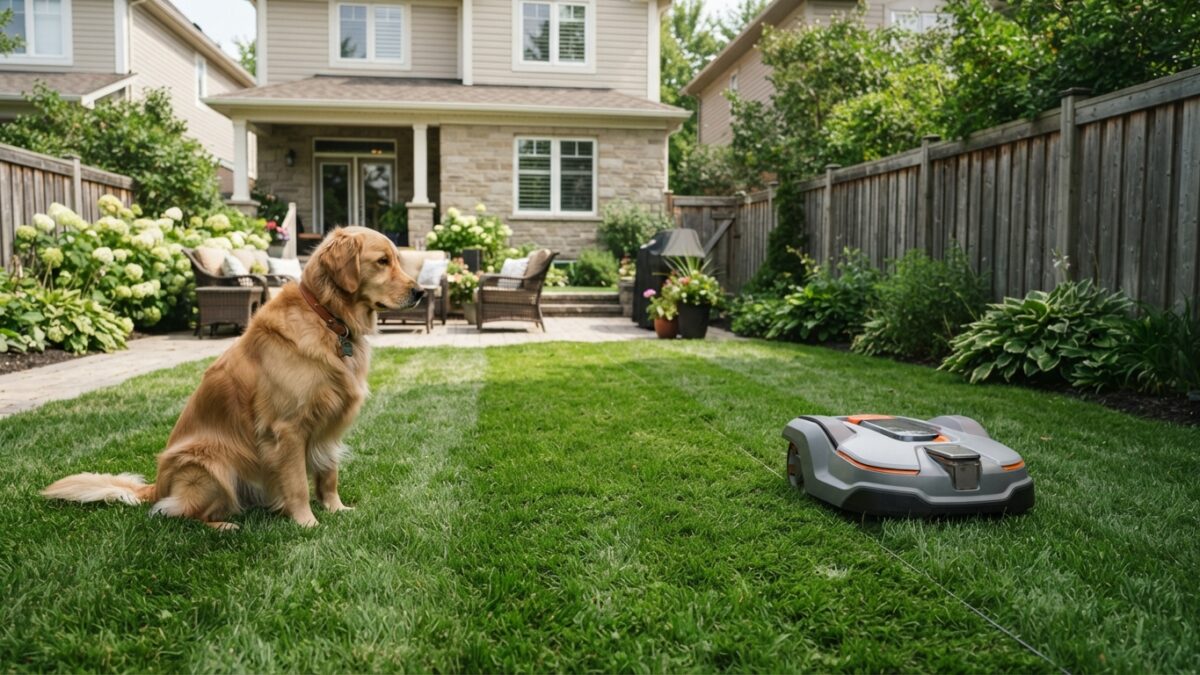
A robot mower and a dog can share a yard perfectly well, but not at the same time unsupervised. The blades sit recessed under the body and stop when the mower is lifted or tilted, which makes serious injury to a standing adult dog unlikely — but published research on robotic mowers and wildlife found the machines needed physical contact to detect an animal at all, and some failed to detect one entirely. So the rule is simple: dog out, mower in; mower out, dog in. The two problems you’ll actually meet most are dog waste being spread across the whole lawn, and a dog that wants to chase or challenge the machine.
This question comes up more than almost any other, and it deserves a straight answer rather than either reassurance or alarm. Robot mowers are designed with safety features that work well for their intended purpose. They are not designed to identify and avoid a living animal, and it’s important to understand the difference.
For the general safety picture, including children, see are robot mowers safe? — this post is specifically about living with a dog.
What the safety design actually does
Robot mowers sold in the US are covered by a safety standard, ANSI/OPEI 60335-2-107, which specifies safety requirements for the design and construction of robotic battery-powered rotary mowers and their charging stations, addressing hazards in intended use and reasonably foreseeable misuse. That standard is why every mainstream mower shares a common set of protections:
- Recessed blades. The cutting disc sits well inside the footprint of the body, not at its edge. Something has to get underneath to reach it.
- Small pivoting blades. Most use thin razor-style blades that swing back on impact rather than a rigid steel bar. They are designed to cut grass and to give way to anything harder.
- Lift and tilt sensors. Raise or tip the mower and the blades stop. This is the protection that matters most, and it is standard.
- Collision sensors. The mower detects contact with an obstacle and changes direction.
- Stop button and PIN. A physical stop, and on most models a PIN needed to restart.
For an adult dog standing or walking on the lawn, that combination makes a serious cutting injury genuinely unlikely. The mower will bump the dog and turn away, and most dogs quickly lose interest.
Where the design stops helping
The limitation is detection, and there is good published evidence on it. Oxford University researchers tested robotic mowers against 50 live hedgehogs and found that all the mowers tested required physical contact to detect the animal, and some did not detect it at all. Outcomes ranged from the mower lightly nudging the animal and changing direction to running straight over it with the blades still running. Their recommendations were for sensors that detect at a distance rather than on contact, and for blades that fold away under a protective surface when striking something harder than grass.
Hedgehogs aren’t American wildlife, but the finding transfers directly, and it identifies exactly the risk that matters for pets:
The real risk isn’t a standing dog. It’s a lying one.
A mower that only detects by contact cannot tell the difference between a shrub and a sleeping puppy, and small, low or flat-lying animals are the ones the research found most at risk. The scenarios to take seriously are a small dog asleep in long grass, a puppy, a dog lying flat in the shade, a dog that doesn’t hear well, or a dog physically unable to move out of the way quickly. For those, the mower’s protections are much less reassuring than they sound.
The rule that solves it
Don’t run the mower and the dog on the lawn at the same time without you there. That’s it, and it’s easier than it sounds because robot mowers are scheduled machines.
- Schedule the mower for times the dog is indoors. Mid-morning to mid-afternoon while you’re at work is the usual answer, and it’s the best time for the cut too — the dew has gone and, as our noise guide explains, daylight running also keeps camera-based navigation features working.
- Never overnight. Night mowing puts an undetectable-by-contact machine out at the hours when animals are least visible and least alert.
- Use the app. Most mowers can be paused and sent home from your phone in a couple of taps. A dog wanting out mid-cycle is a two-second problem.
- Supervise the first few encounters. You want to know whether your dog ignores it, chases it or attacks it before you make assumptions.
- Be stricter with puppies and elderly dogs. Puppies investigate everything and are small enough to be genuinely at risk; older dogs may not move quickly or hear it coming.
The problem nobody warns you about: dog waste
This is, in practice, the single biggest day-to-day issue for dog owners with a robot mower, and it is worse than most people imagine before it happens.
A push mower covers the lawn once a week, in lines, with you watching. A robot mower covers it several times a week, in unpredictable patterns, unsupervised. Anything on the lawn gets driven over repeatedly and distributed. Dog waste goes onto the wheels, onto the underside of the deck, into the grass across a wide area, and then back to the charging station.
What to do about it
- Clear the lawn before every scheduled run, not weekly. This becomes a thirty-second habit, and it’s the whole solution.
- Pick a consistent schedule so the clearing habit attaches to a known time rather than needing to be remembered.
- Train a toilet area if you can. A gravelled or mulched corner outside the mowing zone solves the problem permanently, and you can map it as a keep-out zone.
- If it happens, deal with the mower properly. Power it off, clean the underside and wheels with a brush and a damp cloth, and check what your manual says before any hose goes near it. Also clean the charging contacts.
- Consider skipping a run after heavy rain. Wet waste spreads much further than dry.
Dogs that chase the mower
Reactions vary enormously, and most dogs settle within a week or two. The common patterns:
| Behaviour | What it usually means | What to do |
|---|---|---|
| Ignores it after a day or two | Most common outcome | Nothing. Keep the schedule separate anyway |
| Barks at it from a distance | Novelty; usually fades within a fortnight | Don’t reward the barking with attention; let it become boring |
| Herds or chases it | Common in herding breeds | Strict separation. A chasing dog is at the front of the machine, which is where you least want it |
| Bites or attacks it | Territorial response to an intruder | Strict separation permanently. Damaged sensors and bodywork are expensive, and teeth near a cutting deck are not acceptable |
| Frightened, avoids the whole yard | Noise or movement sensitivity | Introduce it stationary and switched off, then mowing at a distance; run it only when the dog is inside |
| Digs up the boundary wire | Terrier logic | Bury the wire deeper or consider a wire-free mower — see wire versus wire-free |
Things dog owners specifically should check when buying
- Obstacle detection method. A mower that detects by camera or sensor at a distance is meaningfully better around animals than one that detects on contact. This is the one feature worth paying for if you have pets. Navigation compared sets out the differences.
- Blade type. Thin pivoting blades that swing back on impact are the safer design; the Oxford researchers specifically recommended blades that fold away under a protective surface.
- Keep-out zones. If you want a toilet corner, a kennel run or a dog bed area excluded, check the model actually supports no-go zones.
- App pause and send-home. You will use this constantly. Make sure it’s quick.
- Boundary wire versus wire-free if your dog digs. A chewed wire is a fault-finding afternoon.
The other animals in an American yard
Dogs are the easy case, because you control where they are. Worth thinking about too: rabbits and their nests in the lawn, box turtles in the Southeast, toads and frogs near water, ground-nesting birds, and cats that sleep in long grass. The Oxford findings apply to all of them, and the mitigations are the same — daylight running, a walk of the lawn before a scheduled cut, and keep-out zones around anywhere an animal shelters. Robot mowers and garden wildlife goes into this properly.
Questions
Are robot lawn mowers safe for dogs?
For a healthy adult dog that is awake and standing, serious injury is unlikely: the blades are recessed, they stop when the mower is lifted or tilted, and the mower turns away on contact. The risk rises sharply for a small, sleeping, elderly or deaf dog, because published research found tested mowers needed physical contact to detect an animal and some failed to detect one at all. The safe approach is not to run the mower while the dog is out unsupervised.
Will a robot mower stop if my dog touches it?
It will detect the contact and change direction, and the blades stop if the mower is lifted or tilted. What it will not reliably do is notice the dog before touching it, which is the limitation that matters for an animal lying down rather than standing up.
What happens if a robot mower runs over dog poop?
It spreads it across the lawn and carries it on the wheels and underside back to the charging station. It is the most common practical complaint from dog owners. Clearing the lawn before each scheduled run — a thirty-second job — prevents it entirely.
Can I stop my dog chasing the robot mower?
Most dogs lose interest within a week or two once it stops being novel, and not reacting to the barking speeds that up. Herding breeds and territorial dogs are the exceptions, and for those the answer is permanent separation of mower time and dog time rather than training.
Should I schedule the mower at night so the dog can use the yard by day?
No. Night running puts a contact-detection machine out when animals are least visible, and on camera-based models it also disables the vision features — Husqvarna states that its 300-series vision technology doesn’t function in the dark. Mid-morning to mid-afternoon, while the dog is indoors, is a better answer for everyone.
Will the mower damage my dog’s worn paths across the lawn?
The mower doesn’t cause those paths, but it adds traffic to them. Clemson extension guidance names traffic, including pet runs, as probably the leading cause of soil compaction in lawns. If your dog has a favourite route, expect that strip to thin, and consider aerating it or accepting it as a path and mulching it.
The short version
The blades are recessed and stop when the machine is lifted, which makes a standing adult dog fairly safe — but these mowers detect by touch, not sight, and a sleeping or very small dog is a different proposition. Keep mower time and dog time separate, run it in daylight, clear the lawn before every run, and if you’re still choosing, pay for distance-based obstacle detection and proper keep-out zones. Done that way, the two coexist without drama.
Choosing with pets in mind
Obstacle detection and keep-out zones are the two features that matter most in a yard with animals, and they vary a lot between models.