How MowReview makes money: As an Amazon Associate, MowReview earns from qualifying purchases, at no extra cost to you. We don’t test mowers ourselves; we explain what manufacturers and independent testers report. How we research
Quick answer
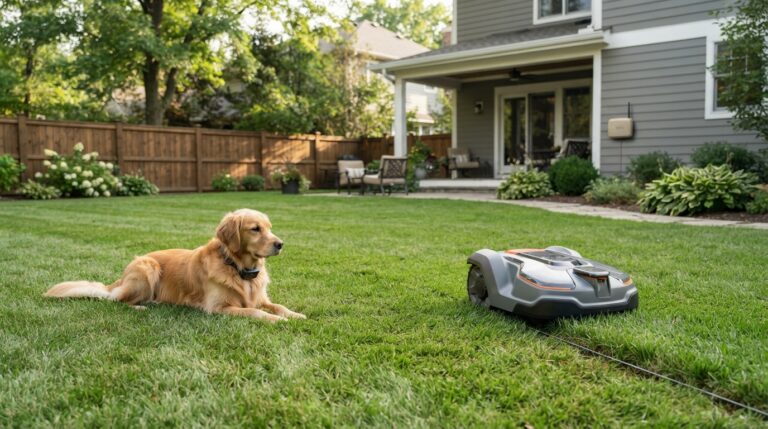
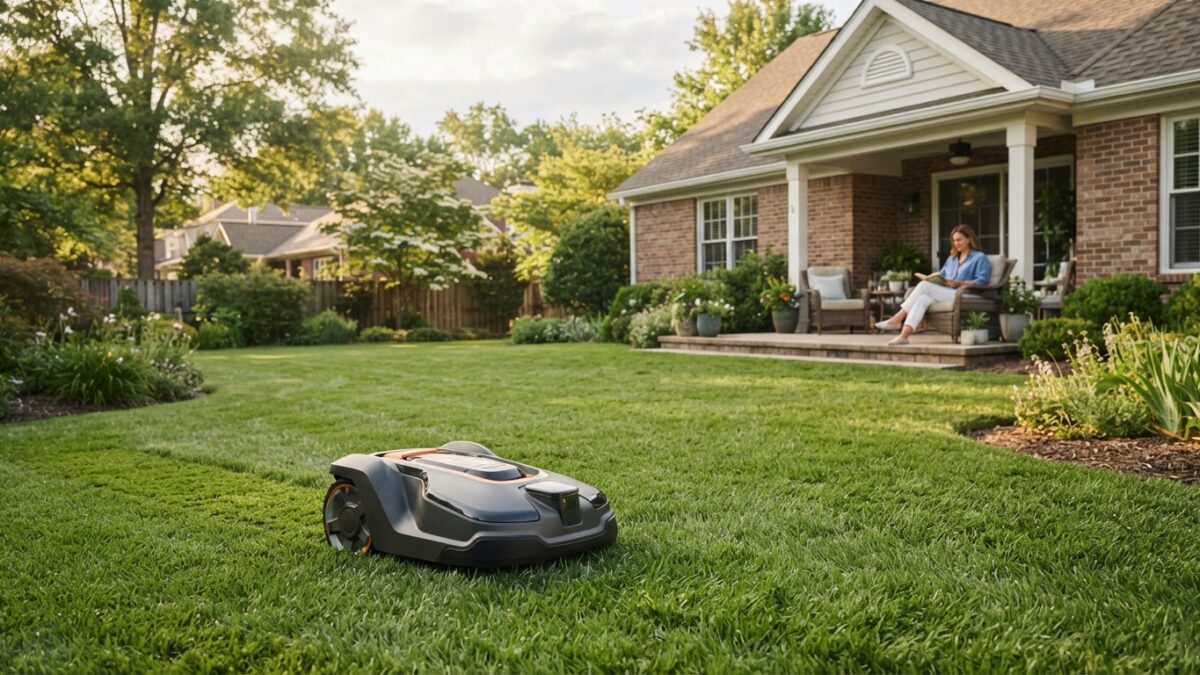
Robot mowers are genuinely quiet. Husqvarna states around 60 dB for its residential Automower range, comparable to a conversation, and Segway quotes 54 to 68 dB(A) across the Navimow line with some models around 58. A gas push mower runs roughly 80 to 90 dB(A) and a rider 85 to 100. Because decibels are logarithmic, that gap is far bigger than the numbers look. Night running is usually technically possible but often a bad idea — for local noise rules, for wildlife, and because some camera-based models lose their navigation features in the dark.
Noise is one of the strongest practical arguments for a robot mower, and it’s the one people underestimate until they own one. This post gives you the figures manufacturers actually publish, explains what they mean at your neighbour’s fence rather than on a spec sheet, and covers night mowing honestly.
As always, MowReview quotes no prices and hasn’t tested these mowers; the sound figures below are manufacturers’ own stated figures. How we research explains why.
The numbers
| Machine | Stated sound level | Source of the figure |
|---|---|---|
| Segway Navimow range | 54 to 68 dB(A), some models around 58 | Segway |
| Husqvarna residential Automower | Around 60 dB | Husqvarna |
| Husqvarna commercial Automower | Around 60 dB | Husqvarna |
| Husqvarna CEORA (commercial, large area) | Around 70 dB, likened to a running dishwasher | Husqvarna |
| Gas push mower | Roughly 80 to 90 dB(A) | Segway, for comparison |
| Gas riding mower | Roughly 85 to 100 dB(A) | Segway, for comparison |
| Normal conversation | Around 60 dB(A) | Segway, for comparison |
| Light traffic | Around 70 dB(A) | Segway, for comparison |
These are manufacturers’ stated figures, measured under their own conditions. Treat them as the right order of magnitude rather than as a like-for-like comparison between brands.
Why 60 versus 90 is a much bigger difference than it looks
Decibels are a logarithmic scale. Every 10 dB represents roughly ten times the sound intensity, and is generally perceived as about twice as loud. A 90 dB gas mower is therefore not 50% louder than a 60 dB robot mower — it is around eight times louder to the ear. That is the difference between a machine you can hold a conversation over and one you wear ear defenders for.
What those figures mean in your yard
Spec-sheet decibels are measured close to the machine. What reaches a neighbour is much less, because sound falls off sharply with distance and is absorbed by fences, hedges and walls. In practice, most owners report that a robot mower is audible as a soft hum when you’re standing near it, and unnoticeable from indoors or across a garden.
Three things change that, and they’re worth knowing before you assume yours will be silent:
- Hard surfaces reflect sound. A dock sited against a house wall or in a walled courtyard will sound louder than one in the open.
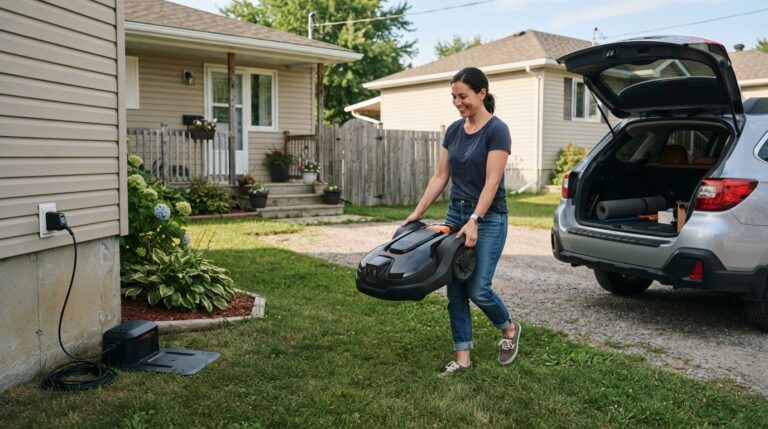
- The dock is the noisiest moment. The clunk of docking and the charging relay are the sounds owners notice most, not the mowing. Site the dock away from a bedroom window.
- Cutting long or wet grass is louder than cutting little and often, because the disc is working harder. The mower gets quieter as your lawn gets into a routine.
Can you run one at night?
Usually yes, mechanically. Whether you should is a different question with three separate parts.
The local rules
Most US municipalities have a noise ordinance with quiet hours, commonly something like 10 p.m. to 7 a.m., and many HOAs set stricter limits than the city does. Robot mowers are quiet enough that they rarely provoke a complaint, but “quiet” is not a legal exemption — ordinances generally regulate the activity and the hour, not just the decibel level. Check your own city code and your HOA documents. Robot mowers and HOA rules covers the HOA side.
The technology
This is the part that surprises people. Some mowers rely on cameras to see, and cameras need light. Husqvarna notes that its 300-series models with daytime-only vision technology will still function at night, but the features supported by vision technology will not. If you bought a mower partly for its camera-based obstacle avoidance, running it at 2 a.m. switches off the thing you paid for.
The wildlife
Night is when nocturnal animals are out. Oxford University researchers testing robotic mowers with 50 live hedgehogs found that all the mowers tested required physical contact to detect a hedgehog at all, and some failed to detect one entirely — with outcomes ranging from a light nudge and a change of direction to the machine running straight over the animal with the blades still turning. Their recommendations focused on sensors that detect at a distance and blades that fold away on striking something harder than grass.
Hedgehogs are a European species, but the principle transfers directly to the animals in an American yard, which is why we recommend daytime running as the default. Our guide to robot mowers and garden wildlife goes further, and are robot mowers safe? covers the safety picture generally.
The simple recommendation
Run it during the day, and if you want it out of your way, run it mid-morning to mid-afternoon when you’re at work. That sidesteps noise ordinances, keeps camera-based features working, avoids the worst of the wildlife risk, and gives you a better cut than mowing through dew. Night running solves a problem robot mowers mostly don’t have.
If quiet is your main reason for buying
Two mowers worth looking at, with the drawbacks independent testers reported. Neither is a “silent” mower — no such thing exists — but both sit in the quiet end of a category that is quiet to begin with.
Quiet, with a dealer behind it
Husqvarna Automower
- Stated sound levelAround 60 dB for residential models
- Stated blade life3 to 6 weeks on the main disc
- SupportEstablished U.S. dealer network
Husqvarna makes the quiet-running case explicitly, saying the figure lets the mower work while you host a garden party without disturbing noise or fuel fumes. The broader argument for the range is the unglamorous one: long experience, deep published documentation, and a dealer who knows the machine when something needs fixing.
Good for
- Owners who want a servicing dealer rather than a support ticket
- Running the mower while the yard is in use
Less good for
- Anyone avoiding installation work: many models use a boundary wire
- Night running on camera-equipped models: Husqvarna states that 300-series vision features don’t work in the dark
- Narrow gardens: Husqvarna itself recommends a 6 ft 6 in passage without a guide wire
The fuller line-up by yard type is in robot mowers for every yard, and brands compared covers who makes what.
Four ways to make any robot mower quieter
- Move the dock away from windows and hard walls. Docking is the loudest moment, and a wall behind the dock reflects it back at the house.
- Keep the blades fresh. Dull blades make the motor work harder and sound rougher. Husqvarna’s signal is frayed or whitened grass tips.
- Cut little and often. A mower keeping pace with short growth is quieter than one grinding through a backlog.
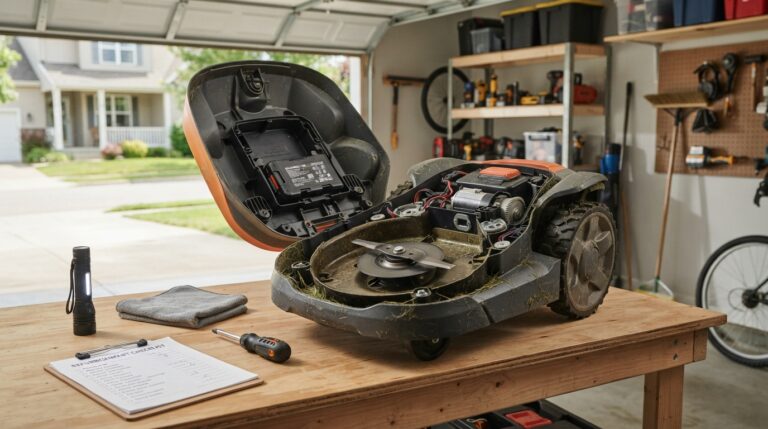
- Clean the underside. Packed clippings unbalance the disc, and an unbalanced disc rattles.
Questions
How many decibels is a robot lawn mower?
Husqvarna states around 60 dB for its residential Automower range and around 70 dB for its large-area CEORA commercial machines. Segway quotes 54 to 68 dB(A) across the Navimow range, with some models around 58 dB(A). For comparison, Segway puts gas push mowers at roughly 80 to 90 dB(A).
Are robot mowers quiet enough to run while I’m in the garden?
Yes. Husqvarna describes its residential figure as similar to a typical conversation and says the mower can work while you host a garden party without disturbing noise or fuel fumes. Most owners find it registers as a soft hum nearby and is inaudible indoors.
Can I run a robot mower at night?
Mechanically, usually yes, but there are three reasons not to. Local noise ordinances and HOA rules often set quiet hours regardless of how quiet the machine is; camera-based models lose their vision features in the dark, as Husqvarna states for its 300-series; and nocturnal wildlife is at risk, since Oxford research found tested mowers needed physical contact to detect a hedgehog at all.
Will my neighbours hear my robot mower?
Rarely, and rarely enough to mind. Sound falls off quickly with distance and is absorbed by fences and planting. The exception is the dock: siting it against a shared wall or close to a neighbour’s window puts the loudest part of the cycle in the worst place.
Which is the quietest robot mower?
On published figures, Segway’s Navimow range quotes the lowest numbers, from 54 dB(A). But brands measure under their own conditions, so small differences between published figures aren’t reliable. Every mainstream robot mower is dramatically quieter than any gas mower, so choose on yard fit first and treat noise as a tiebreaker.
Why has my robot mower got louder?
Usually worn blades, packed clippings unbalancing the cutting disc, or grit in the wheels. All three are ten-minute fixes. A new rattling or grinding noise that cleaning and fresh blades don’t cure is worth raising with support while the mower is under warranty.
The short version
Around 54 to 68 dB depending on model and maker, against 80 to 100 for gas — and because decibels are logarithmic, that is roughly eight times quieter to the ear rather than a third quieter. Quiet enough to run while you’re in the yard, quiet enough that neighbours rarely notice. Run it in daylight anyway: noise ordinances, camera-based navigation and nocturnal wildlife all point the same way, and a daytime mower cuts better than one working through dew.
Quiet is a tiebreaker, not a starting point
Every robot mower is quiet. What separates them is whether they suit your area, your slopes and your layout — so start there.