How MowReview makes money: As an Amazon Associate, MowReview earns from qualifying purchases, at no extra cost to you. We don’t test mowers ourselves; we explain what manufacturers and independent testers report. How we research
Quick answer
On a bumpy lawn, traction and obstacle clearance matter more than slope rating. Look for all-wheel drive and a stated obstacle height of about 2 inches or more. The Segway Navimow X430 states 2.8 inches with dual suspension, the Dreame A3 AWD Pro states 2.2 inches, and the Mammotion LUBA 3 AWD is listed at about 2 inches by a U.S. retailer. Hands-on reviewers found all three handled roots and uneven ground well. But no mower copes with deep holes, so walk the lawn first, fill the dips, and start with a slightly higher cutting height so the mower doesn’t scalp the high spots.
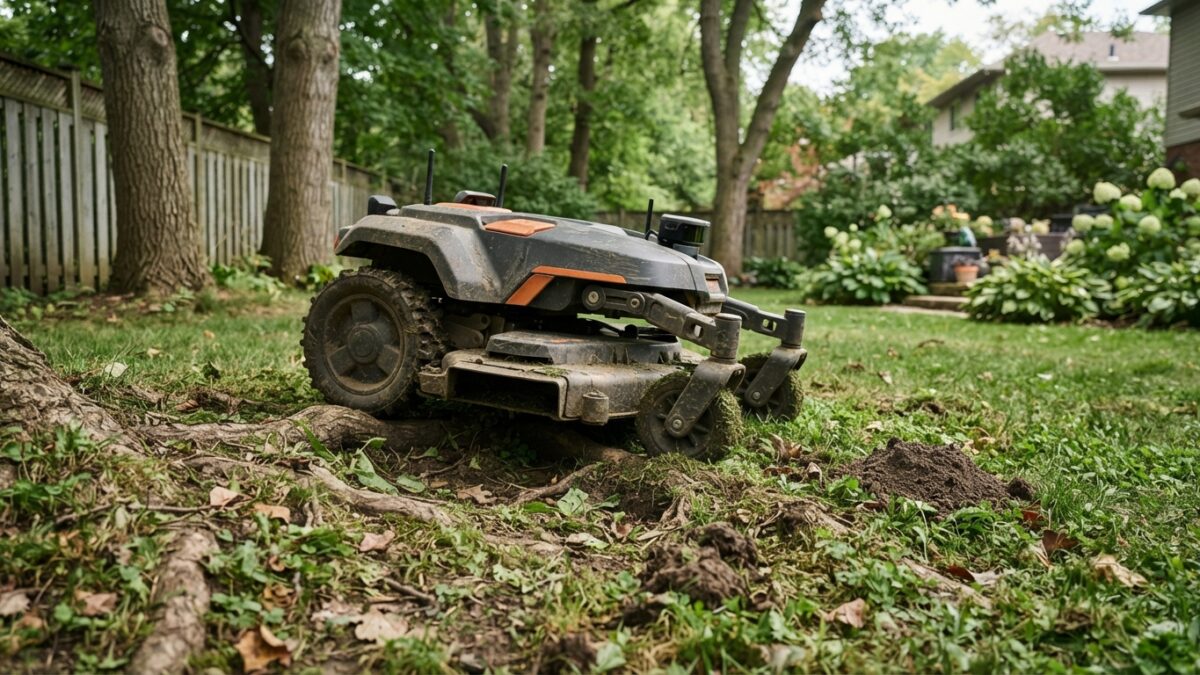
Most robot mower guides talk about slopes. But plenty of lawns that aren’t steep at all are still hard work for a robot: an old lawn that has settled unevenly, a yard crossed by surface roots, a lawn pocked with mole runs, dog holes or frost heave. Segway puts it plainly in its own troubleshooting guide: “Small ruts, divots, holes, and even bumpy areas can stop the mower.”
This guide is about that kind of ground: lumps, dips and roots, not hills. For hills, see robot mowers for slopes. It covers what specs to look for, which mowers reviewers found coped best, and how to fix the worst spots before you install. MowReview quotes no prices and hasn’t tested these mowers. How we research explains why.
Why bumps stop robot mowers
A robot mower is small, light and low. That’s what makes it quiet and safe, and it’s also why a dip a push mower wouldn’t notice can stop it.
- A wheel drops into a dip. Segway explains that when a wheel falls into a hole, “the mower’s weight shifts, and it loses traction.” Two-wheel-drive mowers with free-rolling front casters are most at risk, because the casters “don’t have the power to come out of a divot.”
- The body tilts and the sensors react. Husqvarna says driving over tree roots or stones can tilt a mower sharply enough to trigger its lift sensor, which stops the blades and the mower until you reset it.
- The blades hit the high spots. As the mower rides over a hump, its cutting disc drops toward the crown of the grass, which scalps a bald patch.
- Wheels spin in soft ground. An expert quoted by Tom’s Guide says wheels spin on waterlogged ground, “creating ruts,” which makes the lawn bumpier over time.
What to look for
| Mower | Stated obstacle height | Drive and chassis |
|---|---|---|
| Segway Navimow X430 | 2.8 in | All-wheel drive, dual suspension |
| Dreame A3 AWD Pro | 2.2 in (55 mm) | All-wheel drive |
| Mammotion LUBA 3 AWD | About 2 in (50 mm), per a Lowe’s listing | All-wheel drive, suspension |
| Ecovacs GOAT A3000 LiDAR | 4 cm (about 1.6 in) | Rear-wheel drive, 8.66 in drive wheels |
| Husqvarna Automower 435X AWD | Not stated | All-wheel drive, pivoting rear body |
| Worx Landroid Vision Cloud 4WD | Not stated | Four-wheel drive, articulated chassis, floating blade deck |
| Mammotion YUKA mini 2 | Not stated | Rear-wheel drive, 7.9 in rear wheels |
From manufacturer pages, except the LUBA 3 AWD figure, which Mammotion’s own U.S. page doesn’t state. The Worx details come from its U.K. product page.
Three features matter, in this order:
- All-wheel drive. With power to every wheel, a mower can climb out of a dip instead of spinning in it.
- Obstacle height. This is the tallest ledge the mower claims to climb, such as a root or the edge of a dip. About 2 inches or more is what separates mowers built for rough ground.
- A chassis or deck that follows the ground. Suspension, an articulated or pivoting body, or a floating blade deck helps the wheels stay in contact and the blades stay level, which reduces both stalls and scalping.
The picks
Best reviewed on roots
Mammotion LUBA 3 AWD
- Listed obstacle heightAbout 2 in (50 mm), per Lowe’s
- DriveAll-wheel drive, suspension
- Stated max slope80%
Two independent reviews singled out its handling of rough ground. PCWorld’s reviewer said that in “the area with tree roots and patches of dirt… the Luba navigated it like a champ,” and credited its “large treaded wheels.” TechRadar found it could “traverse uneven terrain, roots and edges with impressive confidence,” with full suspension and paddled rear tires. It’s sold in two height versions: standard (1.0 to 2.7 inches) and H (2.2 to 4.0 inches).
Good for
- Lawns crossed by tree roots
- Rough lawns that are also sloped or split into zones
Less good for
- Unmapped hazards: EasyLawnMowing’s mower got stuck once, which the reviewer put down to incomplete mapping
- Soft or shaded turf: TechRadar found the front tires can damage grass in shady areas when turning
- Speed: PCWorld noted it “moved slowly through the uneven ground”
Rough ground plus close edges
Dreame A3 AWD Pro
- Stated obstacle height2.2 in (55 mm)
- DriveAll-wheel drive with hub motors
- Stated cutting height1.2 to 3.9 in
Freshly Charged tested it on a property with “uneven terrain, hills, and exposed roots,” and said it “handled all of it with no trouble.” Basic Tutorials found it “copes surprisingly well with uneven ground,” and that “roots, small edges or slightly uneven patches in the lawn hardly upset it.” It navigates by LiDAR and cameras without needing RTK, and it cuts closer to edges than most mowers, which suits older, irregular lawns.
Good for
- Uneven lawns with exposed roots
- Lawns kept short, at about 1.2 inches, where its fixed-height edge cutter matches
Less good for
- Very soft ground: Basic Tutorials noted “slight twisting can also occur”
- Carrying: Basic Tutorials puts its weight at almost 24 kg (about 53 pounds)
- Taller-cut lawns: Freshly Charged found its edge cutter is fixed at 1.2 inches and scalps the perimeter of a higher-cut lawn
If your lawn is rough and steep, a tracked mower may suit it better than any wheeled one. Tracked robot mowers for steep, rough ground covers that option.
Fix the worst spots first
No mower is a substitute for filling holes. Husqvarna’s installation advice is to walk the lawn “noting any holes, exposed roots or low drainage areas” and repair them before installation. Segway says the same: level out ruts and divots with topdressing. Here’s how extension services recommend doing it.
Work out what caused the bumps
Purdue says the most common cause is the natural settling of soil over time, followed by moles. Iowa State adds freezing and thawing of the soil, thin turf and earthworm castings. If moles are still active, fix that first, or the bumps will come back.
Topdress in thin layers
- Keep each layer thin. Purdue recommends topdressing home lawns with up to about a quarter inch per application.
- Match your soil. Michigan State Extension advises using sand only if the soil underneath is sandy. Otherwise use a soil like your own.
- Repeat rather than pile it on. MSU suggests thin layers every week or two, without burying the grass crowns. Deep spots may take into the next season.
Don’t reach for a heavy roller
Iowa State warns that “rough, bumpy lawns should not be rolled with a heavy roller,” because it compacts the soil. Purdue notes rolling can smooth raised mole runs, but trapping is what removes the moles.
For a very rough lawn, start again
For the worst cases, Purdue’s advice is to kill the turf, till 2 to 4 inches deep, let the soil settle, and reseed. If you’re planning a robot mower for a badly uneven lawn, that one-off job may save months of rescuing a stuck mower.
While you’re leveling, keep the robot off the topdressed areas until the grass has grown back through, or map them as temporary no-go zones. Getting your lawn ready for a robot mower covers the rest of the prep.
Setting up on uneven ground
- Start high. Begin with a slightly higher cutting height, then lower it over a week or two once you’ve seen whether the high spots scalp.
- Map around what you can’t fix. A cluster of exposed roots or a drainage dip can become a no-go zone rather than a daily rescue.
- Treat false “lifted” alarms as a clue. Husqvarna says roots and stones, grass that’s too long, or a height set too low can all trigger the lift sensor. If the alarm keeps happening in one spot, that spot needs leveling or a no-go zone.
- Keep it off soaked ground. Wheel spin in wet soil is how ruts start. Will a robot mower damage my lawn? covers wear paths and ruts.
Will a robot mower chase off the moles?
Probably not. Belrobotics, a robot mower maker, claims mowing drives moles away, but it cites no evidence. Rutgers says frightening devices such as vibrating windmills and mole wheels “are ineffective.” Don’t buy a robot mower as mole control.
If your robot keeps stopping in the same places, why robot mowers get stuck walks through the usual causes, and robot mowers for yards with trees covers roots and canopy together.
Questions
Do robot mowers work on bumpy lawns?
Yes, within limits. Small bumps, roots and shallow dips are fine for all-wheel-drive models with a good obstacle rating, and hands-on reviewers found the Navimow X430, Mammotion LUBA 3 AWD and Dreame A3 AWD Pro handled uneven ground well. Deep holes and sharp dips can still trap any mower, so fill them before installation.
What obstacle height can a robot mower climb?
Segway states 2.8 inches for the Navimow X430, Dreame states 2.2 inches for the A3 AWD Pro, and a Lowe’s listing gives 50 mm (about 2 inches) for the LUBA 3 AWD. Ecovacs states 4 cm (about 1.6 inches) for the rear-wheel-drive GOAT A3000 LiDAR. Many brands don’t publish a figure at all.
Why does my robot mower keep saying it has been lifted?
On uneven ground, it’s usually the lawn. Husqvarna says driving over raised objects such as tree roots or stones can tilt the mower sharply enough to trigger the lift sensor, and that grass that’s too high or a cutting height set too low can do the same. Removing the obstacle, adding a stay-out zone or adjusting the height gradually usually fixes it.
How do I level a bumpy lawn for a robot mower?
Topdress the low spots with thin layers of soil or sand. Purdue recommends no more than about a quarter inch per application, and Michigan State Extension says to match your existing soil and repeat every week or two without burying the grass. Iowa State warns against using a heavy roller, which compacts the soil.
Will a robot mower scalp the high spots?
It can. A mower rides over a bump and its blades drop toward the crown of the grass. Start with a slightly higher cutting height and lower it once you see how the lawn responds. Some mowers, such as the Navimow X430, claim blade systems that adjust to uneven terrain to reduce scalping.
Do robot mowers scare away moles?
Don’t count on it. A robot mower maker, Belrobotics, claims mowing drives moles away but cites no evidence, and Rutgers says frightening devices such as vibrating windmills and mole wheels are ineffective. Purdue says rolling smooths mole runs, but trapping is what removes the moles.
The short version
For a bumpy lawn, pick all-wheel drive and a stated obstacle height of about 2 inches or more. The Navimow X430 has the highest figure and a strong hands-on report, the LUBA 3 AWD won the best reviews on roots, and the Dreame A3 AWD Pro handled exposed roots with no trouble. Fill the holes and topdress the dips in quarter-inch layers before you install, start with a higher cut, and map around anything you can’t fix.
Bumps are one test. Check the others.
Lawn area, slope and trees decide the rest of the shortlist.