How MowReview makes money: As an Amazon Associate, MowReview earns from qualifying purchases, at no extra cost to you. We don’t test mowers ourselves; we explain what manufacturers and independent testers report. How we research
Quick answer
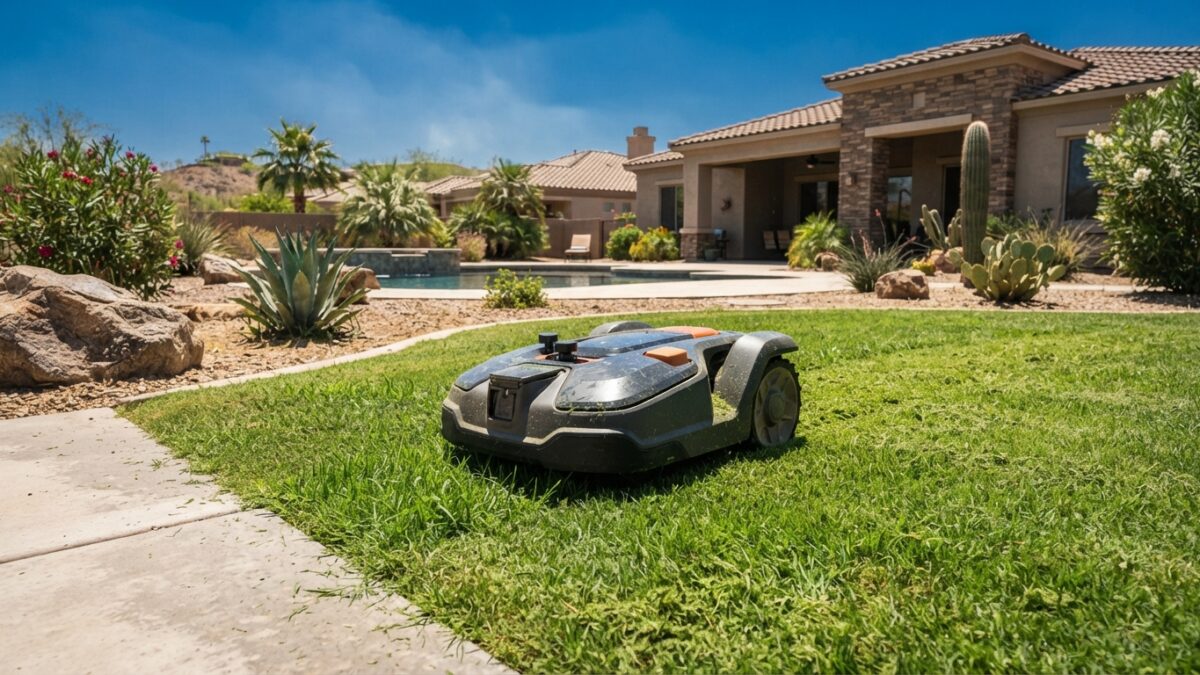
Robot mowers have a heat limit, and it’s lower than many buyers expect. Segway Navimow and the Mammotion LUBA 3 AWD are rated to mow only up to 104°F (40°C), and most models stop charging above about 113°F (45°C). In a desert or Texas summer, that means the mower pauses in the afternoon, it doesn’t break. The highest stated ceilings are the Worx Landroid Vision (131°F) and Husqvarna Automowers (122°F). Whatever you buy, shade the charging station, schedule mowing for the morning or early evening, and expect heat to wear the battery faster.
If you live in Phoenix, Las Vegas, much of Texas or inland California, summer afternoons regularly go past 104°F, and a mower sitting in full sun on a dark lawn gets hotter than the air around it. Robot mowers run on lithium-ion batteries, and every manufacturer builds in protection that stops the mower when the battery gets too hot.
That’s a safety feature, not a fault. But it decides when your mower can work, and how long its battery lasts. This guide compares the stated temperature limits, explains what happens when a mower overheats, and covers the setup that keeps one working through a hot summer. MowReview quotes no prices and hasn’t tested these mowers. How we research explains why.
Stated temperature limits
| Mower | Mowing (ambient) | Charging |
|---|---|---|
| Worx Landroid Vision | 32 to 131°F (0 to 55°C) | 39 to 113°F (4 to 45°C) |
| Husqvarna Automower (all models) | 32 to 122°F (0 to 50°C) | 32 to 113°F (0 to 45°C) |
| Ecovacs GOAT (general support guidance) | 32 to 113°F (0 to 45°C) | 41 to 113°F ambient (5 to 45°C) |
| Segway Navimow X3, X4 and i2 AWD | 32 to 104°F (0 to 40°C); 50 to 95°F recommended | Stops charging when the battery reaches 127°F; resumes at 120°F |
| Mammotion LUBA 3 AWD | 32 to 104°F (0 to 40°C) recommended | 39 to 113°F (4 to 45°C) |
| Mammotion YUKA mini 2 | 41 to 104°F (5 to 40°C) | 39 to 113°F (4 to 45°C) |
From each brand’s operator’s manual or official support pages. Ecovacs’s figures come from a general GOAT support article, not the A3000 LiDAR’s own spec sheet. We found no published operating maximum for the Dreame A3 AWD Pro.
Two numbers matter. The mowing limit decides whether the mower can work on a hot afternoon. The charging limit, 113°F for most brands, decides whether it can recharge. A charging station in full afternoon sun can easily go past that even on days when the air is cooler, so a mower with a high mowing limit can still end up waiting on its dock.
What happens when it gets too hot
- Segway Navimow: the manual says that when the battery is too hot, “the mower will not start mowing,” and you’ll get a push notification. Charging resumes when the battery cools to 120°F or below.
- Husqvarna: the mower shows “battery temperature outside limits” and “will resume its scheduled operation once the battery temperature returns to the acceptable range.” If it happens often while charging, Husqvarna says to move the station to the shade or add its Automower House.
- Worx: error E11, “Battery Temperature Out Of Range.” Worx says to move the mower and charging station to a shaded or cool place.
In every case, the mower protects itself and picks up again later. The cost is lost mowing time on the hottest days.
Heat and battery life
Heat doesn’t just pause a mower. It ages the battery. Battery University says “elevated temperature hastens permanent capacity loss,” and its figures show how much:
| Temperature | Stored at 40% charge | Stored at 100% charge |
|---|---|---|
| 77°F (25°C) | 96% | 80% |
| 104°F (40°C) | 85% | 65% |
Source: Battery University, BU-808. Laboratory storage figures, not robot mower tests, but they show the direction of the effect.
A robot mower spends most of its life sitting fully charged on its dock. Keeping that dock out of the afternoon sun is the single biggest thing you can do for the battery. How long a robot mower battery lasts covers replacement, and robot mower warranties explains what’s covered.
The picks
Highest stated mowing temperature
Worx Landroid Vision
- Stated mowing range32 to 131°F
- Stated charging range39 to 113°F
- Stated cutting height1.57 to 3.54 in
Worx gives the Landroid Vision the highest stated mowing temperature we found, 131°F, well above a desert afternoon. It navigates by camera, with no boundary wire and no satellite antenna, and Worx’s manual is direct about heat: put the base in shade, because “batteries and chargers don’t like over-heating.”
Good for
- Small and medium lawns in the hottest climates
- Bermuda lawns kept at 1.5 to 2 inches
Less good for
- Thick St. Augustine: Bob Vila’s Florida tester found it lost traction in thick grass
- Debris: Reviewed found it weak with leaves and said it’s “designed for maintenance rather than cleanup mowing”
- Charging in the sun: like most mowers, it stops charging above 113°F
High heat rating with dealer support
Husqvarna Automower 435X AWD
- Stated mowing range32 to 122°F
- Stated charging range32 to 113°F
- Stated cutting height1.2 to 2.8 in
Husqvarna rates all its Automowers to mow up to 122°F, and its cutting range suits bermuda, the main lawn grass of the desert Southwest and Texas. Husqvarna sells Automower House covers that it says protect against the long-term effects of sun exposure (check the fit for your model), and its dealer network means someone local can service it. PCWorld’s reviewer found the lawn became “carpet-like” once it had settled in.
Good for
- Bermuda and zoysia lawns in hot climates
- Sloped lots, with all-wheel drive and a 70% rating
Less good for
- St. Augustine, which needs a taller cut than its 2.8-inch maximum
- Impatient owners: PCWorld found the lawn looked rough for the first week
- Blade costs: Husqvarna says blades typically last 3 to 6 weeks, and a year-round desert season uses more
LiDAR mower with a 113°F rating
Ecovacs GOAT A3000 LiDAR
- Stated mowing range (GOAT guidance)32 to 113°F
- Stated cutting height1.2 to 3.6 in
- Water ratingIPX6
Ecovacs’s support guidance gives its GOAT mowers a mowing limit of 113°F, higher than Navimow’s and Mammotion’s 104°F. The A3000 LiDAR navigates mainly by laser, so it doesn’t depend on satellite signal, and its range covers both bermuda and St. Augustine kept at 3.5 inches.
Good for
- Hot-climate lawns up to about three-quarters of an acre
- Mixed bermuda and St. Augustine properties
Less good for
- Certainty: the 113°F figure comes from Ecovacs’s general GOAT support page, not a spec sheet for this model
- Overgrown grass: PCWorld found it left trails of clippings in moderately tall grass
- Steep lots: its stated maximum slope is 50%
Does a 104°F rating rule a mower out?
No. Plenty of Navimow and Mammotion mowers work in hot states. Bob Vila’s reviewer tested the Navimow X430, the Dreame A3 AWD Pro and the Mammotion LUBA mini 2 AWD on thick St. Augustine in Florida and reported no heat problems, and we found no hands-on review from Texas, Florida or Arizona reporting heat shutdowns. A lower rating simply means the mower’s working window on the hottest days is shorter, so morning and evening scheduling matters more. For St. Augustine, which needs a tall cut, see robot mowers for St. Augustine.
How to keep a robot mower working in the heat
- Shade the charging station. Husqvarna recommends a station “in an area with protection from the sun.” Afternoon shade is what counts: the east side of the house, under the eaves, or beside a wall.
- Use a cover, but let it breathe. Segway says its Garage S gives “additional protection from heat.” Mammotion warns that an enclosed, dark garage with no airflow can run hotter than outside: “Shade is good—heat traps are not.”
- Mow in the cooler hours. UGA turfgrass specialist Clint Waltz suggests mowing when grass is dry, around mid-morning or about 5:30 to 6 p.m. Those windows also keep the mower inside its rated range. Avoid scheduling through the early afternoon in July and August.
- Mow higher and less during drought. UF/IFAS says to mow less often during drought and always at the highest recommended height. Ohio State says to avoid mowing drought-stressed, dormant turf, and that wheel tracks add injury.
- Protect the plastics. A UN Environment Programme panel review found ultraviolet light cracks and discolors plastics over time, and warmth speeds that up. Mammotion says constant UV can degrade housings and seals. A cover protects both the body and the battery.
Year-round mowing in the low desert
In Phoenix, Tucson and Yuma, a robot mower can work almost all year. The University of Arizona recommends mowing bermuda at least weekly from May to October, and overseeding with ryegrass between October 10 and November 10 in low-desert areas, which keeps the lawn green and growing through winter. That’s a long season on a mower, so check blades more often. Florida and the Gulf Coast are similar: a University of Florida study found a robot mowing St. Augustine daily at 2.5 inches produced better quality and uniformity than weekly mowing at 3.5 inches.
If your property is a Sun Belt second home, robot mowers for a vacation home covers running one unattended. For centipede lawns across the Gulf Coast, see robot mowers for centipede grass. For the other extreme, see robot mower batteries in cold weather. For wet summers, robot mowers in rain and wet grass covers storms and soggy ground.
Questions
What temperature is too hot for a robot mower?
It depends on the model. Segway Navimow and the Mammotion LUBA 3 AWD are rated to operate up to 40°C (104°F). Husqvarna rates its Automowers to 50°C (122°F), and Worx rates the Landroid Vision to 55°C (131°F). Most models stop charging above about 45°C (113°F).
What happens when a robot mower gets too hot?
It stops and waits. Segway says the mower won’t start mowing when the battery is too hot and sends a notification, and charging resumes when the battery cools. Husqvarna shows a “battery temperature outside limits” message and resumes the schedule once the battery is back in range.
Should a robot mower’s charging station be in the shade?
Yes. Husqvarna recommends a charging station with protection from the sun, and Worx says to put the base in shade because batteries and chargers don’t like overheating. A well-ventilated cover or garage helps, but Mammotion warns that an enclosed, dark garage without airflow can trap heat.
Does heat shorten a robot mower’s battery life?
Yes. Battery University says elevated temperature hastens permanent capacity loss. In its figures, a fully charged lithium-ion battery kept at 40°C for a year retains about 65 percent of its capacity, against about 80 percent at 25°C.
When should a robot mower mow in summer heat?
In the cooler parts of the day, as long as the grass is dry. UGA turfgrass specialist Clint Waltz suggests mid-morning or about 5:30 to 6 p.m. Running in those windows also keeps the mower inside its temperature limits.
Can a robot mower run year-round in Phoenix?
Often, yes. The University of Arizona recommends mowing bermuda at least weekly from May to October and overseeding with ryegrass in October and November in low-desert areas, so an overseeded lawn keeps growing through winter. The limit is summer afternoons, which can exceed some mowers’ rated temperatures.
The short version
Every robot mower pauses when its battery gets too hot, and several popular models are rated to mow only up to 104°F. The Worx Landroid Vision (131°F) and Husqvarna Automowers (122°F) state the highest limits, with Ecovacs’s GOAT guidance at 113°F. Most stop charging above 113°F. Whatever you choose, shade the dock with a ventilated cover, mow mid-morning or early evening, mow higher in drought, and expect heat to shorten battery life.
Heat is one constraint. Check the others.
Lawn area, grass type and slope decide the rest of the shortlist.