How MowReview makes money: As an Amazon Associate, MowReview earns from qualifying purchases, at no extra cost to you. We don’t test mowers ourselves; we explain what manufacturers and independent testers report. How we research
Quick answer
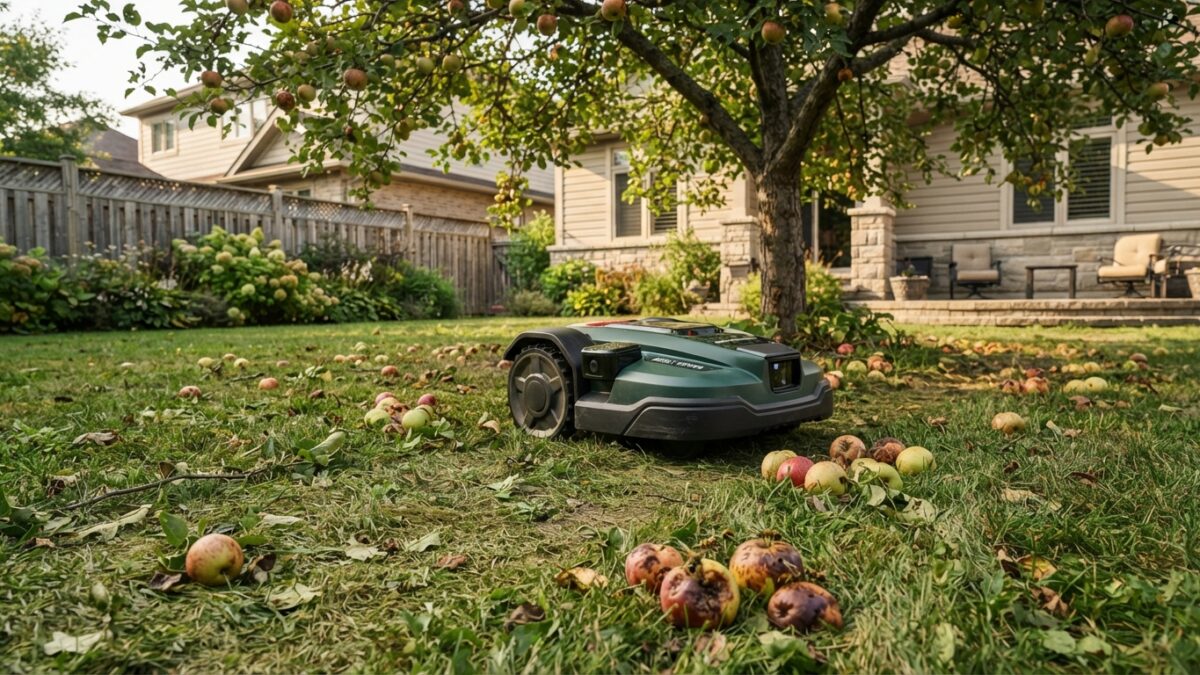
A robot mower can work under a fruit tree, but only if you clear the drop. Fallen apples, pears, peaches and plums jam blades, high-center the mower, dull blades faster than grass, and, most importantly, attract wasps and yellow jackets. Extension services from Washington State, Minnesota and Maryland all recommend removing fallen fruit for pest reasons anyway. Set up a temporary no-go zone under fruit trees during drop season, or plan on picking fruit up before every mow. Under a dense canopy, a LiDAR-assisted mower such as the Ecovacs GOAT A3000 or the Mammotion LUBA 3 AWD works better than one that depends on satellite signal alone.
Fruit trees and lawns don’t mix as neatly as people hope. An apple tree in the corner of the yard drops enough fruit each August and September to fill several buckets, and that fruit lands in the grass, ferments, and hosts wasps for weeks. A robot mower running through it turns a small problem into three: broken blades, sugary residue on the underside, and stirred-up wasp swarms.
This guide covers what to do with a robot mower on a lawn with fruit trees, what the manufacturers actually say about debris, and which mowers cope best under a canopy. MowReview quotes no prices and hasn’t tested these mowers. How we research explains why.
What the manufacturers say about debris
- Husqvarna (UK spring-prep support article): “Rake leaves and clean up any garden debris (sticks, pine cones, leaves and scattered mulch),” which reduces “strain on the mower’s cutting blades.” Its US fall-care page tells owners to “Pick up any sticks and branches.”
- Robomow (blog): “Fallen fruit is simply chopped up by star blades, while blade discs put nicks in fallen fruit,” and “Blades dull regardless of what type your robotic lawnmower has…due to contact with foreign bodies.”
- Segway Navimow (manual): “Periodically inspect the area where the machine is to be used and remove all stones, sticks, wires, bones, and other foreign objects.”
- Mammotion (LUBA 2 manual): “Remove debris, piles of leaves, toys, wires, stones, and other obstacles from the lawn.”
- Worx Landroid Vision: same “remove foreign objects” language before use.
Only Robomow explicitly names fallen fruit. Every other brand covers it under “debris” or “foreign objects,” which is enough. The message is consistent: clear the ground before the mower runs.
Why wasps matter more than blades
Fallen apples ferment quickly. Fermenting fruit attracts yellow jackets and paper wasps, which are the two most dangerous stinging insects in most American yards. Extension guidance is direct:
- University of Maryland Extension: “rake up and discard fallen tree fruit, and equip trash cans with tight-fitting lids.”
- Ask Extension: remove “all fallen fruits so they don’t attract foraging wasps.”
- Washington State University Extension: “Pick up and dispose of fallen apples in the trash—DO NOT COMPOST!!!” (this is about apple maggot control, and the emphasis is theirs).
- University of Minnesota Extension (codling moth): “Pick up and remove any fallen apples throughout the growing season and after harvest and place them in the trash.”
A robot mower crossing a lawn full of wasp-covered fallen fruit disturbs the wasps and knocks fruit apart, sending juice and pulp everywhere. It’s a bad combination for the mower, for the person who has to rescue it, and for anyone in the yard.
Common fruit trees and their problems
| Tree | Drop season | Main mower issue |
|---|---|---|
| Apple | August to October | Wasp attraction; blade jamming on larger fruit |
| Pear | August to September | Similar to apples; softer flesh but tough cores |
| Peach and plum | Mid to late summer | Sticky juice and pits (tough enough to nick blades) |
| Citrus (Florida, Gulf Coast) | Winter, plus after hurricanes | UF/IFAS warns dropped citrus attracts fruit flies and yeasts |
| Mulberry | Early summer | Deep purple stains everywhere; light fruit |
| Fig | Late summer | Very soft, sticky; wasp-friendly |
| Black walnut | Fall | Very tough hulls; permanent stains |
| Pecan | Fall | Hard shells; potential blade damage |
How to set up a fruit-tree lawn
- Draw a temporary no-go zone under each fruit tree. A circle out to the drip line is usually enough. Segway lets you draw off-limit islands for temporary objects and delete them later; Mammotion allows up to 50 no-go zones per area.
- Delete the zones when the drop is over. Otherwise you’ll have shaggy rings under trees all winter.
- Rake or pick up fruit before each mow anyway. Even outside the no-go zone, wind moves fruit onto the lawn.
- Mow in daylight only. Wasps are active during the day, which is when you’d notice a problem. And Husqvarna says its non-vision Automowers may collide with objects at night.
- Change blades more often in drop season. Fruit dulls blades, and Robomow says blades dull “regardless of what type your robotic lawnmower has…due to contact with foreign bodies.”
- Rinse the underside. Sugary juice hardens on the underside and blade hub. Follow each brand’s cleaning guidance (Husqvarna says brush only, no pressure washer; Worx says garden hose is fine on the Vision).
Which mowers cope best under fruit trees
LiDAR under a canopy
Ecovacs GOAT A3000 LiDAR
- Navigation360° LiDAR, 3D ToF, AI camera
- Stated cutting height1.2 to 3.6 in
- Obstacle detectionStated 200+ obstacle types
Fruit trees form a dense canopy that blocks satellite signal. The GOAT A3000 LiDAR navigates by laser and doesn’t depend on RTK alone. Ecovacs also says its time-of-flight sensor can’t reliably identify obstacles lower than about 4 inches, though, so it won’t see small fallen fruit any better than other mowers.
Good for
- Backyard orchards with several fruit trees
- Shaded lots where RTK struggles
Less good for
- Detecting small fallen fruit: still won’t see under 4 inches
- Overgrown lawns: PCWorld found it left clipping trails in moderately tall grass
- Steep lots: stated max slope 50%
LiDAR plus 50 no-go zones
Mammotion LUBA 3 AWD
- Navigation360° LiDAR, RTK, AI vision
- No-go zonesUp to 50 per mowing area
- Stated max slope80%
A backyard orchard with a dozen fruit trees is exactly the kind of yard that benefits from 50 no-go zones and layered navigation. Its LiDAR helps under canopy, and its AI vision reduces (though doesn’t eliminate) the chance of running through debris. Standard and H versions cover different grasses.
Good for
- Backyard orchards
- Sloped lots with multiple fruit trees
Less good for
- Small fallen fruit: no brand’s sensors reliably see under 4 inches
- A polished app: PCWorld found connectivity “a little spotty”
- Utility flags and low objects: Android Authority found it ran over utility flags
Blade wear on a fruit-tree lawn
Plan for the shorter end of blade intervals during drop season:
- Husqvarna: main blades typically last 3 to 6 weeks. Under fruit trees, expect the shorter end.
- Mammotion: every 3 months or after 150 hours. Its Endurance blades flip at 50 hours.
- Segway Navimow: every 80 working hours on X3 and X4.
Keep a spare kit on hand before August. Robot mower maintenance covers the routine.
Setup for a Florida citrus yard
Southern lawns often sit under citrus. UF/IFAS advises clearing dropped citrus promptly, because rotting fruit draws fruit flies and yeasts. In hurricane season, that gets urgent: UF/IFAS notes fruit-fly swarms after hurricanes knock unripe citrus down. See robot mower hurricane prep for the storm side. For year-round Southern mowing, robot mowers for St. Augustine and robot mowers for bermuda cover the two main Southern grasses.
Questions
Can a robot mower run under a fruit tree?
Yes, but not through a carpet of fallen fruit. Robomow says its blades chop up fallen fruit but can nick larger pieces, and third-party reviewers report that big fruit can jam or high-center the mower. Clear the ground under fruit trees during the drop season.
What happens if a robot mower hits an apple?
Small pieces get chopped, but a larger apple can wedge under the mower, dull the blades faster or leave sticky juice on the underside. Robomow says its star blades “chop up” fallen fruit while blade discs “put nicks in” it.
Do fallen apples attract wasps and yellow jackets?
Yes. The University of Maryland Extension says to rake up and discard fallen tree fruit and to fit trash cans with tight lids. Ask Extension recommends removing all fallen fruit so it doesn’t attract foraging wasps. A robot mower running through wasp-covered fruit is a risk to it and to anyone nearby.
Should I set a no-go zone around fruit trees?
In heavy drop season, yes. Draw a no-go zone under the tree during the weeks when fruit falls, and delete it when the drop is over. Segway lets you draw temporary off-limit islands, and Mammotion allows up to 50 no-go zones per mowing area.
Do fruit trees affect satellite navigation?
Yes. A thick canopy blocks satellite signal for RTK-based mowers. UF/IFAS and extension services recommend keeping fallen fruit cleared for pest reasons, and for the mower a LiDAR-assisted or wired model works better under a fruit canopy than RTK alone.
What about walnut hulls and other tough fruit?
Walnut hulls stain badly (Grandpa’s Goody Getter and similar sources warn of permanent stains on fabric) and are physically tough. Add walnut trees, dropping mulberries and figs to the “clear before mowing” list, alongside apples and pears.
The short version
A robot mower can share a lawn with fruit trees, but not with fallen fruit. Wasps make it a safety issue more than a mechanical one, and every extension service recommends clearing dropped fruit anyway. Draw temporary no-go zones under trees during drop season, rake the rest of the lawn before each mow, and expect blades to wear faster in August and September. LiDAR-based mowers cope better under a canopy than RTK-only ones.
Trees are one factor. Grass and slope are the others.
Match a mower to your lawn’s full picture.