How MowReview makes money: As an Amazon Associate, MowReview earns from qualifying purchases, at no extra cost to you. We don’t test mowers ourselves; we explain what manufacturers and independent testers report. How we research
Quick answer
For a front and back lawn, you need a mower that can store at least two zones and, ideally, drive itself between them along a mapped path. The Mammotion LUBA 3 AWD is the strongest fit: up to 30 zones on the 3000 model, and it has been independently tested driving a long route between lawns over gravel and ramps. The Ecovacs GOAT A3000 LiDAR offers editable multi-zone mapping and a stated 31-inch minimum passage. The Mammotion YUKA mini 2 suits smaller lots, with up to 10 zones. Before you buy, check whether the route crosses a public sidewalk, and plan for the front lawn’s extra theft and HOA exposure.
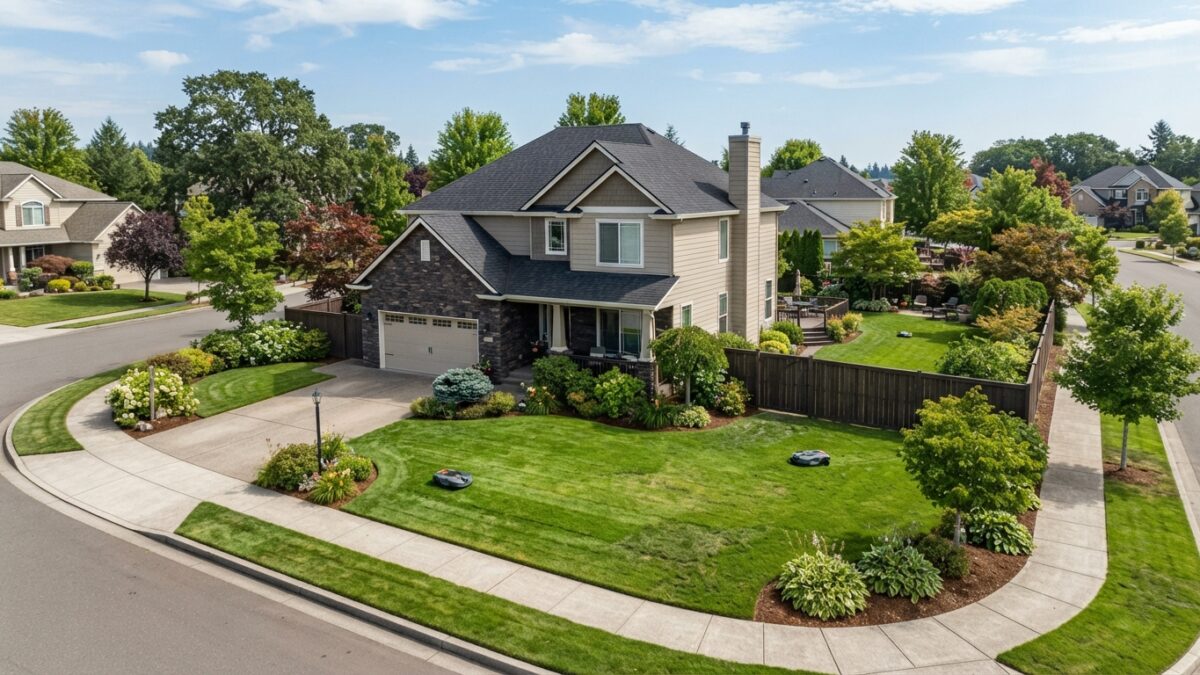
Most American homes have two lawns: a front yard facing the street and a backyard behind the house, joined by a side strip, a driveway, or nothing at all. Robot mower marketing tends to picture one tidy rectangle. This guide is about the two-lawn reality: what the mower has to be able to do, which models handle it, and the front-yard issues nobody mentions.
MowReview quotes no prices and hasn’t tested these mowers. How we research explains why.
Three ways two lawns connect
| Layout | What the mower needs | Difficulty |
|---|---|---|
| Joined by a grass side yard | A mapped path through the side yard, and a passage width it can manage | Easy to moderate |
| Joined across a driveway or path | A channel it can drive along across the hard surface | Moderate |
| Not connected at all | Multi-zone support, and you carry it between them | Easy, but manual |
| Route crosses a public sidewalk | Think carefully; see the caution below | Hardest |
If the side yard is the connection, measure it first. Robot mowers and multiple zones covers the general mechanics.
What to check before you buy
- How many zones it stores. Two is the minimum. More lets you split a lawn with a flower-bed island or a separate strip into its own zone.
- Whether it can drive between zones by itself. Some mowers let you map a travel path, often called a channel, across a driveway or path. Others need carrying.
- Where it docks. One dock serves both lawns, so the mower has to get back from the far one. That usually means docking in the back and travelling out to the front.
- Per-zone settings. Can you give the front lawn a different schedule or cutting height? That matters for a showpiece front lawn or a different grass.
- Signal coverage at both lawns. Wire-free mowers need a good sky view in both yards, and the side route between them is often the weakest point.
Crossing a public sidewalk
If the only way from the back lawn to the front is along or across a public sidewalk, think hard before mapping it as a route. The mower is then travelling unsupervised in a public space, among pedestrians, strollers and children, whether or not its blades are stopped. Many HOAs and some cities also have rules about equipment on sidewalks. Treating the front as a separate zone and carrying the mower is the safer choice.
The picks
Best for complex two-lawn layouts
Mammotion LUBA 3 AWD
- Stated zonesUp to 30 (3000); 15 (1500H)
- Stated max slope80%
- Navigation360° LiDAR, network RTK, AI vision
The most thoroughly tested option for connected lawns. EasyLawnMowing mapped a long channel between separate lawn areas, running over gravel, up ramps and across another mower’s territory, and the LUBA 3 accepted it without warning that the path was too long. TechRadar found its multi-zone function worked well. Check the cutting height version for your grass: standard 1.0 to 2.7 inches, H versions 2.2 to 4 inches.
Good for
- Front and back lawns joined by a driveway or path
- Larger or sloped lots with several separate areas
Less good for
- Long runs that get interrupted: EasyLawnMowing found interrupted tasks may restart from 0%
- Easy setup: TechRadar reported app interface quirks that made zone setup tedious
- Shaded strips, where TechRadar found the front tires could damage turf
Best when the side passage is the connection
Ecovacs GOAT A3000 LiDAR
- Stated minimum passage2.62 ft (about 31 in)
- MappingEditable: add, merge, split and delete areas
- Stated coverageUp to about 0.75 acre
Ecovacs states multiple-zone management with editable mapping, and a stated minimum passage of about 31 inches, which matters when the side yard is how the mower gets from back to front. Dual LiDAR is designed to hold its position in shadow, and the side strip beside a house is often in shade.
Good for
- Lawns joined by a side yard 3 feet wide or more
- Owners who want to reshape zones in the app as the garden changes
Less good for
- Steep front yards: its stated slope limit is 50%, well below the AWD mowers
- Standard St. Augustine at 4 inches: its range stops at 3.6 inches
- Side passages under about 3 feet once pinch points are counted
Best for small front-and-back lots
Mammotion YUKA mini 2
- Stated zonesUp to 10
- Stated minimum passage55 cm (about 21.6 in)
- Stated coverageAbout 0.25 acre
For a typical small suburban lot, where both lawns together are under a quarter acre, the YUKA mini 2 combines zone support with the narrowest stated passage width in our comparisons. EasyLawnMowing found it tracked narrow paths cleanly and crossed a small bridge exactly where mapped.
Good for
- Small lots joined by a narrow side yard
- Front and back lawns with the same grass
Less good for
- Different cutting heights front and back: EasyLawnMowing notes height is manual and can’t be set per zone
- Combined lawn area above about a quarter acre
- Front-yard theft tracking, which needs the separately sold 4G module
The front yard is different
The front lawn raises three issues the backyard doesn’t.
Theft
An unattended mower on an unfenced front lawn is the opportunistic-theft scenario. PIN locks, lift alarms and GPS tracking help, but the best protection is simple: dock in the back, and schedule the front for hours when someone is usually home. Robot mower theft protection covers what each feature does.
HOA and neighbors
Front lawns are what HOAs care about. Check whether your HOA says anything about robot mowers, running hours, or visible equipment and docks. Robot mowers and HOA rules covers this in detail.
Passers-by
Children, dogs on leashes, and people cutting across the corner of the lawn. Schedule the front zone for school hours rather than after school, and keep it off the lawn when you know the street is busy. Are robot mowers safe? covers the protections, and robot mowers with the best obstacle avoidance compares the detection systems.
Planning the setup
- Dock in the back, in shade, out of sight of the street.
- Map the back lawn first and let it run for a week so you know the mower is settled.
- Map the route through the side yard or across the driveway, keeping it as short and straight as possible.
- Map the front lawn as its own zone, with keep-out areas around the mailbox, sprinkler heads and flower beds.
- Schedule the front separately, in daylight hours when someone is often home.
- Turn on alerts and theft protection, and change the default PIN.
Questions
Can one robot mower do a front and back yard?
Yes, if it supports multiple zones. The best setup is a mower that can also drive itself between the lawns along a mapped path. The Mammotion LUBA 3 AWD stores up to 30 zones on the 3000 model and has been independently tested travelling a long route between lawns.
Can a robot mower cross a driveway?
Many wire-free models can follow a mapped route across a paved area between two lawns. EasyLawnMowing tested the LUBA 3 AWD on a channel over gravel and ramps. Keep the route short and straight, and avoid routes that use a public sidewalk.
Do I need two charging stations for two lawns?
Usually not. One dock, normally in the backyard, serves both lawns if the mower can travel between them. If it can’t, you can treat the front as a separate zone and carry the mower there.
Can I set a different cutting height for the front lawn?
It depends on the model. Some allow per-zone settings from the app. EasyLawnMowing notes that on the Mammotion YUKA mini 2, height is set manually and can’t differ per zone, so check before buying if your front and back grasses differ.
Is it safe to run a robot mower on the front lawn?
Generally, with sensible scheduling. Run it in daylight when the street is quiet and someone is often home, dock it in the back, and turn on the PIN, alarm and tracking. Avoid routes along public sidewalks.
What if my side yard is too narrow to connect the lawns?
Map front and back as separate zones and carry the mower between them, which takes seconds. Or use the robot mower on the larger lawn and mow the small one by hand.
The short version
Check zone support, whether the mower can drive itself between lawns, and whether the connecting route is wide enough and has good signal. The LUBA 3 AWD suits complex layouts, the GOAT A3000 LiDAR suits lawns joined by a side yard, and the YUKA mini 2 suits small lots. Dock in the back, schedule the front for quiet daylight hours, and don’t route the mower along a public sidewalk.
Measure both lawns together
Size the mower for the combined area plus the travel between them, not for either lawn alone.