How MowReview makes money: As an Amazon Associate, MowReview earns from qualifying purchases, at no extra cost to you. We don’t test mowers ourselves; we explain what manufacturers and independent testers report. How we research
Quick answer
Measure the narrowest point of your side yard at ground level, then compare it with the mower’s stated minimum passage width. The Mammotion YUKA mini 2 has the narrowest stated figure here, 55 cm (about 21.6 inches). The Ecovacs GOAT A3000 LiDAR states 2.62 feet (about 31 inches). Boundary-wire mowers need much wider gaps unless you add a guide wire: Husqvarna recommends 6 ft 6 in between wires without one, and 24 inches with one. Leave a few inches of margin over any stated figure, because downspouts, AC units and gate posts narrow the real gap.
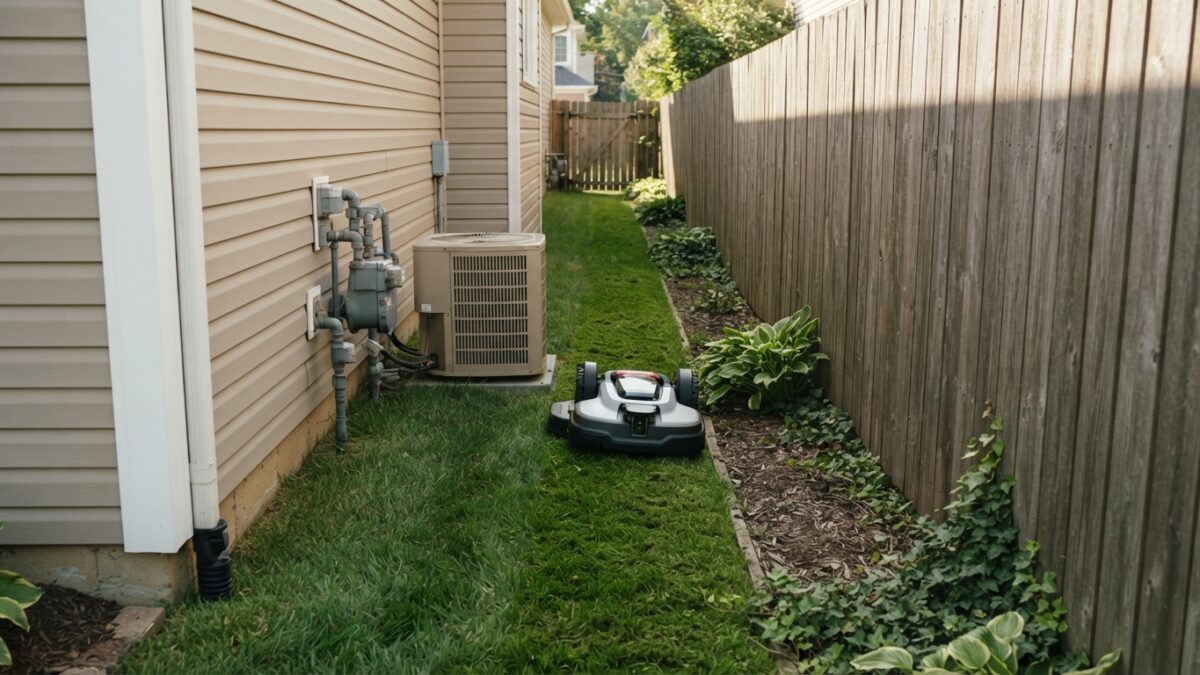
On a typical American suburban lot, the front and back lawns are joined by a strip down the side of the house: often 4 to 8 feet wide, sometimes much less, and usually crowded with a downspout, an AC condenser, a gas meter, trash cans and a gate. It’s the single most common place for a robot mower to fail. It can’t get through, gets through but not back, or wedges itself against the siding.
This guide covers how to measure the gap properly, which mowers state the narrowest passage widths, and what to do if your gap is tighter than any mower can handle. MowReview quotes no prices and hasn’t tested these mowers. How we research explains why.
Measure the real gap, not the nominal one
The distance from the house wall to the fence isn’t the number that matters. The mower meets the narrowest point along the whole route, at wheel height.
- Walk the full route from the back lawn to the front, including the gate.
- Measure at every pinch point at ground level: past the AC unit, the downspout, the meter, the hose reel, the gate post.
- Note the narrowest figure. That’s your passage width.
- Check what’s underfoot. Gravel, pavers, a step or a drain changes things as much as width does.
- Check for turns. A narrow passage with a right-angle turn at the end is much harder than a straight one.
- Check the sky. A side yard between two houses is a tunnel for satellite signal, and wire-free mowers that depend on it can lose position there.
Don’t forget the gate
A gate that swings shut blocks the mower completely. Prop it open during mowing hours, remove it, or fit a latch that holds it open. It’s the most common reason a side-yard route that works on the first day stops working a week later.
Stated minimum passage widths
| Mower or system | Stated minimum passage | Source |
|---|---|---|
| Mammotion YUKA mini 2 | 55 cm (about 21.6 in) | EasyLawnMowing review, specification |
| Husqvarna Automower with a guide wire | 24 in between boundary wires | Husqvarna |
| Ecovacs GOAT A3000 LiDAR | 2.62 ft (about 31 in) | Ecovacs |
| Husqvarna Automower without a guide wire | 6 ft 6 in between boundary wires | Husqvarna |
| Husqvarna 435X AWD and 535 AWD | 6 ft 6 in recommended for a good cut | Husqvarna |
Many manufacturers don’t publish a minimum passage width at all. If a mower you’re considering doesn’t, ask the seller before buying for a side yard.
A stated minimum is a best case: flat, straight, dry, clear and with good signal. Allow at least 4 to 6 inches of margin in a real side yard.
The picks
Narrowest stated passage
Mammotion YUKA mini 2
- Stated minimum passage55 cm (about 21.6 in)
- Stated coverageAbout 0.25 acre
- Navigation360° LiDAR plus AI vision
A compact mower with the narrowest stated passage width in this comparison. EasyLawnMowing’s hands-on review found it tracked down a narrow path cleanly, stayed centered, and crossed a small bridge exactly where it had been mapped. LiDAR navigation also means it doesn’t rely only on satellite signal, which helps between two houses.
Good for
- Side yards down to about two feet wide
- Small suburban lots with a front-to-back route
Less good for
- Lawns over about a quarter acre
- Setting different heights for front and back: EasyLawnMowing notes height is manual and can’t differ per zone
- Remote monitoring away from Wi-Fi without buying the separate 4G module
Best balance of size and access
Ecovacs GOAT A3000 LiDAR
- Stated minimum passage2.62 ft (about 31 in)
- Stated coverageUp to about 0.75 acre
- Stated max slope50%
Ecovacs states a minimum passage of 2.62 feet, uncommon for a mower rated to about three-quarters of an acre. Dual LiDAR navigation is designed not to be thrown by shadows, which suits a side yard in the shade of the house. Ecovacs also claims near-edge mowing to within about 2 inches, useful along a house wall.
Good for
- Larger lots whose side passage is about 3 feet or wider
- Shaded side yards between houses
Less good for
- Gaps under about 3 feet once pinch points are counted, which leave no margin over the stated figure
- Steep ground: its stated 50% slope is well below the AWD mowers’ ratings
- A height of 4 inches for St. Augustine: its stated range stops at 3.6 inches
The wired route, with a dealer to install it
Husqvarna Automower with a guide wire
- Recommended passage with guide wire24 in between boundary wires
- Guide wire clearanceAt least 12 in from the boundary wire
- SupportU.S. dealer network
A guide wire run through the passage lets an Automower follow a precise line through a gap far narrower than it could manage otherwise. It doesn’t depend on satellite signal between two houses, which is where wire-free mowers are weakest. Husqvarna says the mower always runs to the left of the guide wire as seen facing the charging station, which a dealer will account for when installing.
Good for
- Side yards between houses where satellite signal is poor
- Owners who want a dealer to plan and install the wiring
Less good for
- Anyone avoiding installation work: boundary and guide wires both have to be laid
- Passages without a guide wire, where Husqvarna recommends 6 ft 6 in
- Wider AWD models, which Husqvarna recommends a 6 ft 6 in passage for regardless
What about bigger mowers?
Size isn’t everything. PCWorld’s review of the large Segway Navimow X430 reported it got through a narrow gap beside a fence where a smaller Navimow model had previously failed, which suggests navigation and traction matter as much as width. But the X430 weighs nearly 64 pounds, and Segway doesn’t state a minimum passage width in the sources we checked. If you’re considering a big mower for a lot with a side passage, get the minimum passage figure from the seller in writing.
If your gap is too narrow for anything
| Option | When it fits |
|---|---|
| Move the obstacle | Trash cans, hose reels and planters are often the whole problem |
| Treat front and back as separate zones and carry the mower | Many wire-free mowers support this, and it takes seconds |
| Robot mower for the back, push mower for the small front | Common and sensible when the front lawn is small |
| Pave or gravel the side yard | Often the side strip is poor grass anyway, since it’s shaded and walked on |
The best robot mowers for a front and back yard covers the two-lawn setup in full, and robot mowers and multiple zones explains how zone support differs between models, and why robot mowers get stuck covers the jam points.
Side-yard hazards to deal with first
- AC condenser pads and lines: keep the mower well clear with a keep-out zone. It shouldn’t touch refrigerant lines or wiring.
- Downspout splash blocks and drains: a raised block or grate is a wheel trap. Lower it or map around it.
- Gas meters and utility boxes: keep-out zone, always.
- Window wells: a real drop hazard. Cover them or give them a generous keep-out zone.
- Soft ground under drip lines: the side strip often catches roof runoff and stays wet, which leads to ruts.
Questions
How narrow a gap can a robot mower fit through?
It varies widely. Among the models compared here, the Mammotion YUKA mini 2 has a stated minimum passage of 55 cm (about 21.6 inches), and the Ecovacs GOAT A3000 LiDAR states 2.62 feet (about 31 inches). For wired Automower installations, Husqvarna recommends 24 inches between boundary wires with a guide wire and 6 ft 6 in without one.
Can a robot mower go down the side of my house to the front yard?
Often, yes, if the narrowest point on the route is comfortably above the mower’s stated minimum passage width, the gate stays open and nothing on the ground traps a wheel. Between two houses, satellite signal can also be weak, which favors LiDAR-assisted or wire-guided mowers.
How do I measure a side yard for a robot mower?
Measure at ground level at every pinch point along the route: past the AC unit, downspout, meter and gate post. Use the narrowest figure, and allow 4 to 6 inches of margin over the mower’s stated minimum.
What is a guide wire on a robot mower?
An extra wire laid through a passage that the mower follows precisely, instead of relying on the boundary wire alone. Husqvarna says a guide wire lets an Automower use a passage with only 24 inches between boundary wires, compared with 6 ft 6 in without one.
Why does my robot mower get lost in the side yard?
Usually because the strip between two houses blocks the sky, and satellite-guided mowers lose their precise position there. LiDAR-assisted or wire-guided mowers cope better. Moving an RTK antenna to a more open spot can also help.
Is it better to have two zones instead of a side passage?
If the passage is marginal, often yes. Mapping front and back as separate zones and carrying the mower between them takes seconds and avoids daily jams, as long as the model supports multiple zones.
The short version
Measure the narrowest point at ground level, allow a margin of 4 to 6 inches, and compare it with a stated minimum passage figure, not the marketing. The YUKA mini 2 states the narrowest passage for small lots, the GOAT A3000 LiDAR combines about 31 inches with three-quarter-acre coverage, and a Husqvarna with a guide wire handles tight passages without relying on satellite signal. If the gap is too tight for any of them, use two zones instead.
Width is one constraint. Check the others.
Lawn area, slope and trees decide the rest of the shortlist.