How MowReview makes money: As an Amazon Associate, MowReview earns from qualifying purchases, at no extra cost to you. We don’t test mowers ourselves; we explain what manufacturers and independent testers report. How we research
Quick answer
If your robot mower still runs in December, keep every extension cord, light stake and inflatable tether out of its path, because no brand says its sensors reliably detect thin cables or low stakes. Ecovacs, for one, says its time-of-flight sensor can’t identify obstacles lower than about 4 inches and struggles with black objects. That’s an extension cord. Draw temporary no-go zones around displays, including their stakes and tethers, route cords along beds and hard surfaces outside the mowing area, and plug everything into GFCI-protected outlets. In colder regions, the simplest answer is to park the mower for the season before the decorations go up.
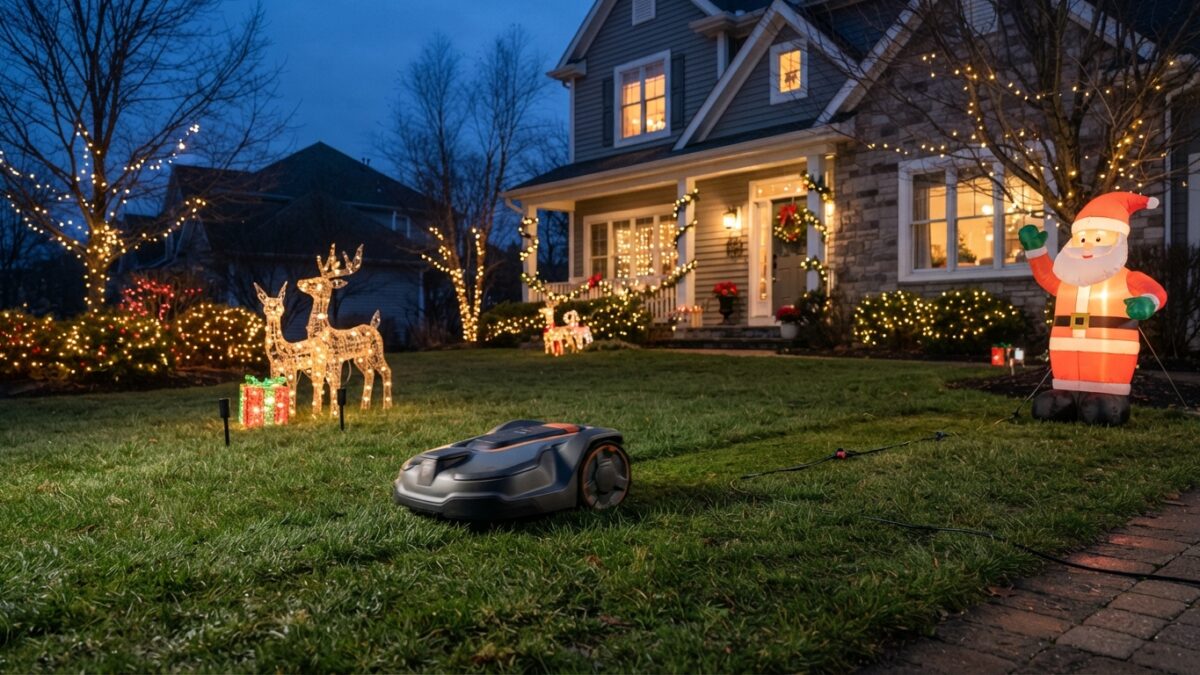
Across most of the country, robot mowers are parked for winter long before anyone hangs a wreath. But in south Florida, along the Gulf Coast, in southern Texas and in the Arizona desert, lawns keep growing through December, and the robot keeps working. That’s exactly when the lawn fills up with inflatable snowmen, light-up reindeer, stake lights and extension cords snaking across the grass.
A robot mower and a lawn full of holiday decorations can coexist. It just takes a little planning, because some of the objects Christmas puts on a lawn are the ones robot mower sensors are worst at seeing. MowReview quotes no prices and hasn’t tested these mowers. How we research explains why.
Does your lawn even need mowing in December?
- South Florida: UF/IFAS says St. Augustine growth there is year-round, though lawns “do not grow as quickly in the winter.”
- North Florida: UF/IFAS says mowing “may not be required during winter months.”
- Texas: Texas A&M says St. Augustine and bermuda go dormant and brown in winter, and mowing frequency fluctuates through the year.
- Arizona low desert: the University of Arizona says bermuda goes dormant in winter, but lawns overseeded with ryegrass in October stay green and need mowing.
If your lawn is dormant, the easy answer is to park the mower before decorating. Robot mower winter storage covers putting it away. If it’s still growing, read on, and cut the schedule back to match the slower winter growth.
What robot mowers can’t see well
Robot mower cameras and sensors are designed around the objects most often found on a lawn in summer: people, pets, toys, hoses, furniture. Christmas decorations add things they handle badly.
| Object | The problem |
|---|---|
| Extension cords | Thin, low and usually black. Ecovacs says its time-of-flight sensor can’t identify obstacles lower than 10 cm (about 4 inches) and “is not good at identifying black, white and transparent objects.” |
| Light stakes and pathway lights | Small and low. Android Authority’s reviewer found the Mammotion LUBA 3 AWD ran over utility flags, a similar kind of object. |
| Inflatable tethers and stakes | Thin lines spread out a few feet from the decoration, near ground level |
| Inflatables themselves | Large and visible, but they move in the wind, and a deflated one lies flat on the grass during the day |
| Anything at night | Husqvarna says models without vision at night may collide with objects |
What every manufacturer says is consistent: clear the lawn. Segway’s Navimow manual says to remove “stones, sticks, wires, bones, and other foreign objects,” Mammotion’s manual says to remove “toys, wires, stones, and other obstacles,” Worx says the same, and Ecovacs recommends no-go zones for “areas with exposed wires on the ground.” Husqvarna’s list of the hazards its AI vision prioritizes names humans, animals and water hoses, but not cables or cords.
A cut cord is an electrical hazard
If a mower cuts through a live extension cord, the exposed conductors can be energized, on wet grass. Unplug the cord at the outlet before you touch it or the mower, and throw the cord away rather than taping it. ESFI (the Electrical Safety Foundation International) advises plugging outdoor decorations into circuits protected by GFCIs, which cut the power when current leaks to the ground. Portable GFCIs are available for outlets that don’t have one.
How to set up the lawn
- Route cords outside the mowing area. Run them along flower beds, driveways, walkways and the house wall, not across the lawn. Where a cord has to cross grass, run it through a bed edge or under a paver path, or accept that the mower stays off that section for the season.
- Make a no-go zone around each display. Draw it wide enough to include the stakes and tethers, not just the decoration. Segway says you can draw an off-limit island around “temporary objects” and delete it later. Mammotion allows up to 50 no-go zones per mowing area. Ecovacs’s minimum no-go zone is about 1.6 feet on a side, and Husqvarna’s EPOS stay-out zones can be as small as 1 foot square.
- Group decorations. One larger no-go zone around a cluster of inflatables is easier to map, and leaves more lawn to mow, than five small ones.
- Mow in daylight only. Cameras work best in good light, and Husqvarna says models without vision at night may collide with objects. Remember that an inflatable switched off during the day lies flat on the grass, which is why the no-go zone matters more than the camera.
- Use outdoor-rated gear. ESFI says to use cords “marked for outdoor use,” inspect lights and cords for damage, match the amperage ratings, and keep cords clear of standing water. Gemmy’s inflatable instructions also say to plug into a GFCI outlet and not to use an extension cord unless the plug fits fully.
- Walk the lawn before each mow. Wind moves stakes and blows light strings across the grass. A quick look saves blades and cords.
Safety matters beyond the mower too. The CPSC estimates about 14,900 people were treated in emergency rooms for holiday decorating injuries in the 2022–23 season, nearly half of them from falls. Are robot mowers safe? covers the mower side.
Mowers that make it easier
Any robot mower can work around decorations if you set it up well. These two make temporary zones straightforward.
Up to 50 no-go zones per area
Mammotion LUBA 3 AWD
- No-go zonesUp to 50 per mowing area
- Navigation360° LiDAR, network RTK, AI vision
- Stated cutting height1.0 to 2.7 in (standard) or 2.2 to 4.0 in (H)
Mammotion allows up to 50 no-go zones in each mowing area, created by driving the mower around the perimeter, so even a yard full of displays can be mapped individually. Its LiDAR and AI vision give it more ways to notice larger objects like inflatables than a single camera.
Good for
- Busy displays that need many separate zones
- Sloped or multi-zone Southern lots
Less good for
- Small, low objects: Android Authority found it ran over utility flags
- A smooth app: PCWorld found connectivity “a little spotty”
- Buyers who pick the wrong version for their grass: check standard vs. H
After the holidays
- Take bases and displays down promptly. Anything that shades grass for weeks weakens it. NC State Extension warns that leaves left on a lawn too long “will shade the grass out, even killing it,” and a flat inflatable or display base does the same.
- Pull every stake. A forgotten metal stake is a blade-breaker the first time the mower passes.
- Delete the temporary zones. Otherwise you’ll have unmown rectangles in January.
- Check the blades. If the mower hit anything hard, inspect the blades and disc. Robot mower maintenance covers blade checks.
If you’re still deciding whether to buy one before Christmas, see robot mowers as a Christmas gift. If you’ve just received one, got a robot mower for Christmas? covers what to do first.
Questions
Can a robot mower detect extension cords?
Don’t rely on it. Every major brand tells owners to remove wires from the lawn before mowing, and none says its sensors reliably detect thin cables. Ecovacs says its time-of-flight sensor can’t identify obstacles lower than 10 cm (about 4 inches) and struggles with black objects, which describes most extension cords.
Should I turn off my robot mower for Christmas?
Not necessarily. In south Florida, UF/IFAS says St. Augustine grows year-round, though more slowly in winter, so a robot mower can keep working. Map temporary no-go zones around decorations, route cords outside the mowing area, and cut the schedule back to match slower growth.
How do I stop a robot mower hitting Christmas inflatables?
Make a no-go zone around each inflatable that includes its stakes and tethers, which sit low and spread out beyond the decoration. Segway Navimow lets you draw an off-limit island around temporary objects and delete it later, and Mammotion allows up to 50 no-go zones per mowing area.
What if a robot mower cuts an extension cord?
Treat the cord as live and dangerous. Unplug it at the outlet before touching it, and replace it rather than taping it. ESFI advises plugging outdoor decorations into GFCI-protected outlets, inspecting cords for damage, and using only cords marked for outdoor use.
Do robot mowers see light stakes and pathway lights?
Not reliably. Small, low objects are the hardest for robot mower sensors, and Android Authority’s reviewer found the Mammotion LUBA 3 AWD ran over utility flags. Put light stakes inside a no-go zone or along a bed edge the mower doesn’t cross.
Will decorations damage the lawn if they stay up all season?
They can. Anything that blocks light for weeks weakens the grass underneath. NC State Extension warns that leaves left on a lawn too long shade out the grass, and inflatable bases and yard displays do the same. Move bases occasionally, and take them down promptly after the holidays.
The short version
Robot mowers don’t reliably see extension cords, light stakes or inflatable tethers, and every brand tells you to clear wires from the lawn. Route cords outside the mowing area, draw temporary no-go zones around each display, mow in daylight, and use outdoor-rated cords on GFCI outlets. In colder areas, park the mower before you decorate. In January, pull the stakes, delete the zones, and check the blades.
Mowing year-round in the South?
Check which mowers suit warm-season grasses.