How MowReview makes money: As an Amazon Associate, MowReview earns from qualifying purchases, at no extra cost to you. We don’t test mowers ourselves; we explain what manufacturers and independent testers report. How we research
Quick answer
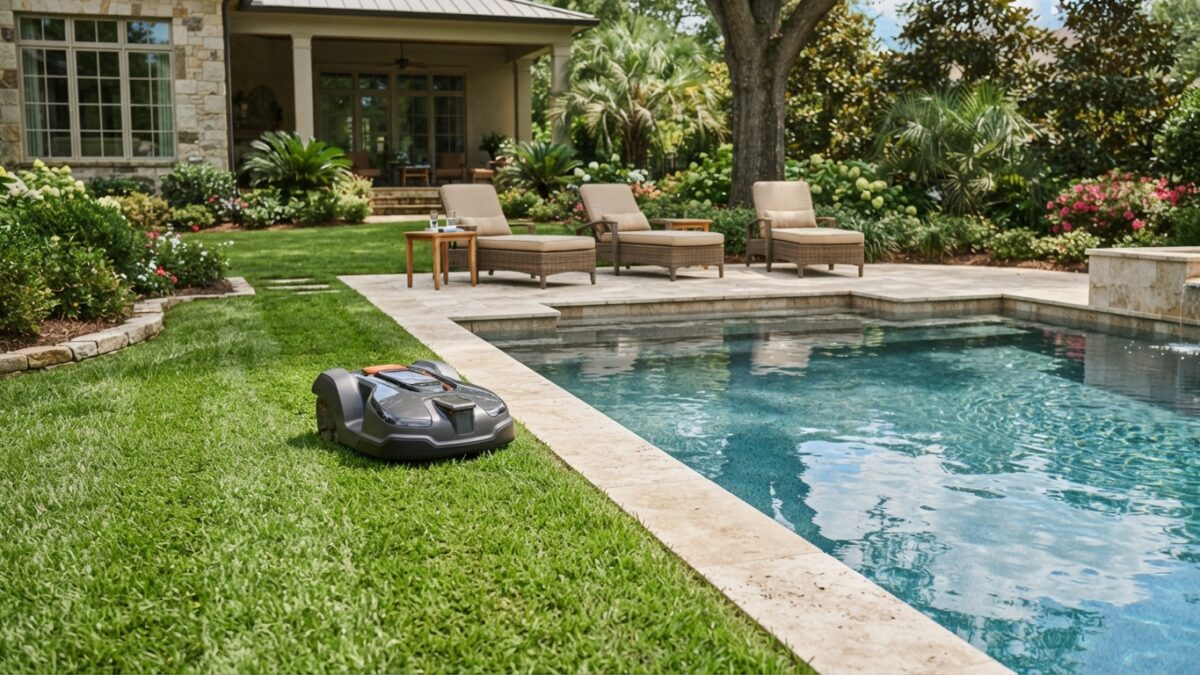
A robot mower works fine in a yard with a pool, but the safety comes from how you set it up, not from the mower. None of the popular models is rated to survive being submerged, warranties exclude water damage, and most can’t recognize water or a drop. Map the pool edge by hand, never with automatic mapping. Give it a no-go zone with at least a foot of margin (Ecovacs specifies 11.8 inches from ponds and drops). Add a low physical barrier wherever the lawn slopes toward the water (Husqvarna requires a 6-inch wall for wired Automowers beside water). Of the mowers in this guide, only the Mammotion LUBA 3 AWD claims to detect pool edges, so treat that as a backup, never as the plan.
Backyard pools are common across Florida, Texas, Arizona and California, and a lot of pool owners are exactly the people who’d rather not push a mower around one in July. A robot mower suits a pool yard well: it runs when nobody’s swimming, it’s quiet, and it keeps grass clippings off the deck if the edge is set up right.
But a pool is the one feature in a yard where a small mapping mistake has an expensive result. This guide covers what manufacturers actually say about pools and water, what the mowers can and can’t detect, which models suit a pool yard, and a setup checklist. MowReview quotes no prices and hasn’t tested these mowers. How we research explains why.
What manufacturers say about pools and water
| Brand | What its manual or guide says |
|---|---|
| Husqvarna (wired Automower) | If the work area is next to water bodies, slopes, precipices or a public road, the boundary wire must have a protective wall at least 6 in (15 cm) high |
| Ecovacs (GOAT RTK models) | Keep the mower 30 cm (11.8 in) from the boundaries of dangerous areas such as a pond or cliff; set a pool as a No-Entry Zone |
| Segway Navimow | Set a pool or pond as an off-limit island; use Auto Mapping only where lawn edges are flat, with no sharp slopes |
| Mammotion (LUBA 2 AWD manual) | Don’t use Auto Mapping in scenes with steps, cliffs, ponds or similar obstacles; don’t operate in standing water |
| Worx (Landroid) | Protect ponds by surrounding them with the boundary; on Landroid Vision, mark steps over 1.5 in with a magnetic strip |
From each brand’s operator’s manual, installation manual or official mapping guide.
Every brand says the same thing in different words. Around water, you set the limit, you set it by hand, and you leave a margin.
Can a robot mower see a pool?
Mostly, no. Robot mowers’ cameras and sensors are trained to recognize objects: people, pets, toys, hoses, furniture. A pool isn’t an object sticking up out of the lawn. It’s the absence of one.
- Husqvarna lists the hazards its AI camera recognizes as humans, animals, hoses, toys and furniture. Water, holes and drops aren’t on the list.
- Segway Navimow: a Tom’s Guide reviewer found “no cliff detection” on the Navimow X350 and recommended fencing off drop-offs manually.
- Mammotion is the exception. It says the LUBA 3 AWD has AI-based anti-fall detection that “detects steps, pool edges, and drop-offs.” We found no independent test of how well it works.
So for almost every mower, the pool is safe only because the map says so. That makes two things matter more than any feature list: how accurately the mower knows where it is, and how carefully you drew the edge.
Water ratings and warranties
| Mower | Rating |
|---|---|
| Segway Navimow X430 | IP66 |
| Mammotion LUBA 3 AWD | IPX6 |
| Ecovacs GOAT A3000 LiDAR | IPX6 (charging station IPX4) |
| Husqvarna Automower 430X NERA | IPX5 |
| Worx Landroid Vision | IPX5 |
An X5 or X6 rating covers water jets. The rating for immersion is IPX7, and none of these mowers claims it.
These ratings mean a mower can be rinsed and can work in rain. They don’t mean it can survive the deep end. The warranty wording we found is consistent too: Husqvarna’s manual excludes damage from being submerged, Segway’s X3 manual excludes “water damage,” and Mammotion’s LUBA 2 manual excludes exposure to liquid spills. A mower that ends up in the pool is almost certainly not covered.
How precisely the mower knows where it is
Wire-free mowers position themselves with RTK satellite correction, LiDAR, cameras or a combination. Manufacturers state high precision:
- Mammotion LUBA 3 AWD: ±0.4 inch (about ±1 cm)
- Ecovacs GOAT A3000 LiDAR: “2cm-precise navigation”
- Segway Navimow X430: “inch-level accuracy”
Those are best cases. RTK specialists list trees, rooflines, walls and metal structures as things that block or reflect satellite signal, and say that moving the base station after mapping shifts the whole map. A pool usually sits right next to the house, which is where signal is weakest. Why RTK robot mowers lose signal explains the causes.
Screen enclosures
Many pools in Florida and the Gulf states sit inside an aluminum screen enclosure. We found no testing of robot mowers working beside one. Because RTK guides list metal structures among the things that degrade satellite signal, a mower that combines LiDAR with RTK, and a wider margin than usual along the cage, is the safer choice if your lawn runs right up to it. Never map the lawn inside the enclosure as part of the mowing area.
The picks
The only one here that claims pool-edge detection
Mammotion LUBA 3 AWD
- Stated positioning±0.4 in
- Navigation360° LiDAR, network RTK, AI vision
- Water ratingIPX6
The LUBA 3 AWD layers three navigation systems, so it isn’t relying on satellite signal alone beside the house, and Mammotion states positioning to within 0.4 inch. It’s also the only mainstream mower we found that claims to detect pool edges and drop-offs, as a backup behind the map. EasyLawnMowing’s reviewer handled a pond on the test lawn the obvious way, with a no-go zone around it. It’s sold in two height versions; see the note under the picks.
Good for
- Pool yards where the lawn runs close to the house
- Owners who want a second layer of protection behind the no-go zone
Less good for
- Relying on the anti-fall feature: it’s a manufacturer claim we found no independent test of
- Unmapped hazards: EasyLawnMowing’s mower got stuck in a ditch that hadn’t been mapped
- Reliable remote checks: PCWorld found connectivity “a little spotty”
LiDAR navigation beside the house
Ecovacs GOAT A3000 LiDAR
- Stated navigation precision2 cm
- SensorsLiDAR, 3D ToF, AI camera
- Water ratingIPX6 (station IPX4)
The A3000 LiDAR navigates mainly by LiDAR, measuring its surroundings with a laser rather than depending on satellite signal. That’s the navigation type least troubled by the walls, rooflines and metal around a typical pool. Ecovacs is also the brand with the most specific guidance on water: the installation manual for its GOAT RTK models gives an 11.8-inch minimum distance from ponds and cliffs, and a 4-inch clearance from edges that drop more than about an inch.
Good for
- Pools close to the house or inside a screened area
- Flat pool yards up to about three-quarters of an acre
Less good for
- Drop detection: Ecovacs’s product page doesn’t list a cliff or drop sensor
- Standard St. Augustine, common in Florida pool yards: its stated range stops at 3.6 inches
- Overgrown grass: PCWorld found it left trails of clippings in moderately tall grass
Whichever you choose, match the cutting height to your grass. Mammotion’s LUBA 3 AWD comes in a standard version (1.0 to 2.7 inches) and “H” versions (2.2 to 4.0 inches). See robot mowers for St. Augustine and robot mowers for bermuda before you order.
Setup checklist for a pool yard
- Exclude the pool area entirely. If the pool has a fence or enclosure, keep the whole fenced area out of the mowing map. The mower has no reason to be inside it, and a pool gate should stay closed anyway.
- Map the pool side by hand. Both Mammotion and Segway say not to use automatic mapping near ponds, drops or sloping edges. Drive or walk the mower along that edge yourself.
- Leave at least a foot of margin. Ecovacs specifies 11.8 inches from ponds and drops. Allow more where the lawn slopes toward the pool or the coping sits lower than the grass.
- Add a barrier where the ground slopes to the water. Husqvarna requires a protective wall at least 6 inches high beside water for wired installations. A low border or edging does the same job for a wire-free mower as a last line of defense.
- Keep the charging station out of the splash zone. Husqvarna says not to install it where standing water can collect, and the Ecovacs station is rated only IPX4.
- Keep the lawn clear. Pool vacuum hoses, noodles, towels and toys end up on the grass. Most cameras recognize hoses and toys, but it’s better not to test that daily.
- Schedule around swimming. Run the mower when nobody’s in the yard, especially children. Are robot mowers safe? covers the child and pet side.
- Watch the first few runs. Stand by the pool edge for the first mows, and again after moving the base station, remapping or a firmware update.
Wet ground and pool water
The area around a pool stays wetter than the rest of the lawn, from splash-out, backwash and wet feet. Segway says a mower’s wheels “will slip and spin out” on wet, slippery grass, and a slip toward the pool is exactly what the margin is there for. If the ground by the deck is often soaked, widen the no-go zone there and consider a paved or gravel border instead of grass. Robot mowers in rain and wet grass covers the rest.
The water itself isn’t a problem for the lawn. Iowa State Extension says turf tolerates higher chlorine levels than other landscape plants, and typical pool water is 1 to 4 ppm chlorine.
The same approach works for ponds, fountains and ditches. Separate no-go areas work differently from one model to the next, so check robot mowers and multiple zones, and how to set up a robot mower for the full mapping process. If you also have an in-ground irrigation system, robot mowers and sprinkler systems covers the sprinkler heads.
Questions
Can a robot mower fall into a pool?
It can if the map or boundary lets it get too close. Most robot mowers rely on the boundary you set rather than detecting water, and Husqvarna’s list of objects its AI camera recognizes doesn’t include water, holes or drops. A no-go zone with a generous margin, and a physical barrier where the lawn slopes toward the pool, are the main protections.
Is a robot mower waterproof?
No. The models in this guide are rated IPX5, IPX6 or IP66, which covers rain and water jets but not being submerged. Every manufacturer’s manual or warranty we checked that mentions water damage excludes it from cover.
How far from a pool should a robot mower’s boundary be?
Ecovacs’s installation manual for its GOAT RTK mowers says to keep the mower at least 30 cm (11.8 inches) from the boundary of dangerous areas such as a pond or cliff. For wired Automowers next to water, Husqvarna requires a protective wall at least 6 inches high. Allow more margin where the lawn slopes toward the water.
Do any robot mowers detect pool edges?
Mammotion says the LUBA 3 AWD has AI-based anti-fall detection that detects steps, pool edges and drop-offs. It’s the only mainstream mower we found that makes that claim, and we found no independent test of it, so treat it as a backup to a proper no-go zone rather than a replacement.
Should I use automatic mapping around a pool?
No. Mammotion’s manual says not to use Auto Mapping near steps, cliffs or ponds, and Segway recommends Auto Mapping only for lawns with flat edges and no sharp slopes. Map the edge beside the pool manually, walking or driving the mower along it yourself.
Does pool water or chlorine harm the lawn or the mower?
Splash-out isn’t a concern for the grass. Iowa State Extension says turf tolerates higher chlorine levels than other landscape plants, and typical pool chlorine is 1 to 4 ppm. The risk to the mower is wet, slippery ground near the pool, where Segway says wheels can slip and spin.
The short version
A robot mower and a pool get along fine, but the safety is in the setup. Map the pool edge by hand, leave at least a foot of margin, add a low barrier where the ground slopes toward the water, and keep the fenced pool area out of the map. The LUBA 3 AWD is the only model here that claims to detect pool edges, the Navimow X430 stayed inside its map in hands-on testing, and the GOAT A3000 LiDAR’s laser navigation copes best beside the house. None of them will survive a swim, and no warranty we found covers one.
A pool is one constraint. Check the others.
Lawn area, slope and trees decide the rest of the shortlist.